Genome-edited Cells
Kidney
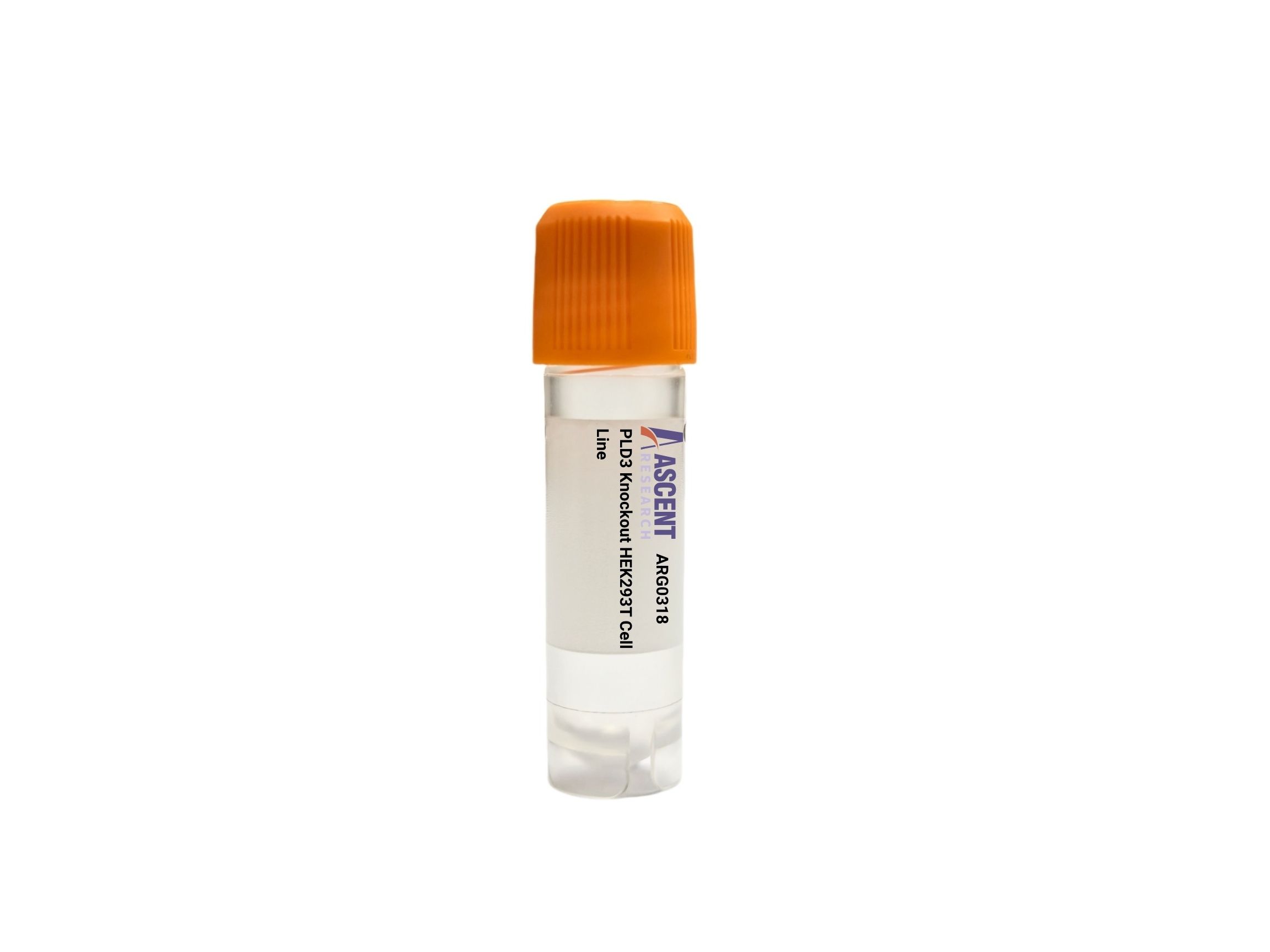
The PLD3 Knockout HEK293T Cell Line is a CRISPR/Cas9-engineered human cell line lacking functional PLD3, a lysosomal 5' exonuclease that degrades single-stranded DNA. Derived from the widely used HEK293T host, this knockout model enables investigation of lysosomal nucleic acid metabolism and its impact on innate immune signaling and neurodegeneration. PLD3 loss disrupts ssDNA clearance, leading to activation of the cGAS-STING pathway and interferon production. Pathways involving TFEB, LAMP1, and LAMP2 are directly relevant. Applications include Alzheimer??s disease research, lysosomal modulator screening, and studies of autoinflammatory mechanisms.
 CNOT10 Knockout SK-HEP-1 Polyclonal Cells
Cat. No. ARG15226
ARHGDIB Knockout 786-O Polyclonal Cells
Cat. No. ARG24973
HOOK2 Knockout AGS Polyclonal Cells
Cat. No. ARG26968
BRD3 Knockout huh-7 Polyclonal Cells
Cat. No. ARG28114
C2orf76 Knockout NCI-H1299 Polyclonal Cells
Cat. No. ARG41425
DNMT3A Knockout MCF7 Polyclonal Cells
Cat. No. ARG39446
CNOT10 Knockout SK-HEP-1 Polyclonal Cells
Cat. No. ARG15226
ARHGDIB Knockout 786-O Polyclonal Cells
Cat. No. ARG24973
HOOK2 Knockout AGS Polyclonal Cells
Cat. No. ARG26968
BRD3 Knockout huh-7 Polyclonal Cells
Cat. No. ARG28114
C2orf76 Knockout NCI-H1299 Polyclonal Cells
Cat. No. ARG41425
DNMT3A Knockout MCF7 Polyclonal Cells
Cat. No. ARG39446
The PLD3 Knockout HEK293T Cell Line is a CRISPR/Cas9-edited human cell line in which the PLD3 gene has been disrupted to create a loss-of-function model. This product provides a defined genetic background for investigating PLD3-dependent lysosomal processes. The knockout cell line is derived from HEK293T cells and is supplied as a stable knockout cell line suitable for downstream applications.
The HEK293T host cell line is a human embryonic kidney epithelial cell line transformed with SV40 large T-antigen. This immortalized line maintains aspects of kidney epithelial physiology and offers robust growth and high transfection efficiency, making it a versatile system for molecular and cell biology studies. In lysosomal research, HEK293T cells endogenously express lysosomal markers such as LAMP1 and LAMP2, enabling analysis of lysosomal dynamics. The well-characterized background ensures experimental reproducibility and compatibility with a broad range of techniques, including immunolabeling, live-cell imaging, and biochemical fractionation.
PLD3 encodes a lysosomal membrane protein with 5′ exonuclease activity that preferentially degrades single-stranded DNA within the lysosomal lumen. This function prevents accumulation of cytosolic DNA, which would otherwise trigger innate immune responses through the cGAS-STING pathway. PLD3 transcription is regulated by TFEB, a master regulator of lysosomal biogenesis, and PLD3 interacts with lysosomal membrane proteins LAMP1 and LAMP2. Loss of PLD3 disrupts nucleic acid clearance, leading to cGAS-STING signaling and interferon responses. This mechanism places PLD3 at the intersection of lysosomal homeostasis and innate immunity, with direct relevance to neuroinflammation and neurodegeneration.
In HEK293T cells, knockout of PLD3 provides a tractable model to study how lysosomal DNA degradation failure activates innate immune sensors. This cell line enables detailed dissection of the cGAS-STING?CIRF3 axis in a controlled in vitro setting. The HEK293T background also supports complementation studies, where wild-type or mutant PLD3 constructs can be reintroduced to assess structure?Cfunction relationships. Moreover, as PLD3 variants are genetically linked to late-onset Alzheimer??s disease, this knockout line serves as a platform to study Alzheimer??s-relevant pathways, including amyloid-beta processing and tau hyperphosphorylation, in the context of lysosomal impairment.
The PLD3 Knockout HEK293T Cell Line is applicable to a wide array of research applications, including mechanistic studies of lysosomal single-stranded DNA degradation, development of small-molecule modulators of lysosomal function, and functional screening of genetic suppressors of cGAS-STING hyperactivation. Standard assays include Western blotting for PLD3 to confirm knockout, immunofluorescence with LAMP1/LAMP2 antibodies to evaluate lysosomal morphology, exonuclease activity assays using fluorescent ssDNA substrates, and LysoTracker staining for lysosomal pH assessment. Activation of the cGAS-STING pathway can be monitored through phospho-STING (Ser366) or phospho-IRF3 (Ser386) immunoblotting, while cytosolic DNA accumulation is quantifiable via dsDNA ELISA. Alzheimer??s disease-related endpoints, such as amyloid-beta peptide secretion and tau phosphorylation, can also be examined. For additional details, please contact Ascent Research.