Genome-edited Cells
Large intestine (colon)
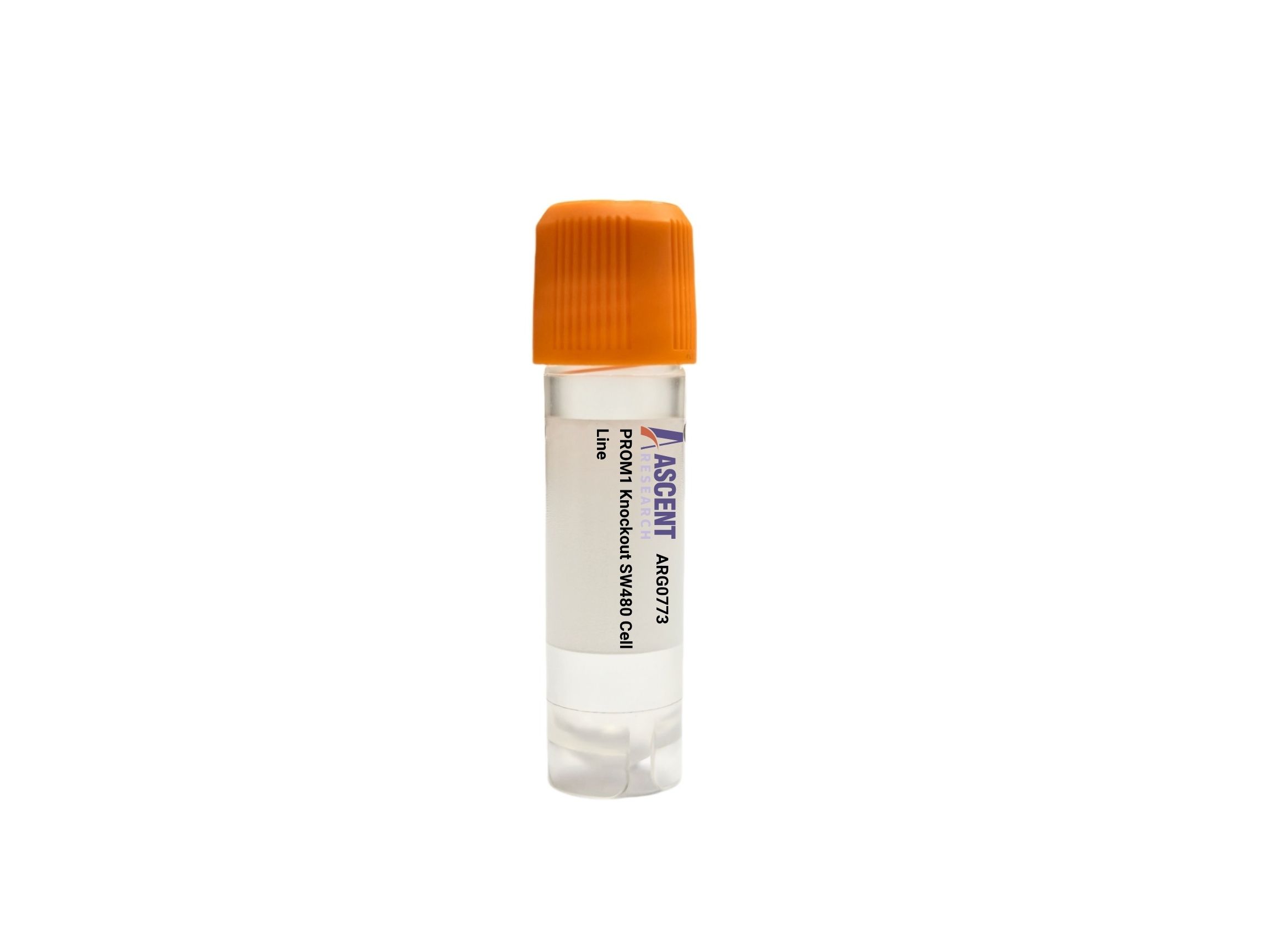
The PROM1 Knockout SW480 Cell Line is a CRISPR/Cas9-edited colorectal adenocarcinoma cell line with targeted disruption of the PROM1 (CD133) gene, a key cancer stem cell marker. Derived from SW480 cells (Dukes' type B), this model enables investigation of CD133??s role in colorectal cancer, where it is regulated by HIF-1?? and ??-catenin/TCF and interacts with HDAC6 and actin to control PI3K/Akt signaling and membrane dynamics. Applications include flow cytometric quantification of CD133+ populations, sphere formation assays, and signaling pathway analysis via western blotting. This knockout cell line is a valuable tool for studying colorectal cancer stem cell biology, drug resistance, and tumor progression in vitro and in xenograft models.
 HLA-DOA Knockout HAP1 Polyclonal Cells
Cat. No. ARG22535
ATXN1 Knockout huh-7 Polyclonal Cells
Cat. No. ARG28048
ALX3 Knockout Hela Polyclonal Cells
Cat. No. ARG37639
CCDC90B Knockout A2780 Polyclonal Cells
Cat. No. ARG43105
MIER2 Knockout AGS Polyclonal Cells
Cat. No. ARG2977
MARVELD2 Knockout AGS Polyclonal Cells
Cat. No. ARG2500
HLA-DOA Knockout HAP1 Polyclonal Cells
Cat. No. ARG22535
ATXN1 Knockout huh-7 Polyclonal Cells
Cat. No. ARG28048
ALX3 Knockout Hela Polyclonal Cells
Cat. No. ARG37639
CCDC90B Knockout A2780 Polyclonal Cells
Cat. No. ARG43105
MIER2 Knockout AGS Polyclonal Cells
Cat. No. ARG2977
MARVELD2 Knockout AGS Polyclonal Cells
Cat. No. ARG2500
The PROM1 Knockout SW480 Cell Line is a CRISPR/Cas9-edited knockout cell line that provides a loss-of-function model for studying PROM1 (CD133) in colorectal cancer biology. This product is derived from the SW480 host cell line and employs CRISPR/Cas9-mediated gene disruption to abrogate PROM1 expression, enabling researchers to dissect the roles of this cancer stem cell marker in tumor progression, stemness, and signal transduction without the need for transient silencing approaches.
The host cell line SW480 is an established human colorectal adenocarcinoma epithelial cell line originating from a Dukes’ type B tumor. SW480 cells are widely utilized as an in vitro model for colorectal cancer biology, exhibiting characteristic features such as epithelial morphology, aberrant Wnt/??-catenin signaling, and tumorigenic potential. Their well-characterized genetic background, including KRAS and TP53 mutations, provides a robust and clinically relevant platform for investigating colorectal cancer initiation, progression, and therapeutic responses.
PROM1 encodes CD133, a pentaspan transmembrane glycoprotein that is enriched in plasma membrane protrusions and lipid raft microdomains. It functions as a cancer stem cell marker and is regulated by upstream factors such as HIF-1??, ??-catenin/TCF, Notch intracellular domain, and TGF-??. PROM1 interacts with HDAC6, MYO6, and actin to modulate cytoskeletal reorganization and lipid raft integrity, and it activates downstream PI3K/Akt signaling. Through these molecular interactions, PROM1 integrates signals from Wnt, Notch, and Hedgehog pathways, coordinating the balance between self-renewal and differentiation of cancer stem cells.
In the SW480 background, disruption of PROM1 provides a powerful tool to elucidate its contribution to colorectal cancer stem cell maintenance and tumorigenesis. Given that SW480 cells harbor hyperactive Wnt/??-catenin signaling, this knockout model enables the dissection of PROM1??s role downstream of ??-catenin/TCF and its cross-talk with PI3K/Akt and Notch pathways. Researchers can investigate how loss of PROM1 alters actin cytoskeleton dynamics, membrane topology, and downstream effectors such as Akt and mTOR, thereby offering insights into mechanisms of drug resistance and metastatic potential in a genetically defined adenocarcinoma context.
This PROM1 knockout cell line is suitable for a range of experimental applications, including cancer stem cell biology studies, assessment of tumorigenicity via xenograft assays, and investigation of stem cell signaling in colorectal cancer. Representative assays include flow cytometry for CD133+ population quantification, sphere formation assays to evaluate self-renewal capacity, western blotting for pathway analysis, and immunofluorescence microscopy for protein localization. By enabling functional dissection of PROM1 in a clinically relevant cell model, this product supports advances in understanding colorectal cancer progression and the development of targeted therapeutics. For more information, please contact Ascent Research.