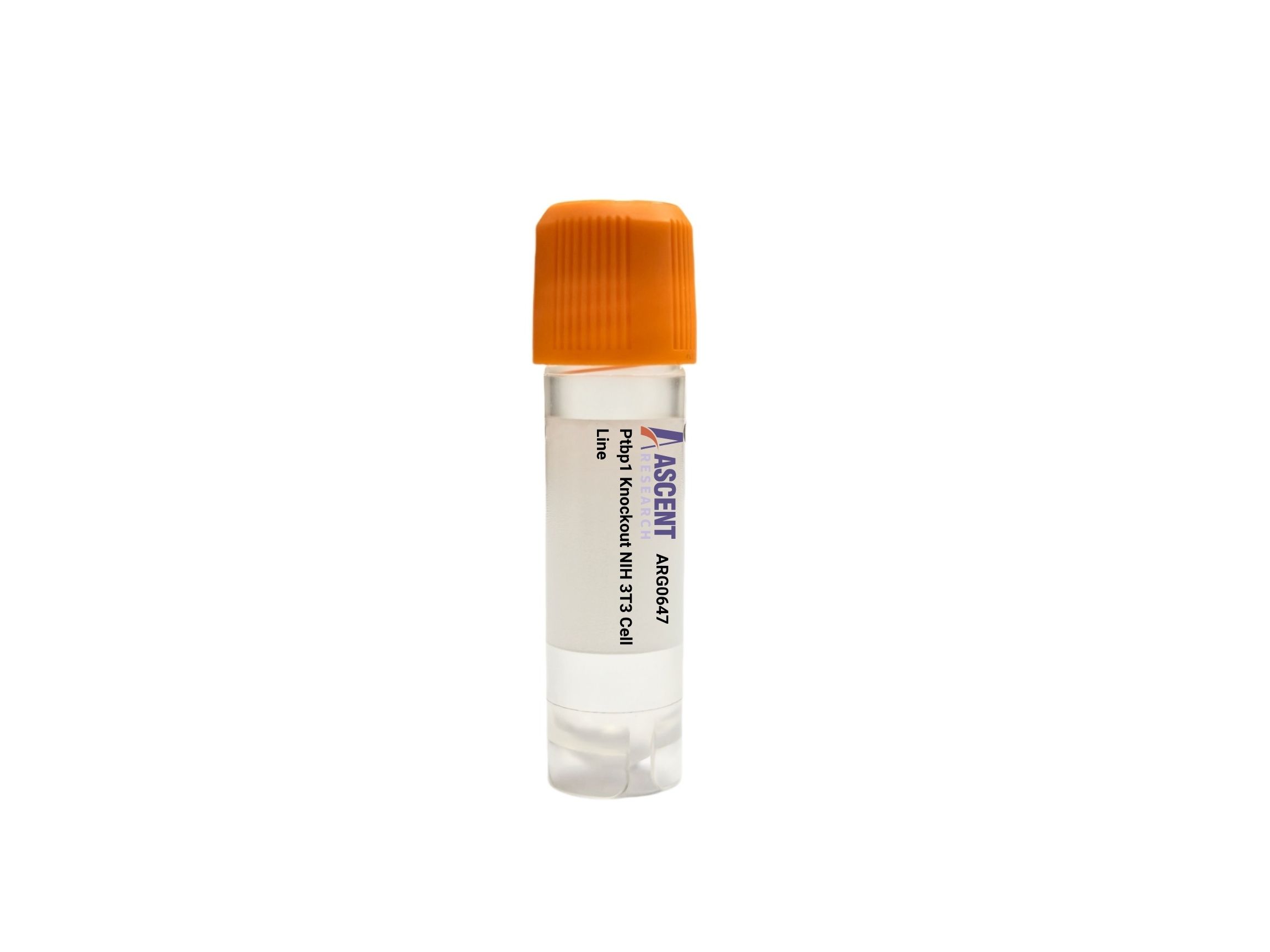
Genome-edited Cells
The Ptbp1 Knockout NIH 3T3 Cell Line is a CRISPR/Cas9-edited knockout cell line derived from mouse embryonic fibroblasts, designed for the study of alternative splicing and cellular reprogramming. Ptbp1 encodes an RNA-binding protein that represses neuron-specific exon inclusion; its disruption allows the investigation of splicing switches and neurogenic conversion in a well-characterized fibroblast model.
 FDFT1 Knockout NCI-H1299 Polyclonal Cells
Cat. No. ARG18136
BAZ1B Knockout Hela Polyclonal Cells
Cat. No. ARG37472
BAX Knockout AGS Polyclonal Cells
Cat. No. ARG26729
FOXO1 Knockout HEK293T Polyclonal Cells
Cat. No. ARG3920
LRRK2 Knockout HEK293T Polyclonal Cells
Cat. No. ARG3399
LPP Knockout AGS Polyclonal Cells
Cat. No. ARG2568
FDFT1 Knockout NCI-H1299 Polyclonal Cells
Cat. No. ARG18136
BAZ1B Knockout Hela Polyclonal Cells
Cat. No. ARG37472
BAX Knockout AGS Polyclonal Cells
Cat. No. ARG26729
FOXO1 Knockout HEK293T Polyclonal Cells
Cat. No. ARG3920
LRRK2 Knockout HEK293T Polyclonal Cells
Cat. No. ARG3399
LPP Knockout AGS Polyclonal Cells
Cat. No. ARG2568
The Ptbp1 Knockout NIH 3T3 Cell Line is a CRISPR/Cas9-edited knockout cell line derived from immortalized mouse embryonic fibroblasts, providing a stable loss-of-function model for the Ptbp1 gene.
This cell line enables researchers to investigate the functional consequences of Ptbp1 disruption in a well-characterized fibroblast background.
As a knockout cell line, it offers a homogeneous population for reproducible studies, avoiding the variability inherent in transient knockdown approaches.
The gene editing was performed using CRISPR/Cas9 technology to disrupt the Ptbp1 locus, eliminating expression of the encoded RNA-binding protein.
This model is ideal for controlled experiments on alternative splicing regulation, cellular reprogramming, and transdifferentiation, where Ptbp1 acts as a critical repressor of neuron-specific exon inclusion.