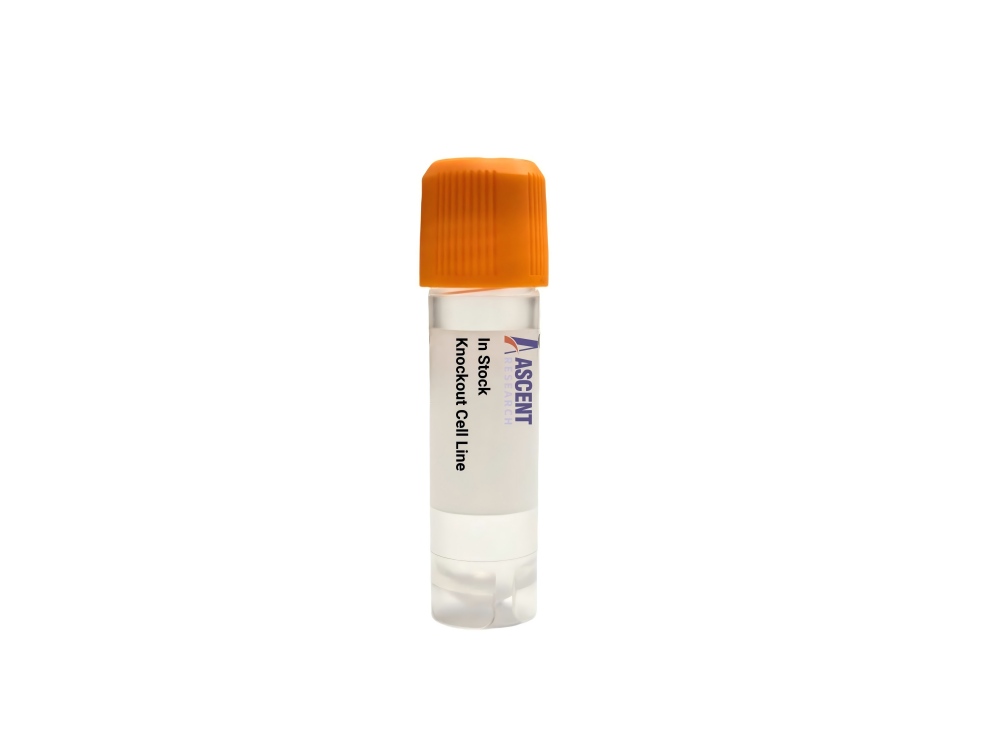
In Stock Cell Lines
Chlorocebus sabaeus (Green monkey)
Kidney
Adherent
The PTEN Knockout Vero Cell Line is a CRISPR/Cas9-edited epithelial cell line from African green monkey kidney, designed for loss?of?function studies of the tumor suppressor PTEN. Disruption of PTEN leads to sustained PIP3?mediated activation of AKT and mTOR, mimicking oncogenic signaling found in many cancers. This interferon?deficient model is invaluable for investigating PI3K/AKT pathway dysregulation, viral replication in a PTEN?null background, and sensitivity to targeted inhibitors. It supports assays such as western blotting for p?AKT, apoptosis, and colony formation.
 LEF1 Knockout A2780 Polyclonal Cells
Cat. No. ARG18904
LEF1 Knockout A2780 Polyclonal Cells
Cat. No. ARG18904
 Human Bronchial Epithelial Cells (DF508/621+1G>T Cystic Fibrosis)
Cat. No. ARP1160
ATG4C Knockout MES-OV Polyclonal Cells
Cat. No. ARG24263
KATNA1 Knockout SK-HEP-1 Polyclonal Cells
Cat. No. ARG32732
ASGR1 Knockout TE1 Polyclonal Cells
Cat. No. ARG36837
GLRX3 Knockout Raji Polyclonal Cells
Cat. No. ARG1756
Human Bronchial Epithelial Cells (DF508/621+1G>T Cystic Fibrosis)
Cat. No. ARP1160
ATG4C Knockout MES-OV Polyclonal Cells
Cat. No. ARG24263
KATNA1 Knockout SK-HEP-1 Polyclonal Cells
Cat. No. ARG32732
ASGR1 Knockout TE1 Polyclonal Cells
Cat. No. ARG36837
GLRX3 Knockout Raji Polyclonal Cells
Cat. No. ARG1756
The PTEN Knockout Vero Cell Line is a CRISPR/Cas9-edited knockout cell line derived from the Vero epithelial cell line, in which the PTEN gene has been disrupted to eliminate its tumor-suppressive functions. This engineered cell line provides a loss-of-function model for investigating the consequences of PTEN deficiency, particularly the deregulation of the PI3K/AKT signaling pathway. The knockout has been generated through CRISPR/Cas9-mediated gene disruption, resulting in the ablation of functional PTEN protein. This cell line is suited for dissecting the molecular mechanisms underlying cancer, Cowden syndrome, and PTEN hamartoma tumor syndrome, as well as for evaluating targeted therapies.
The host Vero cell line is a continuous, interferon-deficient epithelial line isolated from the kidney of an adult African green monkey (Chlorocebus aethiops). Due to its lack of interferon production, Vero cells are highly permissive to viral replication, making them a standard model in virology research and vaccine production. The epithelial origin and stable growth characteristics of Vero cells render them suitable for examining the interplay between tumor suppressor loss and viral infection within a well-defined cellular background.
PTEN encodes a dual-specificity phosphatase that acts as a critical negative regulator of the PI3K/AKT/mTOR pathway by dephosphorylating phosphatidylinositol-3,4,5-trisphosphate (PIP3) to phosphatidylinositol-4,5-bisphosphate (PIP2). Upstream signals, including growth factors such as PDGF, insulin, and IGF-1, as well as oxidative stress and DNA damage, modulate PTEN activity, while microRNAs (e.g., miR-21) and NEDD4-1 regulate its expression and stability. In the absence of functional PTEN, PIP3 accumulates, leading to constitutive phosphorylation and activation of AKT and downstream effectors like mTORC1, FOXO transcription factors, and GSK3??. This persistent signaling promotes cell survival, proliferation, and migration, while suppressing apoptosis through modulation of BAD and caspase-9, and impairs genomic stability by affecting DNA repair pathways.
In the context of Vero cells, PTEN knockout introduces a pro-survival and proliferative phenotype that can influence host?virus dynamics and cellular responses to genotoxic stress. The interferon-deficient status of Vero cells combined with PTEN loss may reveal novel aspects of innate immune evasion and viral pathogenesis, offering a unique platform for studying virus?Chost interactions in a tumor?suppressor?null environment. This engineered line thus extends the utility of Vero cells beyond classical virology into cancer biology by enabling dissection of signal transduction pathways that govern cell fate decisions.
Typical research applications include mechanistic studies of PI3K/AKT pathway hyperactivation, functional compensation assays, and drug sensitivity profiling with PI3K, AKT, or mTOR inhibitors (e.g., LY294002). The cell line supports tumorigenesis models and can be employed to investigate how PTEN deficiency alters viral replication or oncolytic virus efficacy. Representative assays include western blot analysis of phosphorylated AKT (Ser473), immunofluorescence detection of FOXO subcellular localization, proliferation and apoptosis assays (cleaved caspase-3), migration and invasion tests, and colony formation assays. For additional details, please contact Ascent Research.