Genome-edited Cells
Large intestine (colon)
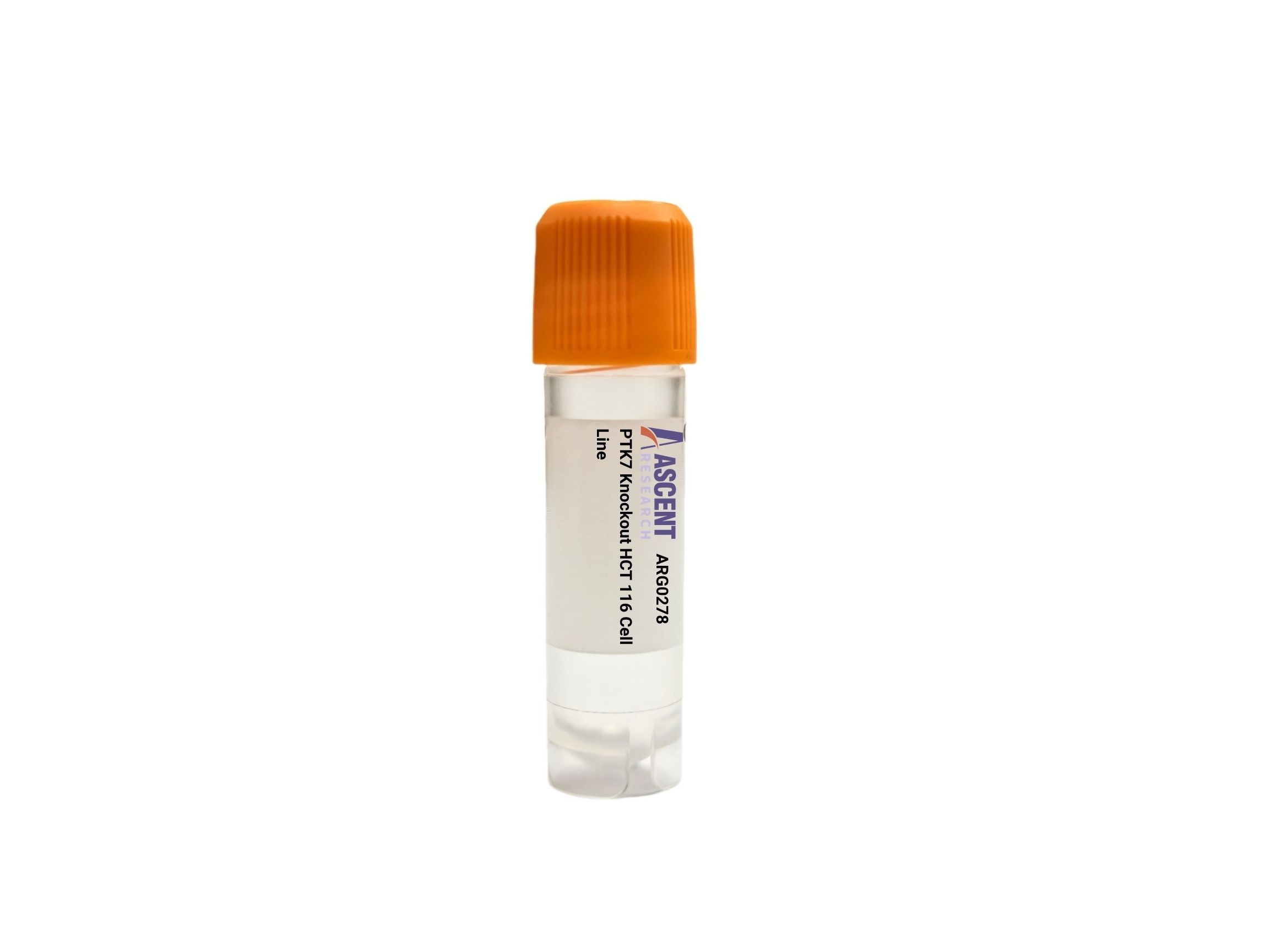
The PTK7 Knockout HCT 116 Cell Line is a CRISPR/Cas9-edited human colorectal carcinoma cell model lacking PTK7, a pseudokinase co-receptor critical for Wnt/planar cell polarity signaling. PTK7 interacts with ROR2 and Frizzled7 to regulate RhoA and Rac1 pathways, essential for cell migration and invasion. This loss-of-function model enables precise dissection of non-canonical Wnt signaling in an MSI-high genetic background with mutations in KRAS, CTNNB1, and TP53. Applications include migration and invasion assays, Wnt/PCP pathway analysis, and tumor xenograft studies.
 LAPTM4B Knockout NCI-H1975 Polyclonal Cells
Cat. No. ARG17149
JAG2 Knockout 786O Polyclonal Cells
Cat. No. ARG35741
HDAC1 Knockout Hela Polyclonal Cells
Cat. No. ARG37457
FLCN Knockout PATU8988T Polyclonal Cells
Cat. No. ARG11313
LAPTM4B Knockout NCI-H1975 Polyclonal Cells
Cat. No. ARG17149
JAG2 Knockout 786O Polyclonal Cells
Cat. No. ARG35741
HDAC1 Knockout Hela Polyclonal Cells
Cat. No. ARG37457
FLCN Knockout PATU8988T Polyclonal Cells
Cat. No. ARG11313
 Rabbit Small Intestinal Smooth Muscle Cell Medium
Cat. No. ARM0711
Rabbit Small Intestinal Smooth Muscle Cell Medium
Cat. No. ARM0711
 LN-18
Cat. No. ARC0447
LN-18
Cat. No. ARC0447
The PTK7 Knockout HCT 116 Cell Line is a CRISPR/Cas9-edited knockout cell line that provides a loss-of-function model for the PTK7 gene. Derived from the HCT 116 human colorectal carcinoma cell line, this product enables researchers to investigate PTK7-dependent signaling pathways and their roles in cancer biology. The targeted gene disruption is generated using CRISPR/Cas9 technology, resulting in the elimination of functional PTK7 protein expression. This cell line serves as a valuable tool for dissecting the molecular mechanisms of Wnt/planar cell polarity (PCP) signaling, cell migration, and tumor progression.
HCT 116 is a well-characterized human colorectal carcinoma cell line exhibiting microsatellite instability (MSI) and harboring activating mutations in KRAS, CTNNB1 (encoding ??-catenin), and TP53. These genetic alterations recapitulate key features of colorectal cancer, including dysregulated canonical Wnt signaling and genomic instability. The cell line’s robust growth characteristics and well-defined mutational landscape make it an ideal host for generating gene knockouts aimed at studying colorectal adenocarcinoma biology.
PTK7 encodes a pseudokinase receptor that functions as a co-receptor in the non-canonical Wnt/PCP pathway. PTK7 is activated by ligands such as Wnt5a and cooperates with ROR2 and Frizzled7 to recruit Dishevelled (DVL) and initiate downstream signaling. This activation leads to the regulation of small GTPases RhoA and Rac1, which orchestrate cytoskeletal rearrangements and directional cell migration. Additionally, PTK7 signaling involves c-Jun N-terminal kinase (JNK) phosphorylation, linking it to stress responses and gene expression. Interacting partners like VANGL2 and the PRICKLE protein further modulate PCP signaling, highlighting PTK7’s role in coordinating complex cell polarity networks.
In the context of HCT 116 cells, PTK7 knockout disrupts non-canonical Wnt/PCP signaling while the canonical Wnt pathway remains constitutively activated due to ??-catenin mutation. This allows for the specific interrogation of PCP-dependent processes, such as cell migration, invasion, and adhesion, without confounding effects from the canonical branch. The model is particularly relevant for studying colorectal cancer metastasis, where PTK7-mediated cell motility plays a critical role. It also provides a platform to assess drug resistance mechanisms and to evaluate therapeutic strategies targeting Wnt/PCP signaling components.
Researchers can utilize the PTK7 Knockout HCT 116 Cell Line for a range of functional assays, including transwell migration and wound healing assays to quantify cell motility, RhoA activation assays to assess GTPase activity, and immunofluorescence staining for F-actin to visualize cytoskeletal dynamics. Western blotting for phospho-JNK levels offers a readout of pathway activation. This model is also suitable for in vivo tumor xenograft studies to examine PTK7’s role in tumor growth and dissemination. For further details or to place an order, please contact Ascent Research.