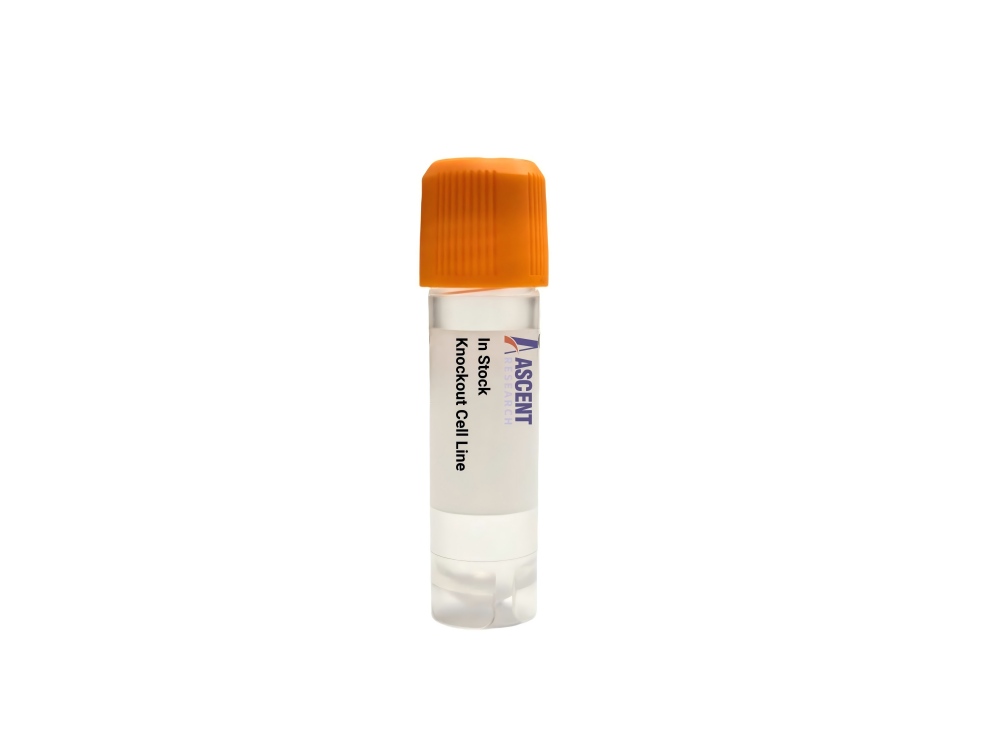
In Stock Cell Lines
Homo sapiens (Human)
Breast (mammary gland)
Adherent
The PTPN11 Knockout BT-549 Cell Line is a CRISPR/Cas9-edited human knockout model in which the PTPN11 gene encoding the SHP-2 phosphatase has been disrupted. Derived from a triple-negative breast cancer (TNBC) epithelial line with mesenchymal features, this tool enables loss-of-function studies of SHP-2 in an aggressive carcinoma context. SHP-2 positively regulates RAS-MAPK, JAK-STAT, and PI3K-AKT pathways downstream of RTKs, and interacts with adaptors such as GAB1 and kinases like ERK. This knockout line supports drug target validation for SHP-2 inhibitors, signaling mechanism dissection, and functional genomics screens. Key assays include western blot for phospho-ERK and migration/invasion tests.
 ADNP2 Knockout Raji Polyclonal Cells
Cat. No. ARG21079
CCNY Knockout HGC-27 Polyclonal Cells
Cat. No. ARG43290
JADE2 Knockout huh-7 Polyclonal Cells
Cat. No. ARG28442
EXT2 Knockout NCI-H1299 Polyclonal Cells
Cat. No. ARG17839
CRIM1 Knockout MES-OV Polyclonal Cells
Cat. No. ARG6201
ADNP2 Knockout Raji Polyclonal Cells
Cat. No. ARG21079
CCNY Knockout HGC-27 Polyclonal Cells
Cat. No. ARG43290
JADE2 Knockout huh-7 Polyclonal Cells
Cat. No. ARG28442
EXT2 Knockout NCI-H1299 Polyclonal Cells
Cat. No. ARG17839
CRIM1 Knockout MES-OV Polyclonal Cells
Cat. No. ARG6201
 D-Glucose, 300mg/mL
Cat. No. ARM0989
D-Glucose, 300mg/mL
Cat. No. ARM0989
The PTPN11 Knockout BT-549 Cell Line is a CRISPR/Cas9-edited human knockout cell line that disrupts the PTPN11 gene, encoding the SHP-2 non-receptor tyrosine phosphatase. This loss-of-function model provides a powerful tool for studying SHP-2-dependent signaling in an epithelial carcinoma context. The gene disruption is achieved through targeted CRISPR/Cas9-mediated editing, resulting in loss of functional SHP-2 protein.
The parental BT-549 line originates from a mammary ductal carcinoma of a 72-year-old female and is characterized by a triple-negative phenotype??lacking estrogen receptor, progesterone receptor, and HER2 amplification. These cells exhibit a mesenchymal morphology and invasive properties, making them a representative model for aggressive triple-negative breast cancer (TNBC). They grow as an adherent monolayer and are widely employed to investigate mechanisms of metastasis and therapeutic resistance.
SHP-2 is a ubiquitously expressed protein tyrosine phosphatase that positively regulates RAS-MAPK signaling downstream of RTKs such as EGFR and PDGFR. It is recruited to phosphotyrosine-containing adaptors like GAB1 and GAB2, where it dephosphorylates inhibitory tyrosine residues on SPRED, sustaining ERK activation. SHP-2 also interfaces with JAK-STAT and PI3K-AKT pathways through interactions with JAK2, STAT3, and focal adhesion components paxillin and FAK. Key pathway components include EGFR, GAB1, SHP-2, GRB2, SOS, RAS, RAF, MEK, ERK, and transcription factors ELK-1 and c-Fos.
In BT-549 TNBC cells, SHP-2 activity drives proliferation and migration via sustained ERK and AKT signaling. Disruption of PTPN11 is expected to attenuate these oncogenic processes, impairing tumor cell invasiveness and anchorage-independent growth. Given their mesenchymal characteristics, BT-549 cells rely on integrin-mediated adhesion dynamics, and SHP-2 loss may further compromise this by altering paxillin/FAK signaling. Thus, this knockout line enables targeted investigation of SHP-2 contributions to TNBC aggressiveness.
The PTPN11 Knockout BT-549 Cell Line is ideal for functional analysis of SHP-2 in breast cancer, validation of inhibitors like SHP099, and CRISPR-based screens. Representative assays include western blot for SHP-2 and phospho-ERK, MTS proliferation, transwell migration/invasion, immunofluorescence for paxillin, and RT-qPCR for DUSP6 and ETV5. This model also supports in vivo xenograft studies of tumor growth. For inquiries, contact Ascent Research.