Genome-edited Cells
Lung
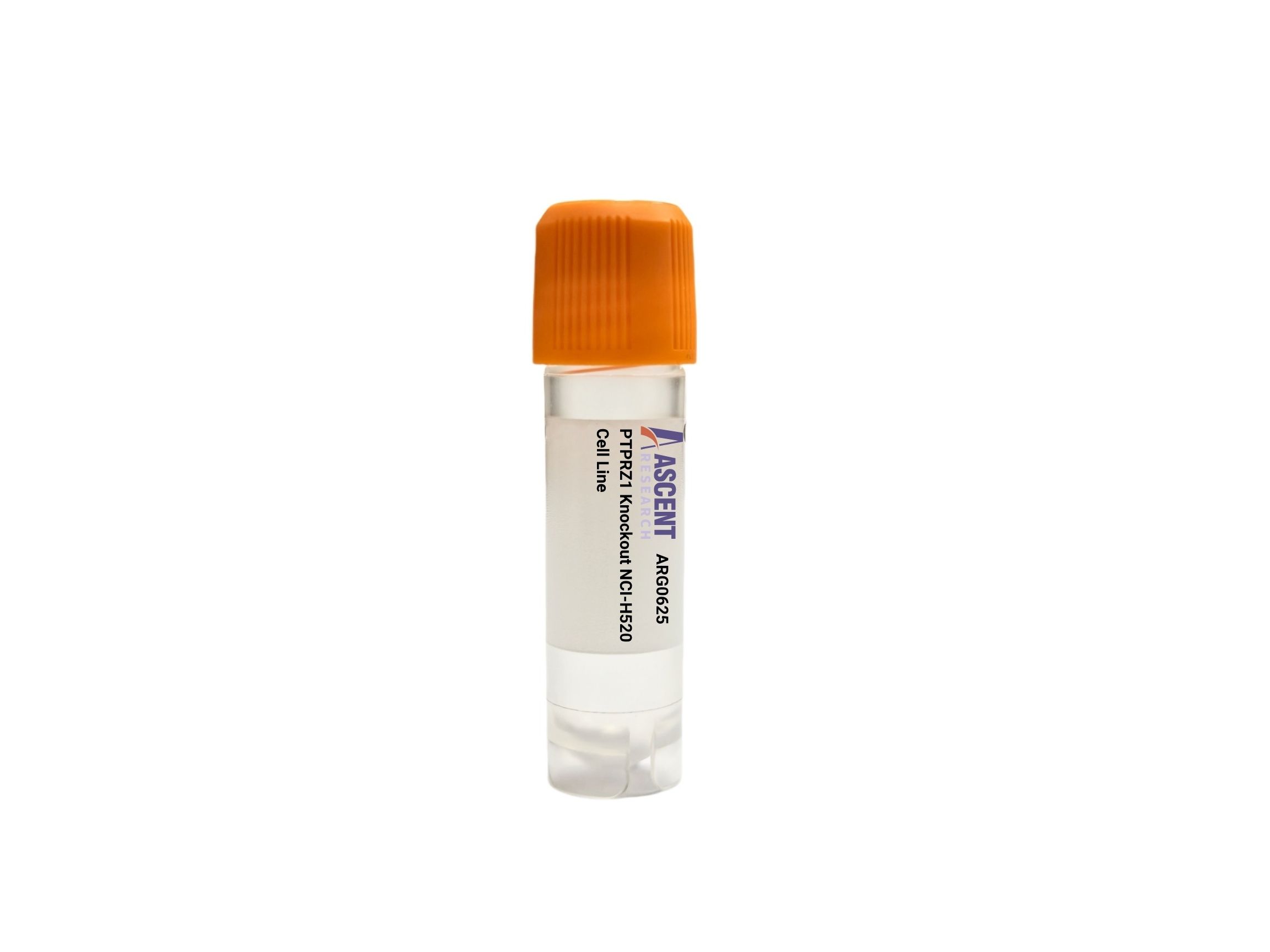
The PTPRZ1 Knockout NCI-H520 Cell Line is a CRISPR/Cas9-edited knockout cell line derived from human lung squamous cell carcinoma. It disrupts the receptor-type tyrosine phosphatase PTPRZ1, which modulates cell adhesion and migration through dephosphorylation of substrates like ??-catenin and paxillin, linking to PI3K/AKT and Wnt pathways. This loss-of-function model enables investigation of PTPRZ1??s role in non-small cell lung cancer. PTPRZ1 is activated by Pleiotrophin and Midkine, and interacts with partners such as Contactin-1 and Tenascin-C. The knockout cell line is suitable for studying tumor cell motility, signaling, and drug target validation using assays like Transwell migration, Western blotting, and phospho-protein analysis.
 GP9 Knockout HAP1 Polyclonal Cells
Cat. No. ARG22291
GMIP Knockout NCI-H1975 Polyclonal Cells
Cat. No. ARG17236
ACTG2 Knockout HAP1 Polyclonal Cells
Cat. No. ARG21608
KAT2B Knockout NCI-H1975 Polyclonal Cells
Cat. No. ARG31808
KLHDC9 Knockout Hela Polyclonal Cells
Cat. No. ARG37487
AMPD1 Knockout A549 Polyclonal Cells
Cat. No. ARG38656
GP9 Knockout HAP1 Polyclonal Cells
Cat. No. ARG22291
GMIP Knockout NCI-H1975 Polyclonal Cells
Cat. No. ARG17236
ACTG2 Knockout HAP1 Polyclonal Cells
Cat. No. ARG21608
KAT2B Knockout NCI-H1975 Polyclonal Cells
Cat. No. ARG31808
KLHDC9 Knockout Hela Polyclonal Cells
Cat. No. ARG37487
AMPD1 Knockout A549 Polyclonal Cells
Cat. No. ARG38656
The PTPRZ1 Knockout NCI-H520 Cell Line is a human lung squamous cell carcinoma-derived CRISPR/Cas9-edited knockout cell line designed to eliminate functional expression of the PTPRZ1 gene. This engineered model is produced through CRISPR/Cas9-mediated gene disruption, generating a stable loss-of-function tool for investigating the tumorigenic roles of PTPRZ1 in non-small cell lung cancer. The product is supplied as a live cell line, suitable for a wide range of functional assays, and serves as an isogenic system for comparative analyses with the parental NCI-H520 cell line.
The host cell line, NCI-H520, is a well-characterized epithelial cell line originally derived from a human lung squamous cell carcinoma of a male patient. This cell line retains key features of squamous cell carcinoma, including characteristic morphology and growth properties, and is widely employed as an in vitro model for non-small cell lung cancer research. Its established use in studying tumor cell migration, invasion, and signal transduction makes it a relevant platform for probing the function of cell adhesion-related molecules like PTPRZ1.
PTPRZ1 encodes a receptor-type tyrosine-protein phosphatase that governs cell adhesion, migration, and signaling by dephosphorylating downstream substrates such as ??-catenin (CTNNB1) and paxillin (PXN). The phosphatase activity is activated by ligands including Pleiotrophin (PTN), Midkine (MDK), and EGF, and functionally impacts the PI3K/AKT, MAPK/ERK, and Wnt signaling cascades. Key pathway components regulated by PTPRZ1 include AKT1, GSK3??, ??-catenin, and MAPK1/3. Additionally, PTPRZ1 interacts with several binding partners, such as Contactin-1 (CNTN1), Tenascin-C (TNC), Myelin-associated glycoprotein (MAG), and Plexin-B1, forming a complex network that integrates extracellular cues with cytoskeletal reorganization and transcriptional responses.
Disruption of PTPRZ1 in the NCI-H520 background creates a valuable model for dissecting its dual roles in lung cancer, where it may act as either a tumor suppressor or oncogene depending on context. Loss of PTPRZ1 is expected to impair tumor cell motility and proliferation, providing a system to validate the gene??s contributions to the aggressive behavior of squamous cell carcinoma. This knockout cell line enables precise functional studies of PTPRZ1-dependent signaling, particularly its influence on ??-catenin?Cmediated transcription and AKT-driven survival pathways, in an epithelial lung cancer microenvironment.
Researchers can employ this knockout cell line for a variety of experimental applications, including Western blotting and RT-qPCR to verify target gene disruption, Transwell migration and wound healing assays to assess cell motility changes, and MTS assays for proliferation profiling. Immunofluorescence and co-immunoprecipitation techniques allow detailed analysis of protein localization and intracellular complexes, while phospho-protein analysis can map alterations in downstream kinase networks. These applications support drug target validation, signal transduction analyses, and comparative functional genomics. For further information or inquiries, please contact Ascent Research.