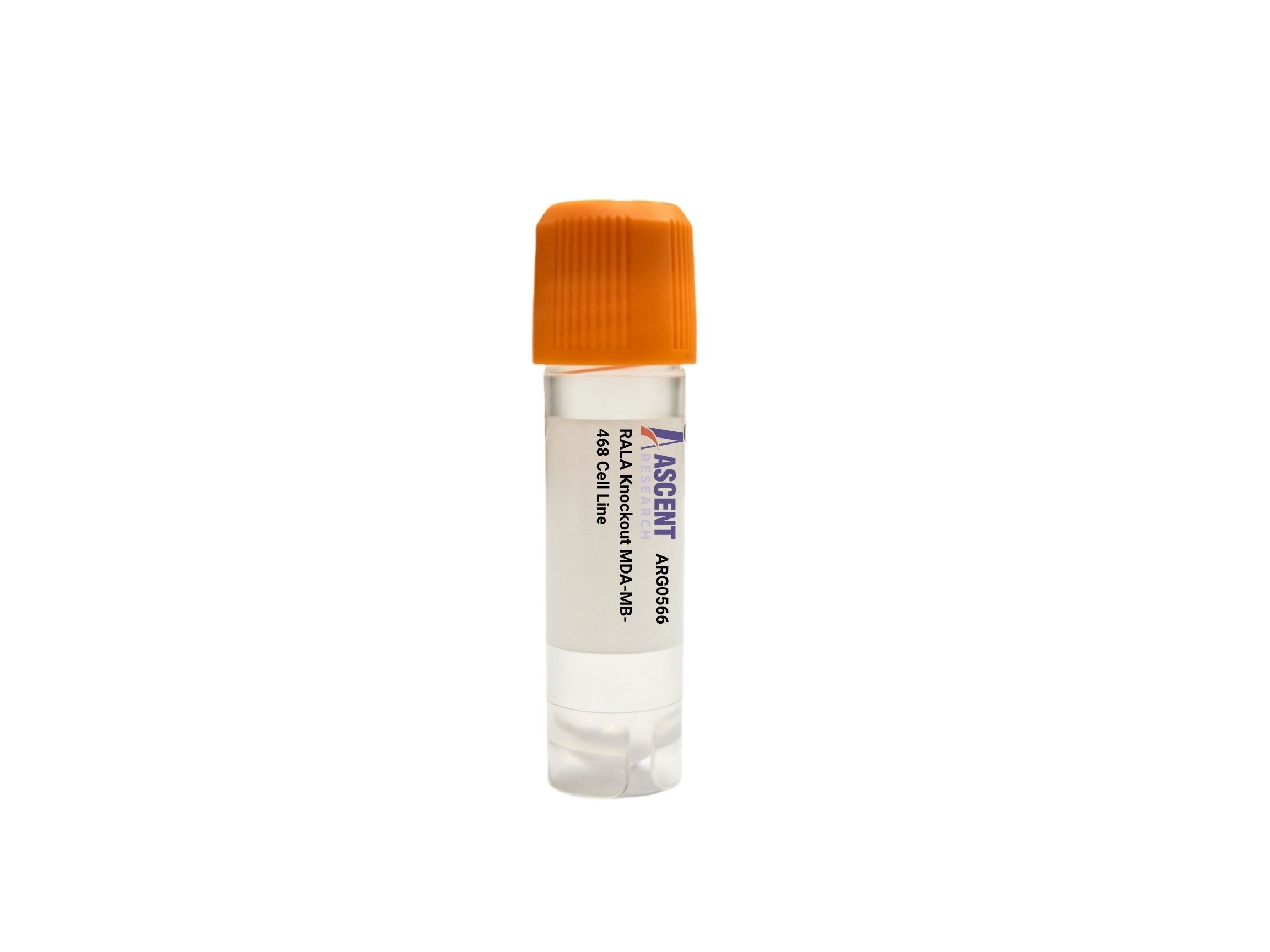
Genome-edited Cells
Breast (mammary gland)
The RALA Knockout MDA-MB-468 Cell Line is a CRISPR/Cas9-edited triple-negative breast cancer cell line with disruption of the RALA small GTPase. This model enables loss-of-function studies of RALA??s involvement in exocyst-dependent secretion, filamin A?Cmediated actin remodeling, and cell migration, downstream of RAS and RalGEF signaling. Applications include investigating metastatic mechanisms, dissecting drug resistance pathways, and examining exocyst biology. The line is compatible with Western blotting, transwell assays, RALA-GTP immunoprecipitation, and immunofluorescence, offering a reliable system for RAL signaling research in a clinically relevant TNBC background.
 FGFR2 Knockout KYSE-510 Cell Line
Cat. No. ARG43854
FGFR2 Knockout KYSE-510 Cell Line
Cat. No. ARG43854
 KANK2 Knockout MES-OV Polyclonal Cells
Cat. No. ARG24694
ARSA Knockout 786-O Polyclonal Cells
Cat. No. ARG24999
AGAP3 Knockout A2780 Polyclonal Cells
Cat. No. ARG28617
ADAM17 Knockout SK-HEP-1 Polyclonal Cells
Cat. No. ARG32054
CD55 Knockout NCI-H1299 Polyclonal Cells
Cat. No. ARG43653
KANK2 Knockout MES-OV Polyclonal Cells
Cat. No. ARG24694
ARSA Knockout 786-O Polyclonal Cells
Cat. No. ARG24999
AGAP3 Knockout A2780 Polyclonal Cells
Cat. No. ARG28617
ADAM17 Knockout SK-HEP-1 Polyclonal Cells
Cat. No. ARG32054
CD55 Knockout NCI-H1299 Polyclonal Cells
Cat. No. ARG43653
The RALA Knockout MDA-MB-468 Cell Line is a CRISPR/Cas9-edited cell line with targeted disruption of the RALA gene in the MDA-MB-468 human breast adenocarcinoma background. This knockout model provides a stable, loss-of-function system to study RALA-dependent pathways without the variability of transient silencing. The cell line is well-suited for detailed biochemical, cell biological, and functional analyses of RALA??s roles in vesicle trafficking, actin reorganization, and oncogenic signaling.
MDA-MB-468 is a triple-negative breast cancer (TNBC) cell line established from a pleural effusion of a 51-year-old Black female with metastatic disease. It lacks ER, PR, and HER2 expression and harbors a TP53 Arg273His mutation, characteristic of aggressive breast cancers with impaired p53 function. The parental cells are highly invasive and tumorigenic, recapitulating key features of metastatic TNBC and providing a clinically relevant context for knockout studies.
RALA encodes a small GTPase that functions as a molecular switch, cycling between inactive GDP-bound and active GTP-bound states. Upstream activation is mediated by Ras-dependent RalGEFs (RalGDS, RGL1, RGL2) downstream of HRAS, KRAS, and receptor tyrosine kinases. GTP-bound RALA engages effectors including the exocyst complex (via EXOC2/EXOC8), filamin A (FLNA), and RALBP1, linking membrane trafficking to actin dynamics and cell migration. RALA also impacts transcription through ZONAB and YAP1, integrating proliferative signals.
In the MDA-MB-468 background, which exhibits elevated RALA activity associated with metastatic behavior, this knockout enables dissection of RAL-dependent contributions to TNBC aggressiveness. The line can be used to investigate how RALA coordinates signals from growth factor receptors to exocyst-mediated secretion and cytoskeletal remodeling. The TP53-mutant context also facilitates studies of synthetic lethal interactions and altered chemosensitivity, particularly to agents such as cisplatin and paclitaxel.
Researchers can employ Western blotting for RALA and downstream targets like phospho-AKT, migration and invasion assays, RALA-GTP pull-downs, and immunofluorescence for exocyst localization to characterize the knockout phenotype. RNA-seq analysis can reveal transcriptomic changes, while comparative drug response testing provides insight into RALA-dependent resistance mechanisms. This cell line serves as a versatile tool for metastatic breast cancer research, RAL signaling studies, and exocyst biology. For additional details or custom inquiries, contact Ascent Research.