Genome-edited Cells
Liver
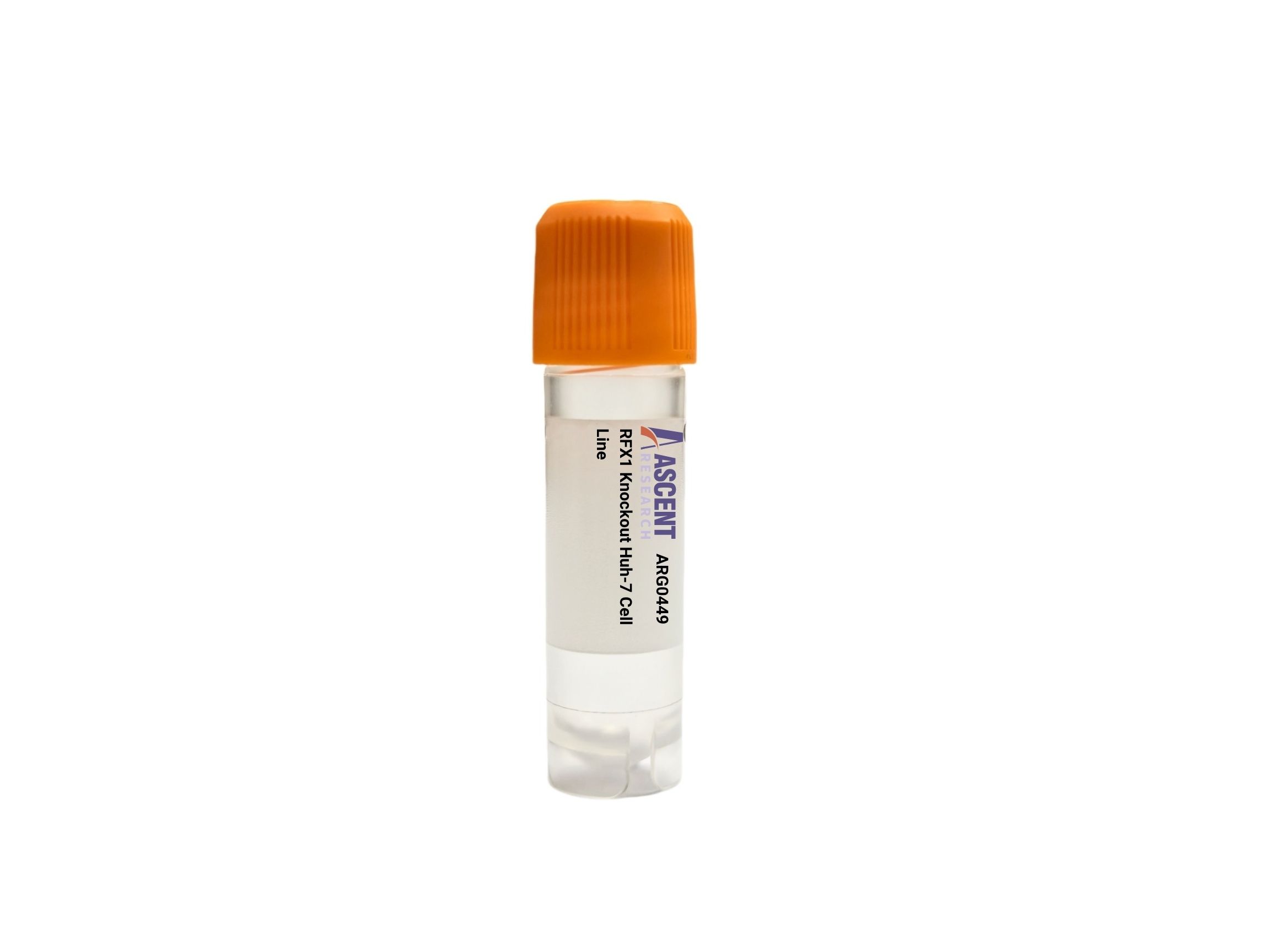
The RFX1 Knockout Huh-7 Cell Line is a CRISPR/Cas9-edited knockout cell line based on the Huh-7 human hepatocellular carcinoma cell line. This model ablates RFX1, a transcription factor that regulates MHC class II genes, ciliary genes, and cell cycle factors such as CDK4 through interactions with CIITA. It is ideal for studying immune escape, ciliary dysfunction, and proliferative signaling in liver cancer. Researchers can employ this knockout line in assays including flow cytometry for MHC class II, immunofluorescence for cilia, RNA-seq, and drug response profiling. It provides a tractable system for dissecting RFX1-mediated transcriptional networks and their roles in hepatocarcinogenesis and ciliopathies.
 CALCRL Knockout HAP1 Polyclonal Cells
Cat. No. ARG22229
HEMGN Knockout K562 Polyclonal Cells
Cat. No. ARG20544
ATRN Knockout K562 Polyclonal Cells
Cat. No. ARG20270
ARID4A Knockout huh-7 Polyclonal Cells
Cat. No. ARG27979
GPHN Knockout HGC-27 Polyclonal Cells
Cat. No. ARG29850
CBR4 Knockout SK-HEP-1 Polyclonal Cells
Cat. No. ARG42734
CALCRL Knockout HAP1 Polyclonal Cells
Cat. No. ARG22229
HEMGN Knockout K562 Polyclonal Cells
Cat. No. ARG20544
ATRN Knockout K562 Polyclonal Cells
Cat. No. ARG20270
ARID4A Knockout huh-7 Polyclonal Cells
Cat. No. ARG27979
GPHN Knockout HGC-27 Polyclonal Cells
Cat. No. ARG29850
CBR4 Knockout SK-HEP-1 Polyclonal Cells
Cat. No. ARG42734
The RFX1 Knockout Huh-7 Cell Line is a CRISPR/Cas9-edited knockout cell line derived from the human hepatocellular carcinoma Huh-7 cell line. This product provides a defined loss-of-function model for studying the transcriptional regulatory functions of RFX1. The knockout cell line has been generated using CRISPR/Cas9-mediated gene disruption to ablate RFX1 expression, enabling investigators to dissect its roles in immune response, ciliogenesis, and cell cycle control. It is supplied as a stable knockout cell line suitable for a wide range of downstream functional assays.
The parental Huh-7 cell line is a well-characterized model of human hepatocellular carcinoma, originally established from a liver tumor of a 57-year-old Japanese male. Huh-7 cells retain hepatocyte-like features and are widely employed in liver cancer research, drug metabolism studies, and investigations of hepatic signaling. The availability of a targeted RFX1 knockout in this background facilitates dissection of RFX1-dependent pathways in a liver-relevant context.
RFX1 encodes a transcription factor that belongs to the regulatory factor X (RFX) family. It specifically binds X-box DNA motifs found in the promoters of MHC class II genes and ciliary genes. RFX1 is activated by upstream signals including IFN-gamma and forms complexes with CIITA, RFX2, RFX3, RFX5, and NF-Y to transcriptionally regulate downstream targets such as HLA-DRA and HLA-DRB (key components of MHC class II antigen presentation), IFT88 and FOXJ1 (essential for ciliogenesis), and CDK4 (a regulator of cell cycle progression). Through these interactions, RFX1 integrates immune and developmental signals with cell proliferation control.
In the Huh-7 hepatocellular carcinoma context, RFX1 knockout is particularly relevant for studying immune evasion mechanisms, as MHC class II downregulation is often associated with tumor progression. Additionally, disruption of RFX1 may impair ciliogenesis, a process linked to hepatic cyst formation and ciliopathy-associated liver diseases. The knockout also permits examination of CDK4-dependent cell cycle alterations in liver cancer, providing a platform for investigating therapeutic vulnerabilities.
Researchers can apply this cell line to transcriptional regulation studies using ChIP-seq and RNA-seq, quantify MHC class II surface expression via flow cytometry, visualize cilia with immunofluorescence, and assess protein changes by western blotting or RT-qPCR. The model supports liver cancer drug response profiling and ciliopathy-related phenotypic screening. For further details or customization, please contact Ascent Research.