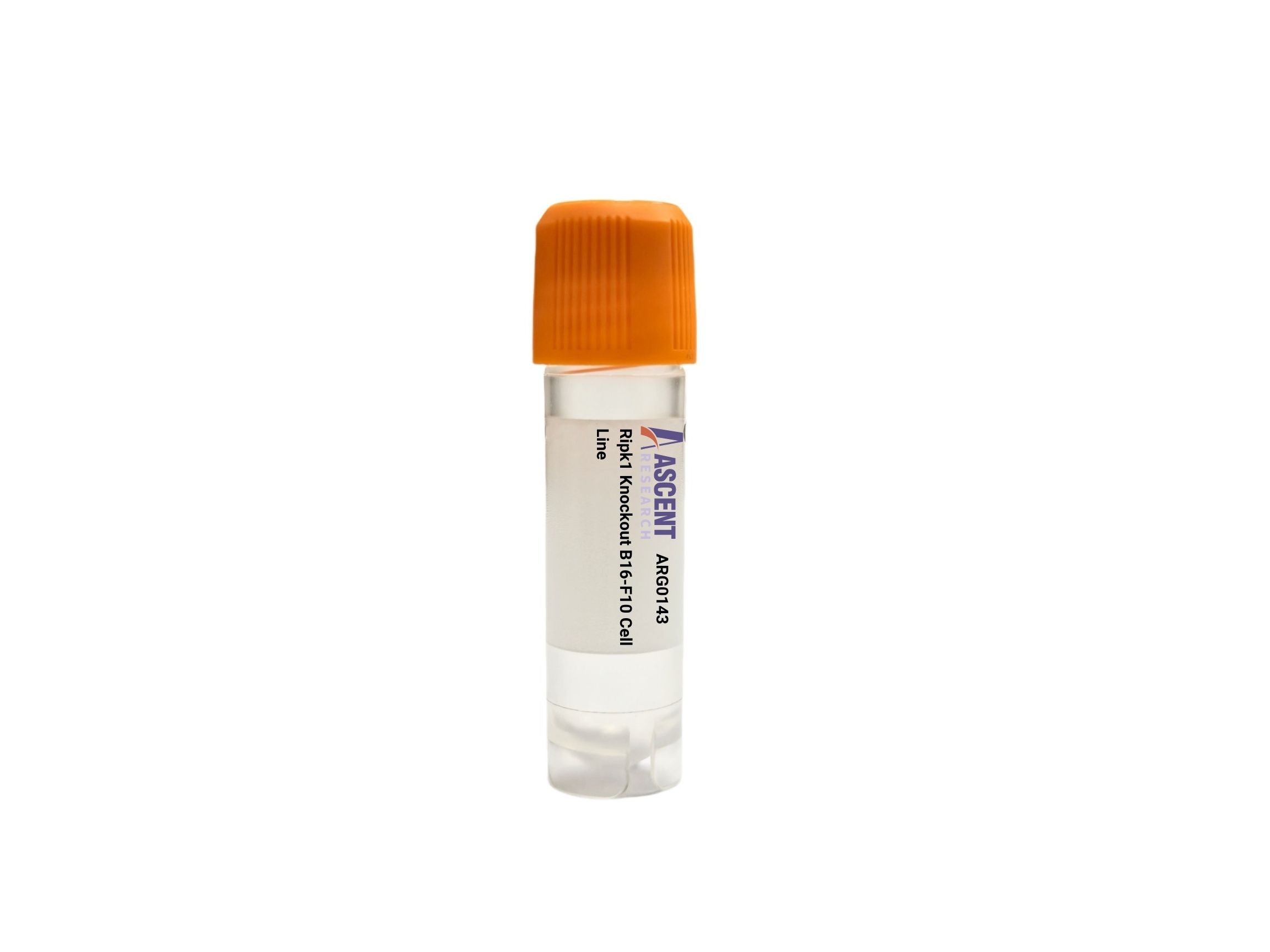
Genome-edited Cells
Skin
Ripk1 Knockout B16-F10 is a CRISPR/Cas9-edited mouse melanoma cell line generated in the highly metastatic B16-F10 background. RIPK1 functions downstream of TNFR1 with TRADD, TRAF2, cIAP1/cIAP2, and LUBAC to regulate NF-kB/MAPK activation, caspase-8-dependent apoptosis, and RIPK3-MLKL necroptosis. Disruption of Ripk1 in this syngeneic melanoma model supports studies of TNF-driven signaling, tumor inflammatory responses, cell death-survival checkpoint control, and melanoma drug sensitivity. Common applications include western blotting, RT-qPCR, RNA-seq, annexin V/PI assays, caspase-3/7 analysis, MLKL phosphorylation studies, cytokine profiling, and mechanism-of-action testing for SMAC mimetics.
 Cynomolgus Monkey Mononuclear Cells (PBMC)
Cat. No. ARP1039
Cynomolgus Monkey Mononuclear Cells (PBMC)
Cat. No. ARP1039
 CDKN1A Knockout T47D Polyclonal Cells
Cat. No. ARG12011
AHNAK2 Knockout 786-O Polyclonal Cells
Cat. No. ARG24856
B2M Knockout NCI-H1703 Polyclonal Cells
Cat. No. ARG36521
Hspa4l Knockout HEK293T Polyclonal Cells
Cat. No. ARG37803
OXNAD1 Knockout AGS Polyclonal Cells
Cat. No. ARG2482
CDKN1A Knockout T47D Polyclonal Cells
Cat. No. ARG12011
AHNAK2 Knockout 786-O Polyclonal Cells
Cat. No. ARG24856
B2M Knockout NCI-H1703 Polyclonal Cells
Cat. No. ARG36521
Hspa4l Knockout HEK293T Polyclonal Cells
Cat. No. ARG37803
OXNAD1 Knockout AGS Polyclonal Cells
Cat. No. ARG2482
The Ripk1 Knockout B16-F10 Cell Line is a CRISPR/Cas9-engineered mouse melanoma model in which the Ripk1 gene has been disrupted to eliminate functional RIPK1 expression. This stable edited cell line is generated in the B16-F10 background, a widely used murine melanoma cell line, and provides an in vitro system for investigating RIPK1-dependent control of inflammatory signaling and regulated cell death. As a knockout model in a tumor cell context, it is suited for mechanistic studies of death receptor signaling, survival pathways, and stress responses relevant to cancer biology and immunology.
B16-F10 is a highly metastatic subline derived from B16 melanoma and is broadly used in C57BL/6-associated syngeneic research. The line is valued as a tumor cell model for melanoma growth, invasion, metastatic dissemination, and anti-tumor immune interactions. Because B16-F10 retains experimental relevance to tumor-intrinsic signaling as well as host-tumor inflammatory crosstalk, it is frequently used to study how melanoma cells respond to cytokines, innate immune stimuli, and therapeutic perturbations. This background makes it useful for examining how gene loss modifies tumor cell survival programs and inflammatory phenotypes in a melanoma setting.
RIPK1 is a serine/threonine kinase and scaffold protein positioned at a central checkpoint downstream of TNF/TNFR1 and related inflammatory inputs. In TNFR1 signaling, RIPK1 interacts with TNFR1, TRADD, TRAF2, cIAP1, cIAP2, and the LUBAC components RBCK1/HOIL-1, RNF31/HOIP, and SHARPIN to support activation of TAK1-TAB2/TAB3 and the IKK complex, including IKKA, IKKB, and NEMO, thereby promoting NF-kB and MAPK signaling. RIPK1 also regulates the transition from pro-survival signaling to FADD- and caspase-8-dependent apoptosis or to RIPK3-MLKL-mediated necroptosis, particularly under conditions such as cIAP loss, SMAC mimetic treatment, or caspase-8 inhibition. Through these interactions, RIPK1 influences downstream outputs including NF-kB target gene expression, caspase-3 activation, MLKL phosphorylation, and cytokine or chemokine production.
In B16-F10 melanoma cells, loss of Ripk1 provides a defined system for studying how disruption of this signaling checkpoint alters sensitivity to TNF-family ligands, innate immune pathway activation downstream of TLR3, TLR4, or ZBP1, and the balance between inflammatory survival responses and cell death execution. This context is particularly relevant for investigating melanoma-associated cell death resistance, tumor inflammation, and mechanisms that may shape tumor-immune interactions.
This knockout cell line can be applied to TNF-induced cell death studies, apoptosis-necroptosis crosstalk analyses, and mechanism-of-action studies involving SMAC mimetics or caspase inhibition. Researchers may use western blotting or phospho-signaling assays to monitor IKK, MAPK, RIPK3, or MLKL pathway responses; annexin V/propidium iodide staining and caspase-3/7 assays to quantify apoptotic versus lytic death; RT-qPCR, RNA-seq, and cytokine secretion assays to profile NF-kB-regulated inflammatory outputs; and co-immunoprecipitation or immunofluorescence to examine remodeling of TNFR1-proximal signaling complexes. The model is also suitable for cell viability and drug sensitivity studies designed to define RIPK1-dependent pathway liabilities in melanoma cells. Researchers may contact Ascent Research for additional technical information, product details, or related gene-edited cell models.