Genome-edited Cells
Pancreas
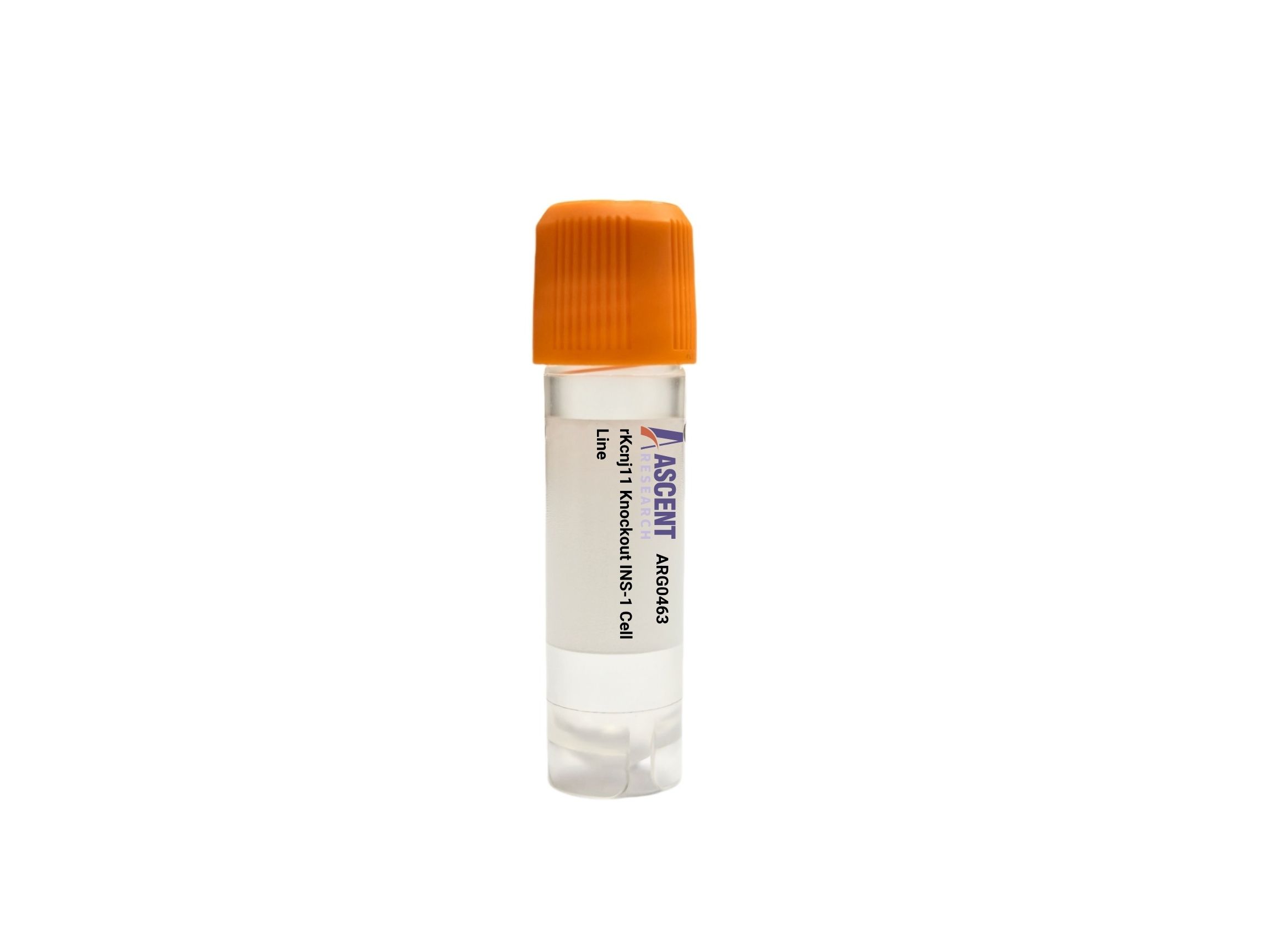
The rKcnj11 Knockout INS-1 Cell Line is a CRISPR/Cas9-engineered rat insulinoma cell line with targeted disruption of the Kcnj11 gene, which encodes the Kir6.2 pore-forming subunit of ATP-sensitive potassium (K_ATP) channels. This knockout model eliminates K_ATP channel activity, leading to constitutive membrane depolarization and dysregulated insulin secretion in a pancreatic beta cell background. Kcnj11 partners with SUR1 (Abcc8) and is modulated by PIP2 and PKA, coupling glucose metabolism to calcium influx and insulin exocytosis. This cell line enables investigation of beta cell electrophysiology, insulin secretion, calcium signaling, and metabolic disease mechanisms, making it a valuable tool for diabetes research and ion channel-targeted drug discovery.
 MIR31 Knockout IPEC-J2 Cell Line
Cat. No. ARG43980
MIR31 Knockout IPEC-J2 Cell Line
Cat. No. ARG43980
 GIPC2 Knockout jurkat Polyclonal Cells
Cat. No. ARG13290
MYOF Knockout A549 Polyclonal Cells
Cat. No. ARG10545
EIF4E3 Knockout HAP1 Polyclonal Cells
Cat. No. ARG41041
CaMK4 Knockout MCF7 Polyclonal Cells
Cat. No. ARG11419
PCBP3 Knockout AGS Polyclonal Cells
Cat. No. ARG2196
GIPC2 Knockout jurkat Polyclonal Cells
Cat. No. ARG13290
MYOF Knockout A549 Polyclonal Cells
Cat. No. ARG10545
EIF4E3 Knockout HAP1 Polyclonal Cells
Cat. No. ARG41041
CaMK4 Knockout MCF7 Polyclonal Cells
Cat. No. ARG11419
PCBP3 Knockout AGS Polyclonal Cells
Cat. No. ARG2196
The rKcnj11 Knockout INS-1 Cell Line is a genetically modified rat pancreatic beta cell line generated through CRISPR/Cas9-mediated disruption of the Kcnj11 gene. This cell line serves as a stable, loss-of-function model for investigating the role of the Kir6.2 subunit of ATP-sensitive potassium (K_ATP) channels in beta cell function. By abrogating Kcnj11 expression, researchers can directly assess the impact of K_ATP channel deficiency on membrane potential, calcium dynamics, and insulin secretion in a physiologically relevant cellular environment. The engineered cell line is provided as a ready-to-use culture, ensuring experimental reproducibility.
The parental INS-1 line, derived from X-ray-induced rat insulinoma, is a well-established model of pancreatic beta cells, retaining robust glucose-stimulated insulin secretion (GSIS) and key beta cell characteristics. These cells sense glucose via glucokinase and respond to incretins and sulfonylureas, making them an ideal substrate for gene-editing studies of beta cell biology. In this knockout line, the INS-1 background ensures that observed phenotypes are directly attributable to Kcnj11 loss, providing a clean system for mechanistic and pharmacological investigations.
Kcnj11 encodes the pore-forming Kir6.2 subunit of K_ATP channels, which partner with the sulfonylurea receptor SUR1 (Abcc8) to sense metabolic signals. Glucose metabolism increases the ATP/ADP ratio, inhibiting channel activity and triggering membrane depolarization. This depolarization activates L-type voltage-gated calcium channels (Cav1.2/Cav1.3), permitting calcium influx that drives insulin exocytosis through SNARE protein complexes. Kir6.2 gating is further regulated by PIP2 and PKA, the latter acting downstream of the GLP-1 receptor. Kcnj11 disruption eliminates K_ATP currents, causing constitutive depolarization, aberrant calcium oscillations, and dysregulated insulin secretion, ultimately affecting transcriptional regulators such as CREB and PDX1.
In the INS-1 context, Kcnj11 knockout recapitulates features of human K_ATP channelopathies, including neonatal diabetes and congenital hyperinsulinism. The loss of K_ATP channel activity disrupts the normal coupling between glucose metabolism and insulin secretion, leading to either elevated basal insulin release or impaired glucose responsiveness. This model enables dissection of K_ATP-dependent and -independent secretory pathways and supports investigations into compensatory adaptations. Moreover, it offers a cellular platform for screening drugs that act on downstream targets, such as calcium channel blockers or exocytosis modulators, in the absence of K_ATP channel input.
Researchers can apply this cell line in patch-clamp electrophysiology to confirm K_ATP current ablation, and in GSIS assays to characterize secretory defects. Intracellular calcium imaging reveals altered calcium dynamics, while Western blotting and RT-qPCR validate Kir6.2 and SUR1 expression changes. The model is also suitable for sulfonylurea and GLP-1 receptor agonist screening, ATP/ADP ratio measurements, and immunofluorescence studies of insulin granule trafficking. By integrating this knockout line into experimental workflows, scientists can deepen insights into beta cell function, metabolic disease, and therapeutic development. For further technical information, please contact Ascent Research.