Genome-edited Cells
Large intestine (colon)
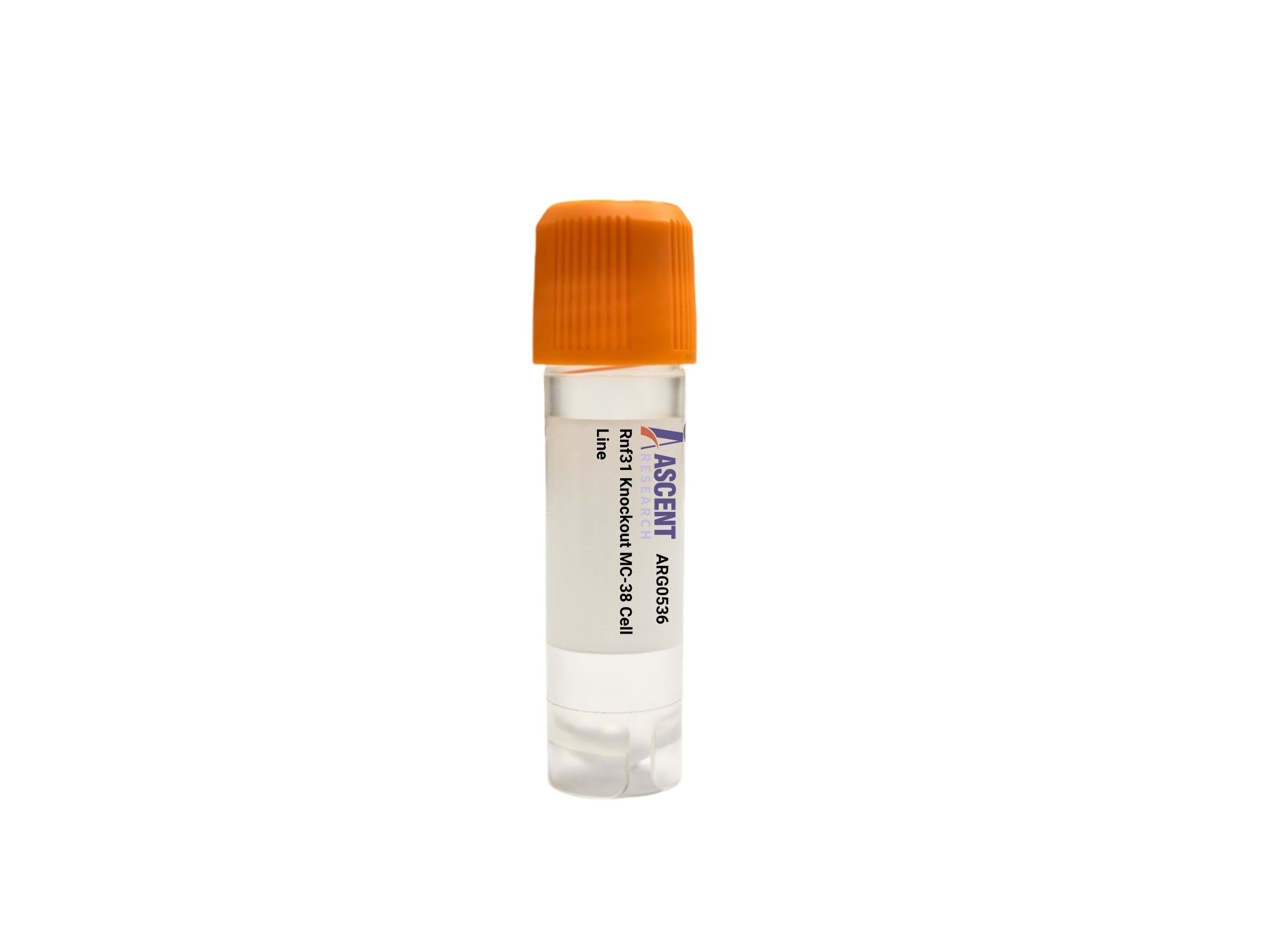
The Rnf31 Knockout MC-38 Cell Line is a CRISPR/Cas9-edited knockout cell line derived from the MC-38 murine colon adenocarcinoma model, featuring disruption of the Rnf31 gene that encodes HOIP, the catalytic subunit of the linear ubiquitin chain assembly complex (LUBAC). Loss of Rnf31 abrogates linear ubiquitination, cripples NF-??B activation, and enhances susceptibility to TNF-??-induced apoptosis and necroptosis. This syngeneic C57BL/6 cell line enables the study of linear ubiquitination in colorectal cancer, tumor immunity, and inflammatory bowel disease. Key applications include western blotting for linear ubiquitin chains, RT-qPCR for NF-??B targets (Il6, Tnf), immunofluorescence for p65 nuclear translocation, and flow cytometry-based cell death assays.
 MCCC1 Knockout A2780 Polyclonal Cells
Cat. No. ARG19163
PDGFD Knockout NCI-H1975 Polyclonal Cells
Cat. No. ARG16530
IGFALS Knockout HAP1 Polyclonal Cells
Cat. No. ARG22719
AGPAT2 Knockout HEK293T Polyclonal Cells
Cat. No. ARG25626
LYSMD3 Knockout Hela Polyclonal Cells
Cat. No. ARG7798
MCCC1 Knockout A2780 Polyclonal Cells
Cat. No. ARG19163
PDGFD Knockout NCI-H1975 Polyclonal Cells
Cat. No. ARG16530
IGFALS Knockout HAP1 Polyclonal Cells
Cat. No. ARG22719
AGPAT2 Knockout HEK293T Polyclonal Cells
Cat. No. ARG25626
LYSMD3 Knockout Hela Polyclonal Cells
Cat. No. ARG7798
 NE-4C
Cat. No. ARI0248
NE-4C
Cat. No. ARI0248
The Rnf31 Knockout MC-38 Cell Line is a CRISPR/Cas9-edited knockout cell line derived from the MC-38 murine colon adenocarcinoma cell line, designed to disrupt the Rnf31 gene. This gene encodes HOIP (HOIL-1-interacting protein), the catalytic subunit of the linear ubiquitin chain assembly complex (LUBAC), a master regulator of linear ubiquitination and NF-??B signaling. By introducing targeted gene disruption via CRISPR/Cas9, this cell line provides a stable loss-of-function model for dissecting the roles of linear ubiquitination in inflammatory signaling, cell death, and tumor immunity.
The parental MC-38 cell line is an epithelial tumor cell line originally established from a chemically induced colorectal carcinoma in C57BL/6 mice. As a syngeneic colon adenocarcinoma model, MC-38 is extensively utilized in cancer immunology and preclinical colorectal cancer studies. It retains key tumor cell characteristics, including oncogenic signaling and immune-modulatory responsiveness, offering a well-characterized background for gene-edited models focused on tumor-intrinsic pathways.
Rnf31 encodes HOIP, which partners with SHARPIN and HOIL-1L (RBCK1) to form LUBAC, the sole E3 ligase generating Met1-linked linear ubiquitin chains. LUBAC is recruited to TNFR1, IL-1R, and TLR complexes, where it linearly ubiquitinates NEMO and RIPK1. This ubiquitination activates the IKK complex, driving NF-??B nuclear translocation and transcription of pro-inflammatory cytokines (e.g., TNF-??, IL-6, IL-1??). Moreover, LUBAC-mediated linear ubiquitination restrains TNF-??-induced apoptosis and necroptosis. Rnf31 disruption abolishes these functions, abolishing linear ubiquitination, impairing NF-??B responses, and sensitizing cells to cell death.
In MC-38 colon adenocarcinoma cells, Rnf31 knockout severely disrupts tumor cell-intrinsic inflammatory signaling and cell death regulation. This model allows dissection of how linear ubiquitination balances NF-??B survival signals and programmed cell death in colorectal cancer. It is ideal for studying immunogenic cell death, tumor-immune interactions, and LUBAC??s role in inflammatory bowel disease-related carcinogenesis. The knockout cell line also facilitates screening of LUBAC inhibitors targeting the catalytic subunit.
Researchers can employ western blotting for linear ubiquitin chains and phospho-IKK, RT-qPCR for NF-??B targets (Il6, Tnf), immunofluorescence for p65 nuclear translocation, and flow cytometry (Annexin V/PI) to assess cell death. Co-immunoprecipitation of RIPK1 with NEMO, TNF-?? sensitivity assays, and cytokine ELISA further support mechanistic studies. Applications span tumor immunity, inflammatory bowel disease, and LUBAC-targeted drug discovery. For further information, contact Ascent Research.