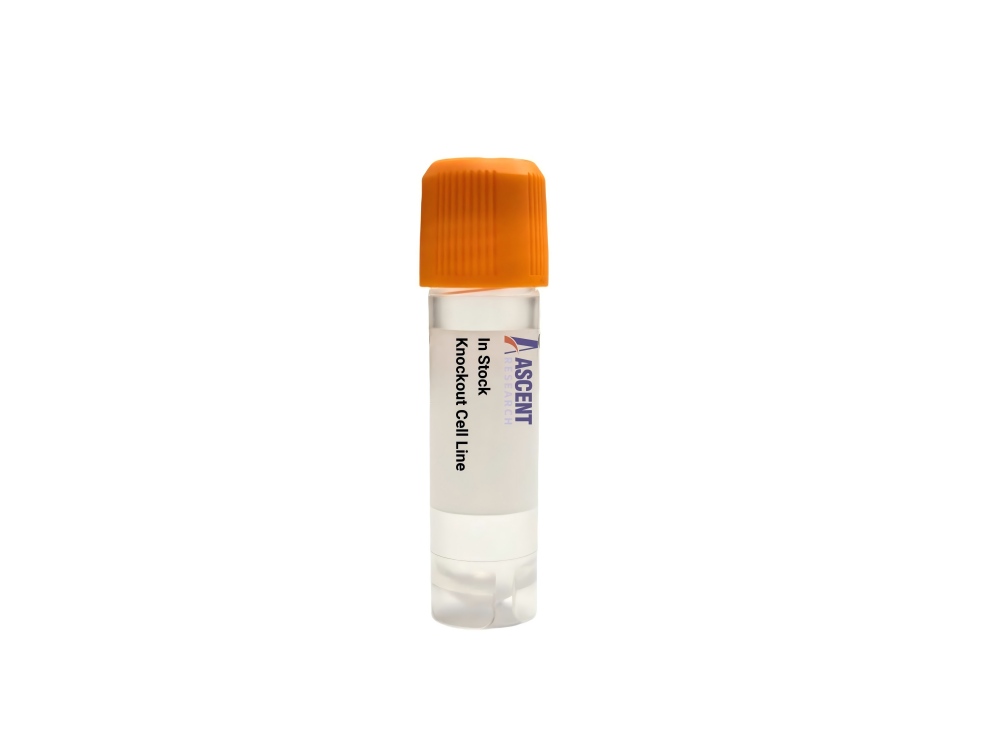
In Stock Cell Lines
The S1PR2 Knockout K-562 Cell Line is a CRISPR/Cas9-edited knockout model in which the S1PR2 gene, encoding the sphingosine-1-phosphate (S1P) receptor 2, has been disrupted. Derived from the BCR-ABL1-positive K-562 chronic myelogenous leukemia line, this model enables investigation of S1P/S1PR2 signaling in a leukemic context, particularly its coupling to G??12/13 and RhoA/ROCK pathways. By eliminating S1PR2, researchers can assess its roles in cell migration, adhesion, and survival, and explore crosstalk with BCR-ABL1-driven PI3K/Akt and MAPK/ERK pathways. Applications include drug resistance studies and therapeutic target evaluation in CML and other diseases involving S1P signaling.
 LMO7 Knockout A2780 Polyclonal Cells
Cat. No. ARG18616
ASPH Knockout A549 Polyclonal Cells
Cat. No. ARG19909
DHCR7 Knockout Lovo Polyclonal Cells
Cat. No. ARG11679
C1GALT1C1 Knockout MES-OV Polyclonal Cells
Cat. No. ARG24381
HDAC4 Knockout CAL27 Polyclonal Cells
Cat. No. ARG35384
COASY Knockout MES-OV Polyclonal Cells
Cat. No. ARG6823
LMO7 Knockout A2780 Polyclonal Cells
Cat. No. ARG18616
ASPH Knockout A549 Polyclonal Cells
Cat. No. ARG19909
DHCR7 Knockout Lovo Polyclonal Cells
Cat. No. ARG11679
C1GALT1C1 Knockout MES-OV Polyclonal Cells
Cat. No. ARG24381
HDAC4 Knockout CAL27 Polyclonal Cells
Cat. No. ARG35384
COASY Knockout MES-OV Polyclonal Cells
Cat. No. ARG6823
The S1PR2 Knockout K-562 Cell Line is a CRISPR/Cas9-edited knockout cell line with disrupted S1PR2 gene expression, eliminating the sphingosine-1-phosphate receptor 2 protein. This loss-of-function model is provided in a live-cell format for direct use in functional studies. S1PR2 encodes a G protein-coupled receptor that binds the bioactive lipid S1P, mediating diverse cellular responses. The knockout enables researchers to dissect receptor-specific roles within the S1P signaling network.
The K-562 host line originates from a blast crisis CML patient and harbors the BCR-ABL1 fusion oncogene. As a lymphoblastoid hematopoietic progenitor cell line, it constitutively activates PI3K/Akt and MAPK/ERK pathways, driving uncontrolled proliferation and survival. K-562 is extensively used in leukemia research, drug screening, and hematopoiesis studies. The S1PR2 knockout in this genetic context provides a platform to investigate interactions between S1P receptor signaling and BCR-ABL1-driven oncogenesis.
S1PR2 couples primarily to G??12/13, G??q, and G??i heterotrimeric G proteins. Activation by S1P triggers G??12/13-mediated RhoA/ROCK signaling, which reorganizes the actin cytoskeleton via LIMK and cofilin, affecting cell migration. G??q stimulates PLC?? to generate IP3 and mobilize intracellular calcium, while G??i modulates adenylyl cyclase and cAMP levels, intersecting with PKA, PI3K/Akt, and MAPK/ERK pathways. Downstream targets include RhoA, ROCK, PTEN, Akt, ERK1/2, and Rac1. Interacting factors such as ??-arrestin and GRK2 regulate receptor trafficking and desensitization.
In CML, S1PR2 signaling may influence cell adhesion, migration, and survival, potentially through crosstalk with BCR-ABL1 at shared pathway nodes. Loss of S1PR2 in K-562 cells allows dissection of receptor-specific contributions to leukemic phenotypes and drug resistance. This model is relevant for evaluating S1PR2 as a therapeutic target in CML and for exploring its involvement in solid tumors and inflammatory diseases.
Applications include Transwell migration and invasion assays, flow cytometric analysis of apoptosis and cell cycle, and western blotting for phospho-Akt, phospho-ERK, and RhoA activity. RT-qPCR can assess downstream gene expression, while MTT assays measure viability under drug treatment. Calcium flux assays provide functional readouts of receptor signaling. Comparisons between knockout and wild-type K-562 cells define S1PR2-dependent mechanisms. For further details, contact Ascent Research.