Genome-edited Cells
Pancreas (islets of Langerhans)
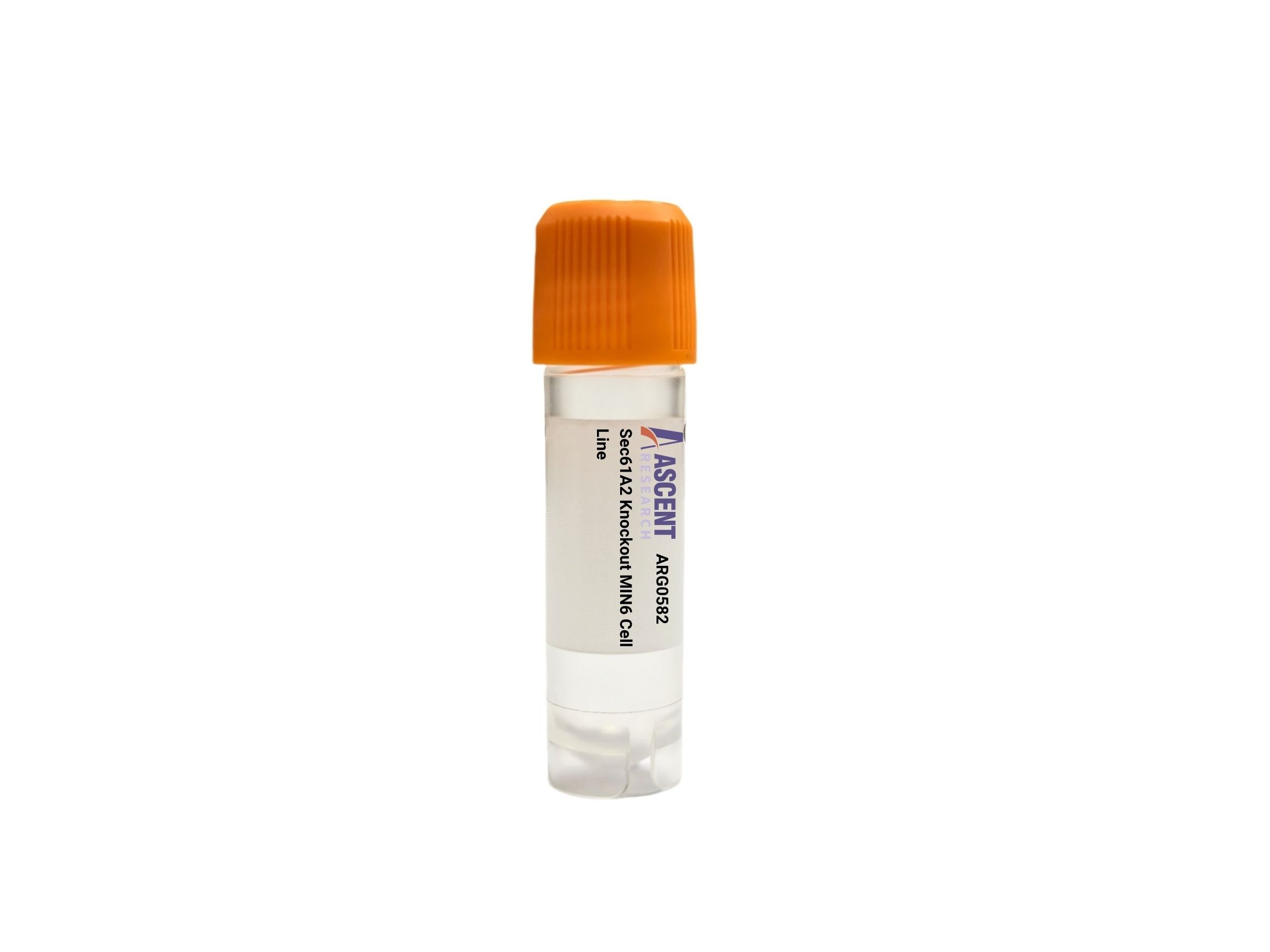
The Sec61A2 Knockout MIN6 Cell Line is a CRISPR/Cas9-edited knockout cell line derived from the mouse pancreatic beta cell line MIN6. This stable model disrupts Sec61A2, the pore-forming subunit of the Sec61 translocon, thereby impairing ER protein translocation and activating the unfolded protein response (UPR) in a context relevant to diabetes. Key interacting partners include Sec61B, Sec61G, and the ER chaperone BiP/GRP78. Suitable applications encompass glucose-stimulated insulin secretion assays, western blotting for UPR markers such as p-PERK and CHOP, co-immunoprecipitation of Sec61 complex components, and investigation of ER stress-mediated beta cell dysfunction and diabetes pathogenesis.
The Sec61A2 Knockout MIN6 Cell Line is a CRISPR/Cas9-edited knockout model from mouse pancreatic beta cell line MIN6, featuring disruption of the Sec61A2 gene. Sec61A2 encodes a key subunit of the Sec61 translocon responsible for polypeptide import into the ER. Loss of Sec61A2 expression provides a loss-of-function system to dissect ER translocation-dependent processes, including proinsulin biosynthesis, ER stress signaling, and insulin secretion, within a physiologically relevant beta cell context. Generated via CRISPR/Cas9-mediated gene disruption, this stable, proliferative cell line is suitable for high-throughput and mechanistic studies.
The MIN6 host cell line is a well-established murine insulinoma-derived pancreatic beta cell model that retains robust glucose-stimulated insulin secretion (GSIS). Recapitulating key beta cell features, it is widely used for diabetes research, particularly for studying ER homeostasis, insulin processing, and secretory dysfunction. The Sec61A2 knockout variant thus enables precise interrogation of ER translocation in beta cell physiology without primary islet heterogeneity.
Sec61A2 is the pore-forming ??-subunit of the trimeric Sec61 complex, partnering with Sec61B and Sec61G to form an ER protein-conducting channel. This complex associates with ribosomes for nascent chain insertion and interacts with chaperones including BiP/GRP78, calnexin, calreticulin, and ERdj3 for folding and quality control. Its activity is regulated by ER stress sensors ATF6, IRE1 (ERN1), and PERK (EIF2AK3), and its transcription is controlled by UPR effectors XBP1 and ATF4. Loss of Sec61A2 disrupts proinsulin translocation, activates the UPR, alters Sec61 complex interactions detectable by co-immunoprecipitation, and impairs calcium homeostasis.
In MIN6 cells, Sec61A2 ablation causes defective proinsulin entry into the ER, leading to cytosolic accumulation, chronic UPR activation, and reduced insulin secretion. This phenotype mirrors ER stress in type 2 diabetes, where beta cells face excessive insulin demand and lipotoxic/glucotoxic insults. The model enables dissection of ER translocation fidelity’s impact on beta cell survival and function, and sheds light on ER storage disorders and protein misfolding diseases.
This cell line supports applications such as western blotting for UPR markers (p-PERK, ATF6, CHOP), RT-qPCR for ER stress genes, immunofluorescence for ER morphology, and glucose-stimulated insulin secretion assays. It also enables co-immunoprecipitation of Sec61 complex components and viability assays under chemical ER stressors. The model is valuable for diabetes pathogenesis, protein secretion biology, and screening ER proteostasis modulators. For technical inquiries, please contact Ascent Research.