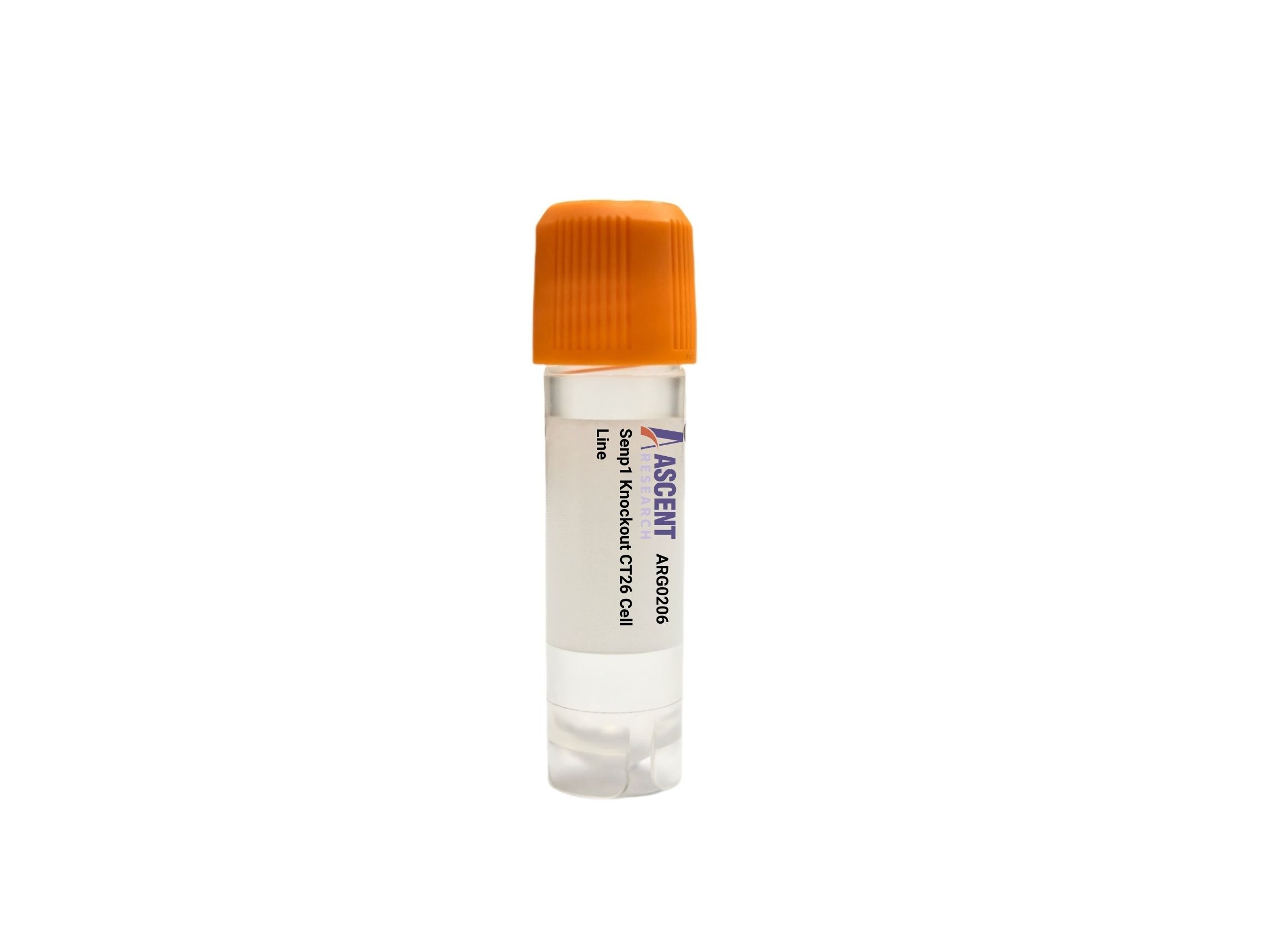
Genome-edited Cells
Large intestine (colon)
The Senp1 Knockout CT26 Cell Line is a CRISPR/Cas9-edited knockout cell line derived from mouse CT26 colon carcinoma cells. This model enables loss-of-function studies of Senp1, a SUMO-specific protease that deconjugates SUMO1 from key substrates to regulate transcription factor activity and signaling pathways. Loss of Senp1 increases SUMOylation of targets such as HIF1A and c-Jun, impairing hypoxia responses and NF-??B signaling, with potential effects on tumor cell proliferation and survival. Applications include cancer biology, SUMOylation research, hypoxia studies, and drug target validation using assays like western blotting, RT-qPCR, and functional assays.
 CAPN2 Knockout Raji Polyclonal Cells
Cat. No. ARG21476
GLB1 Knockout NCI-H1299 Polyclonal Cells
Cat. No. ARG17637
GNE Knockout RAW264.7 Polyclonal Cells
Cat. No. ARG12483
KRAS Knockout HEK293 Polyclonal Cells
Cat. No. ARG23271
ACSL5 Knockout MES-OV Polyclonal Cells
Cat. No. ARG24040
GPM6B Knockout HAP1 Polyclonal Cells
Cat. No. ARG27504
CAPN2 Knockout Raji Polyclonal Cells
Cat. No. ARG21476
GLB1 Knockout NCI-H1299 Polyclonal Cells
Cat. No. ARG17637
GNE Knockout RAW264.7 Polyclonal Cells
Cat. No. ARG12483
KRAS Knockout HEK293 Polyclonal Cells
Cat. No. ARG23271
ACSL5 Knockout MES-OV Polyclonal Cells
Cat. No. ARG24040
GPM6B Knockout HAP1 Polyclonal Cells
Cat. No. ARG27504
The Senp1 Knockout CT26 Cell Line is a CRISPR/Cas9-edited knockout cell line derived from the Mus musculus CT26 colon carcinoma line, providing a stable loss-of-function model for SUMO-specific peptidase 1 (Senp1). This CRISPR-mediated gene disruption enables reproducible investigation of Senp1-dependent deSUMOylation activity without transient silencing artifacts.
The CT26 parental line originates from a BALB/c mouse colorectal carcinoma, an aggressive model widely used in colorectal cancer studies. CT26 cells are highly tumorigenic in syngeneic BALB/c hosts, mimicking tumor microenvironment and immune interactions, and exhibit robust in vitro proliferation, making them a suitable platform for genetic manipulation.
Senp1 encodes a SUMO-specific protease that deconjugates SUMO1 from target proteins, dynamically regulating SUMOylation of transcriptional regulators and signaling molecules. In this knockout, loss of deSUMOylation leads to hyperSUMOylation of substrates including HIF1A, c-Jun, Sp3, and androgen receptor, altering their activity and stability. Senp1 operates within the SUMOylation cascade involving E1 enzymes SAE1/SAE2, the E2 conjugating enzyme UBC9, and E3 ligases such as PIAS family members and RanBP2, and localizes to PML nuclear bodies where it deSUMOylates resident substrates. It intersects with hypoxia signaling through HIF1A, androgen receptor signaling, the NF-??B pathway via NEMO, and cross-talks with Wnt/??-catenin and DNA damage response. Upstream regulators encompass HIF1A, androgen receptor, NF-??B, and the PI3K/AKT pathway.
In CT26 colon carcinoma, Senp1 ablation likely impairs tumorigenic processes. HyperSUMOylation of HIF1A blunts hypoxia-induced transcription, while hyperSUMOylation of c-Jun represses AP-1-driven proliferation. Dysregulation of NEMO deSUMOylation alters NF-??B signaling, potentially reducing inflammatory responses. These disruptions may suppress cell proliferation, survival, and metastasis, making this line valuable for studying SUMOylation dynamics in colorectal cancer progression and therapy response, especially under hypoxic conditions.
This product facilitates applications in cancer biology, SUMOylation research, and drug target validation. Standard assays include western blotting for SUMOylation profiling, RT-qPCR for target gene analysis, migration/invasion and apoptosis assays for functional readouts, and co-immunoprecipitation to identify SUMOylated complexes. Immunofluorescence and phospho-signaling analysis can map pathway alterations, while drug sensitivity testing evaluates therapeutic implications. For further details, please contact Ascent Research.