Genome-edited Cells
Blood (peripheral blood)
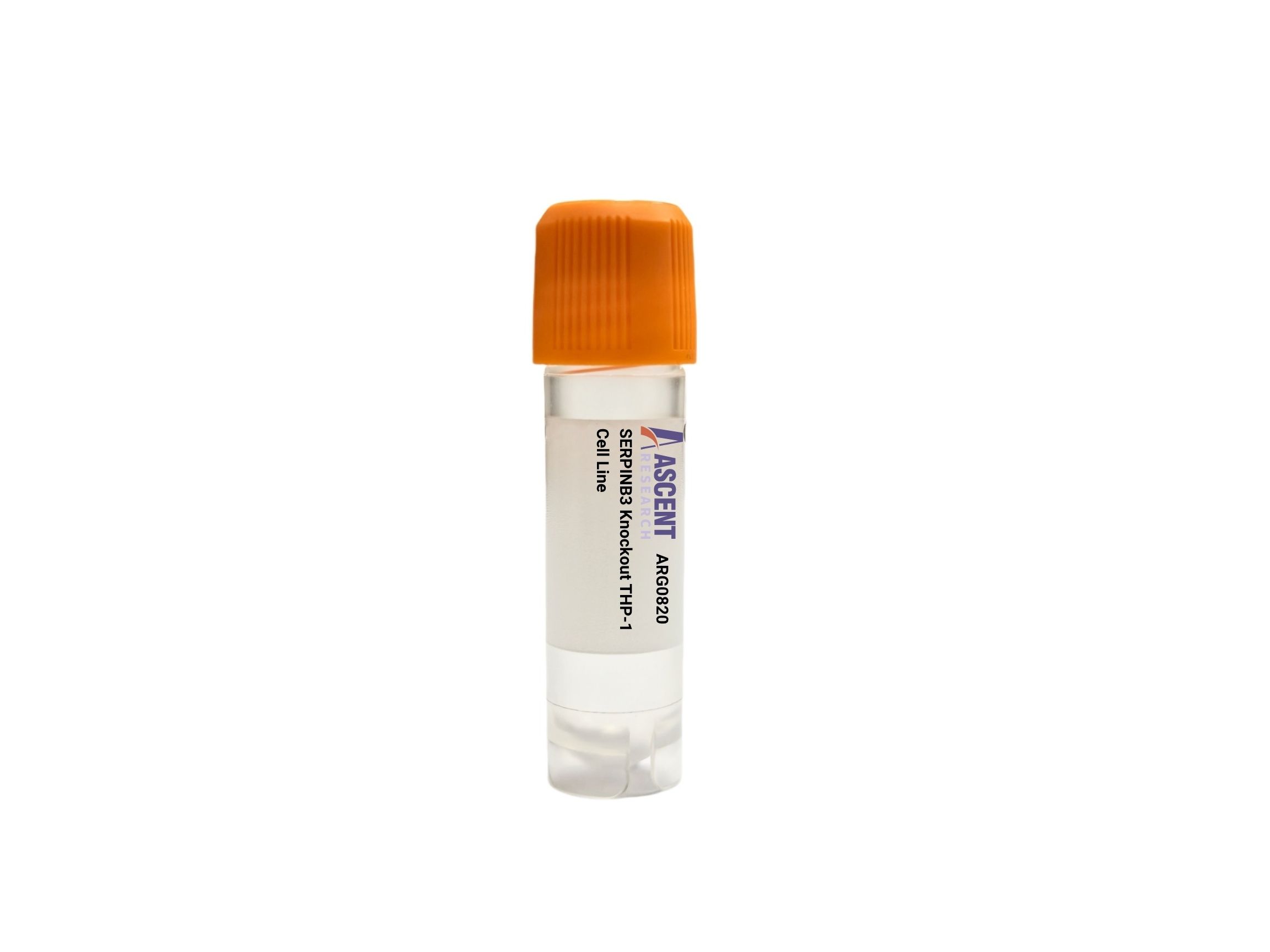
The SERPINB3 Knockout THP-1 Cell Line is a CRISPR/Cas9-edited human monocytic leukemia cell line with targeted disruption of the SERPINB3 gene. SERPINB3 encodes a serine protease inhibitor that cross-inhibits cysteine cathepsins L, K, and S, and is implicated in apoptosis resistance and inflammatory signaling through NF-??B and JNK pathways. This knockout model is valuable for studying monocyte/macrophage differentiation, cathepsin-mediated immune regulation, apoptosis resistance in leukemia, and drug screening. Researchers can employ assays such as Western blotting, cathepsin activity assays, cytokine profiling, and NF-??B reporter assays to explore these processes.
 CTSL Knockout A2780 Polyclonal Cells
Cat. No. ARG18964
OSBPL11 Knockout A2780 Polyclonal Cells
Cat. No. ARG18495
LYAR Knockout Hela Polyclonal Cells
Cat. No. ARG8369
BAIAP2L1 Knockout A2780 Polyclonal Cells
Cat. No. ARG28871
AKT3 Knockout CaSki Polyclonal Cells
Cat. No. ARG35414
ILKAP Knockout HEK293T Polyclonal Cells
Cat. No. ARG37926
CTSL Knockout A2780 Polyclonal Cells
Cat. No. ARG18964
OSBPL11 Knockout A2780 Polyclonal Cells
Cat. No. ARG18495
LYAR Knockout Hela Polyclonal Cells
Cat. No. ARG8369
BAIAP2L1 Knockout A2780 Polyclonal Cells
Cat. No. ARG28871
AKT3 Knockout CaSki Polyclonal Cells
Cat. No. ARG35414
ILKAP Knockout HEK293T Polyclonal Cells
Cat. No. ARG37926
The SERPINB3 Knockout THP-1 Cell Line is a CRISPR/Cas9-edited knockout cell line derived from the THP-1 human monocytic leukemia cell line, with targeted disruption of the SERPINB3 gene. This loss-of-function model facilitates precise dissection of SERPINB3 functions in protease inhibition, apoptosis, and inflammatory signaling.
THP-1 is a spontaneously immortalized human monocytic leukemia cell line from an infant with acute monocytic leukemia. It is a standard model for monocyte and macrophage biology, immune responses, and leukemia, capable of phorbol ester-induced differentiation into macrophage-like cells for studying innate immunity and cytokine production.
SERPINB3 (SCCA1) is a serine protease inhibitor that cross-inhibits cysteine cathepsins L, K, and S, protecting cells from lysosomal protease-induced apoptosis. Its expression is regulated by TNF-??, IL-6, EGF, TGF-??1, NF-??B, STAT3, and HIF-1??. Downstream, SERPINB3 suppresses Bid cleavage and caspase-3/7 activation, and modulates NF-??B and JNK signaling. It interacts with cathepsins and Jab1/CSN5. Knockout of SERPINB3 in THP-1 cells ablates cathepsin inhibition, resulting in elevated lysosomal activity, enhanced apoptosis, and perturbed inflammatory responses, with dysregulation of pathway mediators including IKK, Bcl-2, PI3K, Akt, MMP2, and MMP9.
In THP-1 monocytic leukemia cells, SERPINB3 knockout eliminates a critical safeguard against cathepsin-mediated apoptosis and alters NF-??B-dependent survival signaling. This sensitizes cells to death and disrupts immune regulatory circuits, making the model invaluable for dissecting apoptosis resistance in leukemia, exploring macrophage-mediated immune evasion, and examining crosstalk between lysosomal proteolysis and inflammatory pathways.
This cell line supports diverse research applications, including studies of monocyte/macrophage differentiation, cathepsin-mediated immune regulation, apoptosis resistance in leukemia, and drug screening for SERPINB3 pathway inhibitors. It is also applicable to tumor microenvironment modeling and inflammatory disease research. Standard assays include Western blotting, RT-qPCR, flow cytometry for apoptosis (annexin V/PI), cathepsin activity assays, cytokine profiling (ELISA), NF-??B reporter assays, and Transwell migration/invasion assays. For additional information, please contact Ascent Research.