Genome-edited Cells
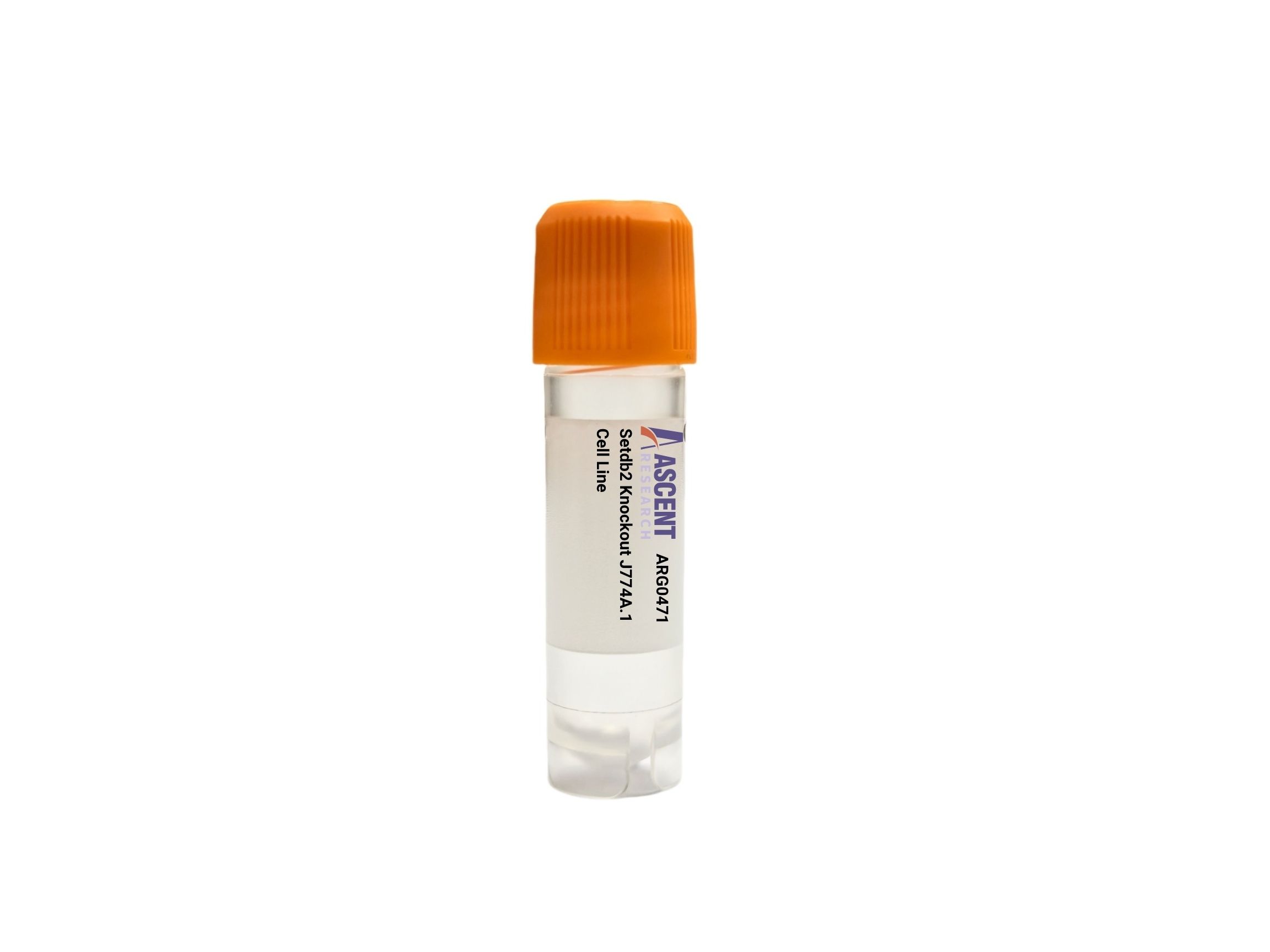
The Setdb2 Knockout J774A.1 Cell Line is a CRISPR/Cas9-edited macrophage cell line lacking functional Setdb2, a histone methyltransferase that deposits the repressive H3K9me3 mark to resolve inflammation. Derived from the BALB/c J774A.1 line, this model enables study of epigenetic control of innate immunity. Setdb2 is induced by interferons and interacts with ATF7IP and TRIM28 to silence proinflammatory genes like TNF and IL-6 via NF-??B pathway modulation. Applications include ChIP-qPCR, cytokine analysis, and NF-??B reporter assays for inflammation, autoimmunity, and cancer research.
 CAMK1 Knockout Hela Polyclonal Cells
Cat. No. ARG23945
ARHGAP12 Knockout Hela Polyclonal Cells
Cat. No. ARG20882
ACTG2 Knockout HEK293T Polyclonal Cells
Cat. No. ARG25593
GTPBP1 Knockout A549 Polyclonal Cells
Cat. No. ARG33611
CD55 Knockout SK-HEP-1 Polyclonal Cells
Cat. No. ARG43655
NECAP1 Knockout 786-O Polyclonal Cells
Cat. No. ARG5609
CAMK1 Knockout Hela Polyclonal Cells
Cat. No. ARG23945
ARHGAP12 Knockout Hela Polyclonal Cells
Cat. No. ARG20882
ACTG2 Knockout HEK293T Polyclonal Cells
Cat. No. ARG25593
GTPBP1 Knockout A549 Polyclonal Cells
Cat. No. ARG33611
CD55 Knockout SK-HEP-1 Polyclonal Cells
Cat. No. ARG43655
NECAP1 Knockout 786-O Polyclonal Cells
Cat. No. ARG5609
The Setdb2 Knockout J774A.1 Cell Line is a genetically engineered loss-of-function model generated by CRISPR/Cas9-mediated disruption of the Setdb2 gene in the J774A.1 macrophage background. This knockout cell line serves as a precise tool for investigating the epigenetic mechanisms by which Setdb2 regulates innate immune responses and inflammatory gene expression.
The parental J774A.1 cell line is a BALB/c mouse monocyte/macrophage line originating from a reticulum cell sarcoma. These cells robustly perform macrophage-effector functions, including phagocytosis, antigen presentation, and secretion of proinflammatory cytokines. They are highly responsive to Toll-like receptor (TLR) ligands such as lipopolysaccharide (LPS) and to type I and II interferons, providing a physiologically relevant host for dissecting innate immune signaling cascades.
Setdb2 encodes a histone lysine methyltransferase that specifically catalyzes the trimethylation of histone H3 at lysine 9 (H3K9me3), a repressive chromatin mark associated with transcriptional silencing. Its expression is strongly induced by interferon-gamma (IFN-??) and type I interferons through the JAK-STAT pathway, with STAT1 and IRF7 serving as key upstream transcription factors. Setdb2 forms functional repressive complexes by interacting with ATF7IP, TRIM28, and HDAC1. These complexes are targeted to the promoters of proinflammatory genes such as tumor necrosis factor (TNF), interleukin-6 (IL-6), and interleukin-1beta (IL-1??). By depositing H3K9me3 at these loci, Setdb2 attenuates NF-??B-driven transcription, thereby restraining inflammatory cytokine production and contributing to the resolution of inflammation.
Within the J774A.1 macrophage context, Setdb2 operates as a critical negative-feedback regulator that limits the amplitude and duration of innate immune activation. Disruption of Setdb2 is expected to impair this epigenetic checkpoint, resulting in sustained or exaggerated expression of inflammatory mediators upon TLR or interferon stimulation. This knockout model therefore enables detailed studies of the chromatin-level control mechanisms that govern macrophage polarization, innate immune memory, and the transition from acute to chronic inflammation, all within a well-characterized and experimentally tractable cell system.
The Setdb2 Knockout J774A.1 Cell Line supports a wide array of experimental approaches, including chromatin immunoprecipitation followed by quantitative PCR (ChIP-qPCR) to profile H3K9me3 occupancy, reverse transcription-qPCR (RT-qPCR) and enzyme-linked immunosorbent assay (ELISA) to quantify cytokine transcripts and proteins, and luciferase reporter assays for monitoring NF-??B transcriptional activity. It is particularly suited for research on epigenetic regulation of inflammation, autoimmune disorders, and cancer immunology, where Setdb2-dependent silencing may influence tumor-associated macrophage phenotypes or responses to immunotherapies. For additional product information, please contact Ascent Research.