Genome-edited Cells
Ascites
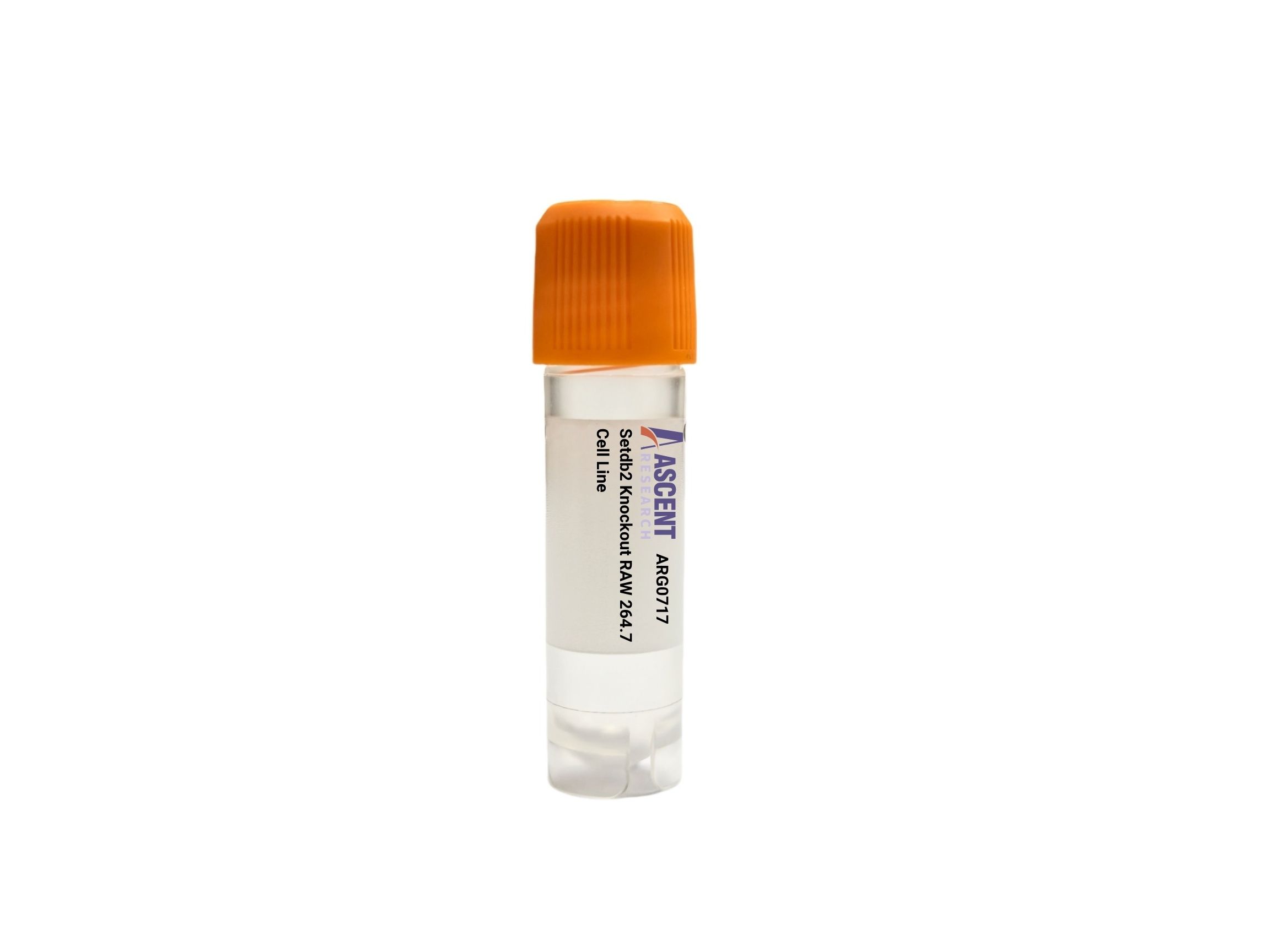
The Setdb2 Knockout RAW 264.7 Cell Line is a CRISPR/Cas9-edited knockout cell line that disrupts the Setdb2 histone methyltransferase in mouse macrophages. Loss of Setdb2 relieves H3K9me3-dependent repression of inflammatory genes, altering NF-??B p65 and interferon signaling, with downstream effects on chemokines such as Cxcl1 and Ccl2. This model is ideal for studying epigenetic regulation in macrophage-driven inflammation, colitis, cancer, and infection. Applications include ChIP-seq, RNA-seq, Western blotting, ELISA, and NF-??B reporter assays.
 FNBP1L Knockout A2780 Polyclonal Cells
Cat. No. ARG18588
OXSR1 Knockout SK-HEP-1 Polyclonal Cells
Cat. No. ARG15297
ADIRF Knockout huh-7 Polyclonal Cells
Cat. No. ARG27816
ALOX5AP Knockout A549 Polyclonal Cells
Cat. No. ARG38710
OASL Knockout AGS Polyclonal Cells
Cat. No. ARG2694
FNBP1L Knockout A2780 Polyclonal Cells
Cat. No. ARG18588
OXSR1 Knockout SK-HEP-1 Polyclonal Cells
Cat. No. ARG15297
ADIRF Knockout huh-7 Polyclonal Cells
Cat. No. ARG27816
ALOX5AP Knockout A549 Polyclonal Cells
Cat. No. ARG38710
OASL Knockout AGS Polyclonal Cells
Cat. No. ARG2694
 YY8103
Cat. No. ARC1028
YY8103
Cat. No. ARC1028
The Setdb2 Knockout RAW 264.7 Cell Line is a CRISPR/Cas9-edited knockout cell line enabling loss-of-function studies of the Setdb2 histone methyltransferase in a macrophage context. Disruption of Setdb2 eliminates its H3K9me3 catalytic activity, providing a clean genetic model to interrogate its role in chromatin-mediated transcriptional repression and innate immune signaling. This cell line facilitates dissection of Setdb2-dependent pathways without pharmacological intervention.
The RAW 264.7 host cell line is an Abelson murine leukemia virus-transformed mouse macrophage line derived from BALB/c mice, widely used as a model for monocyte/macrophage biology. These cells respond robustly to inflammatory stimuli such as lipopolysaccharide and interferons, exhibiting cytokine production, phagocytosis, and polarization, which makes them ideal for investigating NF-??B and interferon signaling. Their genetic tractability supports the creation of knockout derivatives for functional genomics.
Setdb2 encodes a histone-lysine N-methyltransferase that deposits the repressive H3K9me3 mark. It acts as a transcriptional repressor through interactions with TRIM28/KAP1, HP1??, HP1??, and ATF7IP, forming heterochromatin complexes. In macrophages, Setdb2 is activated by IFN-??, IFN-??, NF-??B, and TNF-??, and its downstream targets include Cxcl1, Ccl2, and other NF-??B-dependent inflammatory genes. Knockout of Setdb2 relieves H3K9me3-mediated silencing, leading to chromatin reorganization and altered gene expression profiles.
In RAW 264.7 cells, Setdb2 knockout impairs H3K9me3 deposition, thereby releasing transcriptional constraints on NF-??B p65 and interferon-responsive elements. This results in dysregulated cytokine secretion and shifted macrophage polarization, modeling key aspects of inflammatory diseases such as colitis, cancer, and autoimmune disorders. The model enables precise examination of how histone modifications control macrophage effector functions and pathological inflammation.
This cell line supports a wide range of applications, including Western blotting and immunofluorescence for H3K9me3 analysis, RT-qPCR for target gene quantification, ChIP-seq for genome-wide H3K9me3 profiling, and RNA-seq for transcriptomic characterization. NF-??B reporter assays and ELISA measure signaling and cytokine outputs, while flow cytometry and migration assays assess macrophage phenotype and chemotaxis. These tools make the line valuable for epigenetic and immunological research. For additional information, contact Ascent Research.