Genome-edited Cells
Kidney
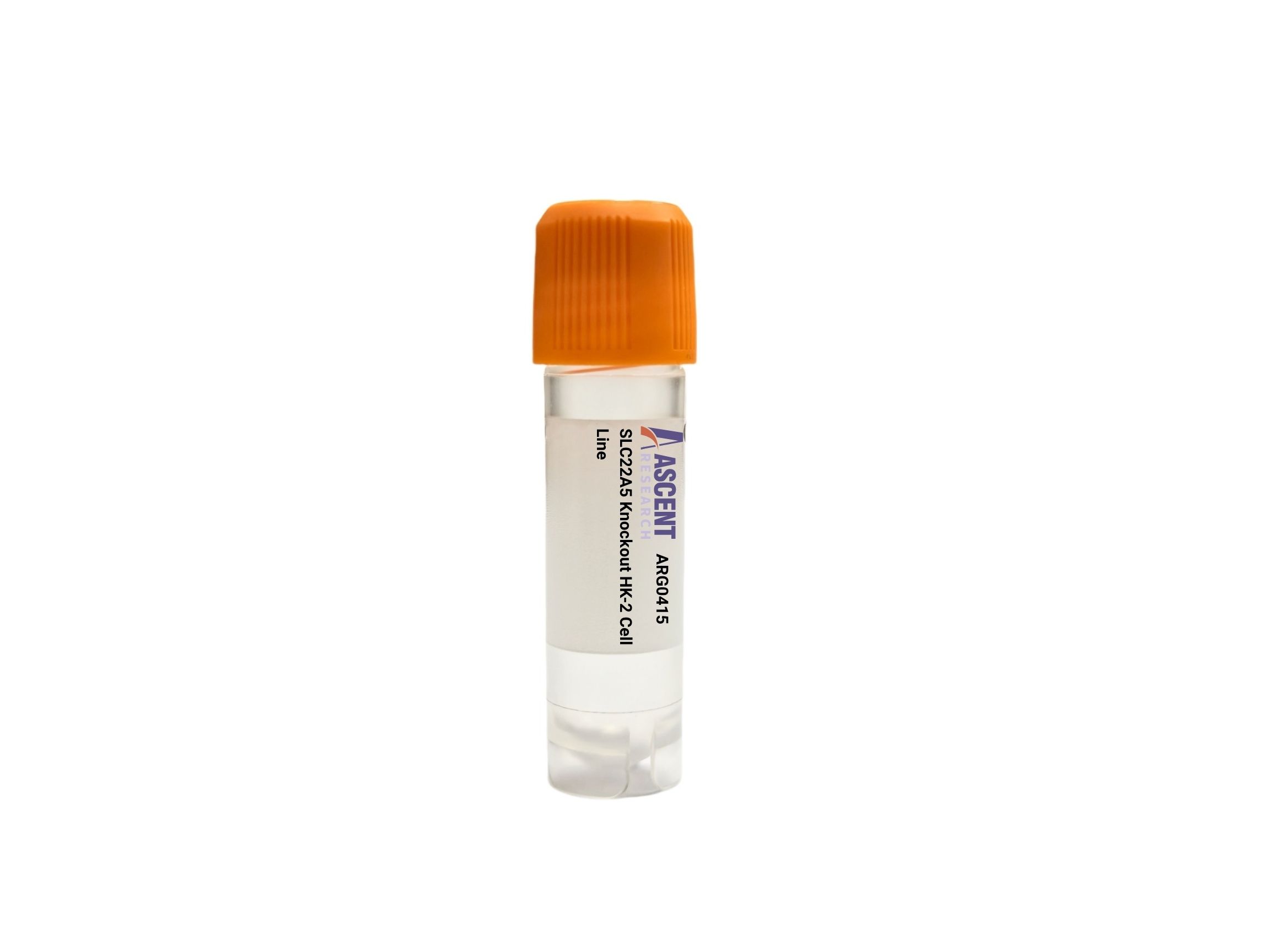
The SLC22A5 Knockout HK-2 Cell Line is a CRISPR/Cas9-edited knockout cell line derived from HK-2 renal proximal tubule cells, featuring disruption of the OCTN2 carnitine transporter. SLC22A5 loss abrogates sodium-dependent carnitine uptake, impairing fatty acid beta-oxidation and mitochondrial energy production. OCTN2 is regulated by PPAR?? and AMPK, and interacts with PDZK1. Applications include radiolabeled carnitine uptake assays, Seahorse metabolic profiling, and drug screening for OCTN2 modulators. This model facilitates research into primary carnitine deficiency, mitochondrial dysfunction, and renal metabolism.
 GRIN2B Knockout HAP1 Polyclonal Cells
Cat. No. ARG22393
BOD1 Knockout SK-HEP-1 Polyclonal Cells
Cat. No. ARG32383
AHSA1 Knockout jurkat Polyclonal Cells
Cat. No. ARG33775
BRD8 Knockout HGC-27 Polyclonal Cells
Cat. No. ARG36118
C4BPA Knockout HT29 Polyclonal Cells
Cat. No. ARG41472
GRIN2B Knockout HAP1 Polyclonal Cells
Cat. No. ARG22393
BOD1 Knockout SK-HEP-1 Polyclonal Cells
Cat. No. ARG32383
AHSA1 Knockout jurkat Polyclonal Cells
Cat. No. ARG33775
BRD8 Knockout HGC-27 Polyclonal Cells
Cat. No. ARG36118
C4BPA Knockout HT29 Polyclonal Cells
Cat. No. ARG41472
 EFE-184
Cat. No. ARC0186
EFE-184
Cat. No. ARC0186
The SLC22A5 Knockout HK-2 Cell Line is a CRISPR/Cas9-edited knockout cell line derived from the human HK-2 renal proximal tubular epithelial cell line. This model features disruption of SLC22A5, which encodes the OCTN2 carnitine transporter, providing a defined loss-of-function system. It is supplied as a stable cell line with verified gene disruption, enabling reproducible studies of carnitine transport and metabolic regulation. Researchers can utilize this line to dissect OCTN2-dependent pathways without the need for pharmacological inhibition.
HK-2 is an immortalized human proximal tubule epithelial cell line that retains key features of its tissue origin, including transporter expression and metabolic activities. These cells are widely employed for renal physiology, drug transport, and toxicology research. The proximal tubule is central to solute reabsorption and secretion, making HK-2 a relevant model for studying renal handling of metabolites. Its human background ensures translational relevance for clinical and pharmacological investigations.
SLC22A5 encodes OCTN2, a sodium-dependent high-affinity carnitine transporter critical for cellular carnitine uptake. OCTN2 mediates the first step in the carnitine shuttle, facilitating mitochondrial beta-oxidation of long-chain fatty acids via CPT1 and CPT2. Its activity is regulated by PPAR??, insulin, AMPK, and HNF4??, and the transporter interacts with sodium ions and the scaffold protein PDZK1. Downstream, SLC22A5 promotes fatty acid oxidation, ATP production, and acetyl-CoA generation. Knockout of SLC22A5 abolishes carnitine influx, impairing fatty acid oxidation and causing lipid accumulation and energy deficiency, mimicking primary carnitine deficiency.
In the renal proximal tubule, OCTN2 is essential for reabsorbing filtered carnitine, maintaining whole-body carnitine pools. Disruption in HK-2 cells provides a model that recapitulates the metabolic consequences of systemic carnitine deficiency, including mitochondrial dysfunction and energetic stress. This line allows dissection of how impaired carnitine transport affects proximal tubule metabolism and contributes to organ-level pathologies such as cardiomyopathy and hypoglycemia. It also enables investigation of the interplay between renal epithelial function and systemic metabolic homeostasis.
This knockout line is suited for radiolabeled carnitine uptake assays, western blot detection of OCTN2, and RT-qPCR confirmation of SLC22A5 disruption. Functional metabolic studies can employ fatty acid oxidation assays using labeled palmitate, ATP quantification, and lipid droplet staining. Seahorse analysis provides real-time metabolic flux data, while transcriptomic profiling reveals downstream gene expression changes. The model is ideal for drug screening to identify OCTN2 modulators or metabolic rescue compounds, and for studying upstream regulators like PPAR?? and AMPK. For inquiries, please contact Ascent Research.