Genome-edited Cells
Uterus (cervix)
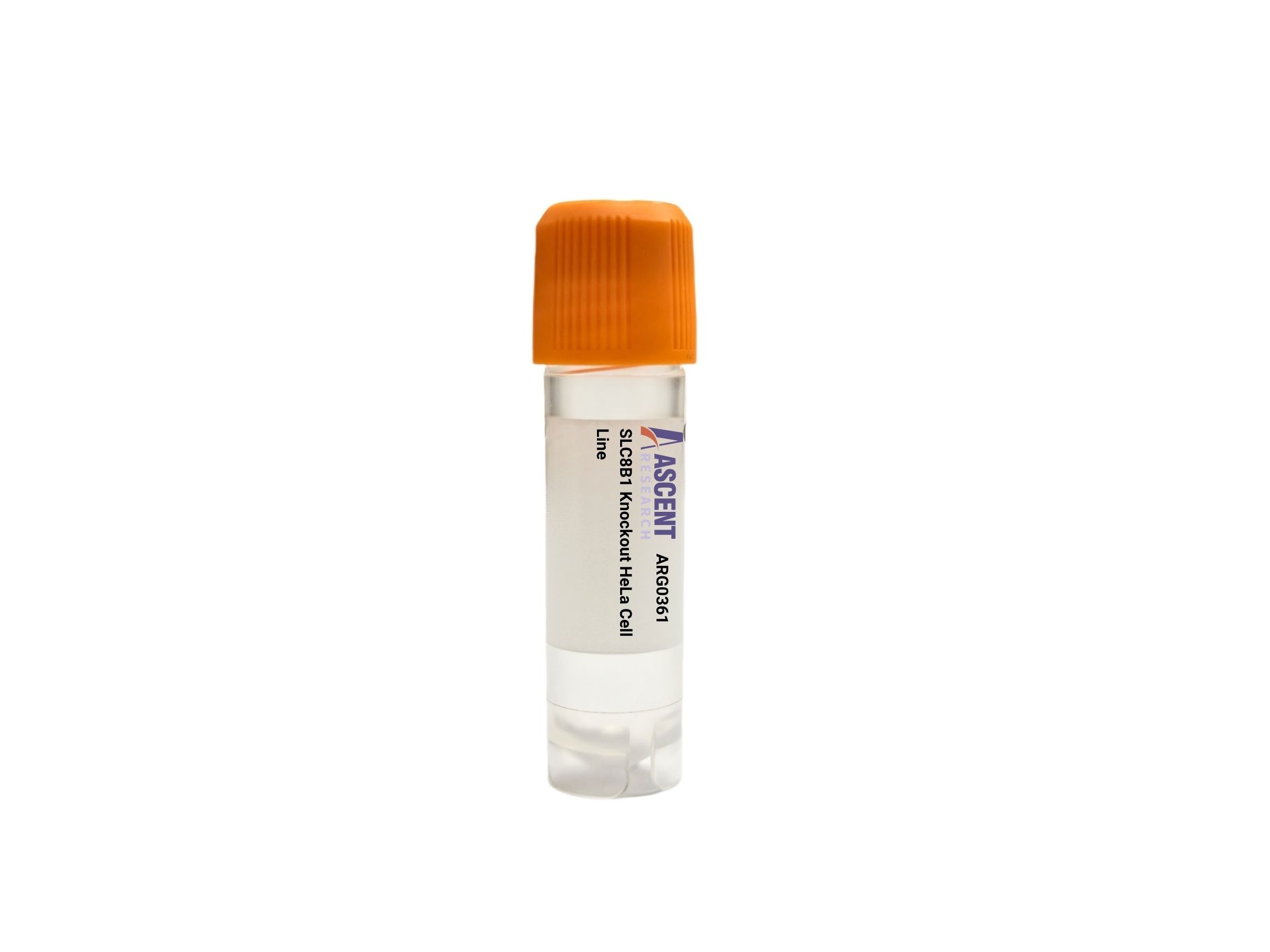
The SLC8B1 Knockout HeLa Cell Line is a CRISPR/Cas9-edited knockout cell line derived from HeLa cervical adenocarcinoma cells, designed to disrupt the mitochondrial sodium/calcium exchanger NCLX. This model impairs mitochondrial calcium efflux, impacting reactive oxygen species production, ATP synthesis, and apoptosis, and is valuable for studying mitochondrial calcium signaling in cardiac, ischemic, and neurodegenerative disorders. Key applications include mitochondrial calcium imaging, Seahorse metabolic flux analysis, and drug screening for calcium modulators. The line permits detailed investigation of calcium-mediated cell death pathways, using assays such as ROS measurement and western blotting for apoptotic markers like cleaved caspase-3.
 CIB2 Knockout Hela Polyclonal Cells
Cat. No. ARG8550
B4GALT7 Knockout HEK293T Polyclonal Cells
Cat. No. ARG25807
AK3 Knockout huh-7 Polyclonal Cells
Cat. No. ARG27850
AZI2 Knockout jurkat Polyclonal Cells
Cat. No. ARG33970
AMPD1 Knockout A549 Polyclonal Cells
Cat. No. ARG38656
EDC3 Knockout jurkat Polyclonal Cells
Cat. No. ARG40443
CIB2 Knockout Hela Polyclonal Cells
Cat. No. ARG8550
B4GALT7 Knockout HEK293T Polyclonal Cells
Cat. No. ARG25807
AK3 Knockout huh-7 Polyclonal Cells
Cat. No. ARG27850
AZI2 Knockout jurkat Polyclonal Cells
Cat. No. ARG33970
AMPD1 Knockout A549 Polyclonal Cells
Cat. No. ARG38656
EDC3 Knockout jurkat Polyclonal Cells
Cat. No. ARG40443
The SLC8B1 Knockout HeLa Cell Line is a CRISPR/Cas9-edited knockout cell line that disrupts the SLC8B1 gene, which encodes the mitochondrial sodium/calcium exchanger NCLX. This loss-of-function model establishes a controlled genetic background for dissecting mitochondrial calcium handling and its implications for cellular physiology. The cell line is provided as a ready-to-use culture, facilitating direct integration into mitochondrial research programs.
The host HeLa line is an immortalized cervical adenocarcinoma cell line positive for human papillomavirus type 18 (HPV18). HeLa cells are extensively utilized in biomedical research owing to their robust proliferation, ease of genetic engineering, and epithelial origin. While the primary utility of this knockout centers on mitochondrial ion transport, the adenocarcinoma background also permits investigations at the intersection of calcium signaling and cancer cell biology.
SLC8B1 (NCLX) operates as the principal mitochondrial sodium/calcium exchanger, mediating the extrusion of calcium from the mitochondrial matrix in exchange for sodium ions. This activity is essential for preventing mitochondrial calcium overload and the consequent opening of the mitochondrial permeability transition pore (mPTP). The transporter is modulated by upstream factors including cytosolic calcium concentration, mitochondrial membrane potential, and cellular ATP levels. Its activity directly impacts downstream mitochondrial calcium dynamics, thereby influencing reactive oxygen species (ROS) generation, ATP synthesis, and the initiation of apoptotic cascades. NCLX functions in coordination with the mitochondrial calcium uniporter (MCU) for calcium uptake and is integrated with voltage-dependent anion channels (VDAC) and IP3 receptors at endoplasmic reticulum?Cmitochondria contact sites.
In HeLa cells, disruption of SLC8B1 abolishes the major route for mitochondrial calcium efflux, leading to pathological mitochondrial calcium accumulation in response to cytosolic calcium elevations. This imbalance perturbs sodium-calcium exchange and impairs metabolic regulation, manifesting as heightened ROS production and an increased propensity for apoptosis. As a result, the model provides a defined system for examining how mitochondrial calcium overload contributes to cell death decisions in epithelial cells, particularly under conditions of oxidative stress or metabolic challenge.
This knockout cell line supports a range of experimental approaches, including real-time mitochondrial calcium imaging with genetically encoded indicators and Seahorse metabolic flux analysis to assess changes in oxidative phosphorylation and glycolysis. It is well-suited for modeling ischemia-reperfusion injury, calcium dysregulation in cardiac arrhythmias, and mitochondrial dysfunction in neurodegeneration. The line also enables high-throughput screening of calcium modulators and detailed apoptosis profiling through western blotting for markers such as cleaved caspase-3 and cytochrome c release. For additional details or technical support, please contact Ascent Research.