Genome-edited Cells
Ascites
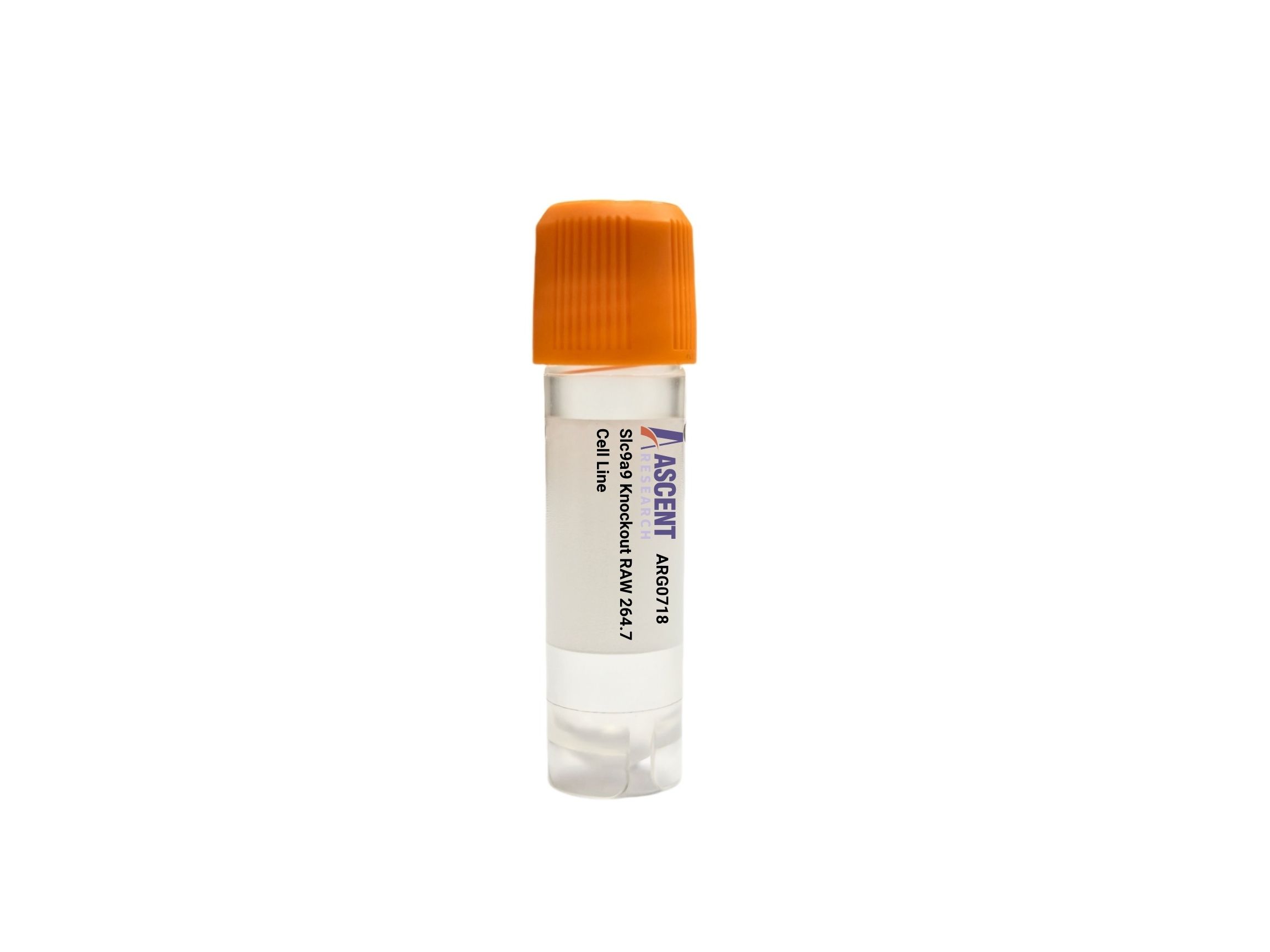
The Slc9a9 Knockout RAW 264.7 Cell Line is a CRISPR/Cas9-edited macrophage model lacking the sodium/hydrogen exchanger NHE9. NHE9 regulates endosomal pH and vesicular trafficking via interactions with calmodulin, NHERF1/2, and the ERM-cytoskeletal network. Knockout in RAW 264.7 cells likely impairs phagocytosis and cytokine secretion due to disrupted endosomal acidification. This tool is suited for studying ion homeostasis in immunity and linking endosomal defects to disorders such as autism and ADHD, with applications in flow cytometry, ELISA, and pH-sensitive dye assays.
 Fem1b Knockout RAW 264.7 Polyclonal Cells
Cat. No. ARG12453
NEK7 Knockout A549 Polyclonal Cells
Cat. No. ARG10393
MRPL48 Knockout HEK293T Polyclonal Cells
Cat. No. ARG3538
Fem1b Knockout RAW 264.7 Polyclonal Cells
Cat. No. ARG12453
NEK7 Knockout A549 Polyclonal Cells
Cat. No. ARG10393
MRPL48 Knockout HEK293T Polyclonal Cells
Cat. No. ARG3538
 UACC-893
Cat. No. ARC0977
UACC-893
Cat. No. ARC0977
 Rabbit Intestinal Microvascular Endothelial Cells
Cat. No. ARP0731
Rabbit Intestinal Microvascular Endothelial Cells
Cat. No. ARP0731
 Rtn4 Knockout AML12 Cell Line
Cat. No. ARG0124
Rtn4 Knockout AML12 Cell Line
Cat. No. ARG0124
The Slc9a9 Knockout RAW 264.7 Cell Line is a CRISPR/Cas9-edited knockout cell line offering stable ablation of the Slc9a9 gene for functional studies. Derived from the RAW 264.7 murine macrophage background, this cell line provides a defined genetic loss-of-function model of the sodium/hydrogen exchanger NHE9. The CRISPR/Cas9-mediated gene disruption ensures consistent knockout across passages, enabling reproducible investigations into endosomal pH regulation and innate immune processes.
RAW 264.7 cells are a widely utilized BALB/c mouse macrophage line, originally transformed by the Abelson murine leukemia virus. They exhibit robust phagocytic activity, secrete diverse inflammatory mediators, and respond to classical activating stimuli such as LPS and IFN-??. The adherent monolayer growth, combined with extensive transcriptomic characterization, makes this line ideal for investigating macrophage signaling and for downstream molecular analyses in gene-edited variants.
The Slc9a9 gene encodes NHE9, a sodium/hydrogen exchanger that localizes to endosomal membranes and regulates luminal pH by exchanging protons for sodium ions. NHE9 activity is modulated by intracellular pH, cAMP, and PKA-dependent phosphorylation, and the exchanger interacts with calmodulin, NHERF1/2 scaffolding proteins, and the ERM family (Ezrin, Radixin, Moesin) to link to the actin cytoskeleton. Through these interactions, NHE9 controls endosomal acidification critical for vesicular trafficking, receptor recycling, and ion homeostasis. Disruption of Slc9a9 is predicted to alter endosomal pH, thereby impacting vesicle dynamics and downstream signaling pathways.
In the macrophage context, Slc9a9 knockout is expected to impair endosomal acidification, leading to compromised phagocytosis, altered cytokine secretion, and disrupted receptor turnover. This cell line thus serves as a model to dissect the role of NHE9-dependent ion homeostasis in innate immune function. Given the involvement of macrophages in neuroinflammation, it also enables exploration of mechanistic links between endosomal trafficking deficits and neurodevelopmental disorders such as autism, ADHD, and epilepsy.
Research applications encompass quantitative phagocytosis assays using flow cytometry, cytokine secretion profiling via ELISA, and pH-sensitive dye measurements to monitor endosomal pH changes. Confirmatory techniques include Western blotting for knockout validation, RT-qPCR for mRNA analysis, immunofluorescence for protein localization, and RNA-seq for transcriptomic profiling. For further information or to discuss custom knockout services, contact Ascent Research.