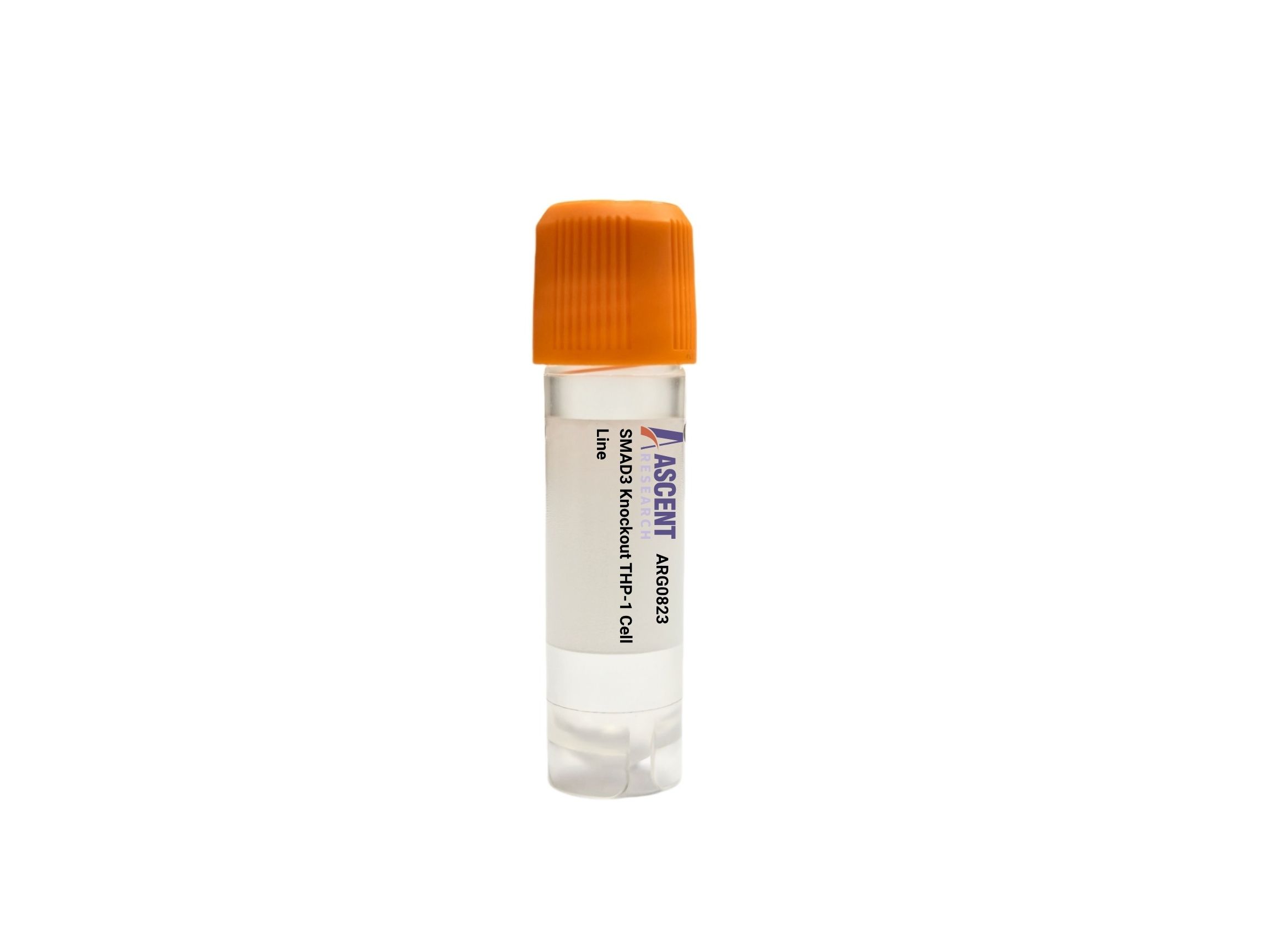
Genome-edited Cells
Blood (peripheral blood)
The SMAD3 Knockout THP-1 Cell Line is a CRISPR/Cas9-edited knockout cell line derived from the THP-1 human monocytic leukemia line, offering a loss-of-function model for studying TGF-?? and activin signaling. By disrupting the SMAD3 gene, this model enables investigation of downstream transcriptional regulation, including targets such as CTGF and SERPINE1, and interactions with SMAD4 and receptor kinases TGFBR1/2. It is a validated platform for exploring monocyte differentiation, macrophage polarization, and cytokine responses, with applications in fibrosis, cancer, and cardiovascular disease research. Typical assays include phospho-SMAD3 detection, luciferase reporters, and flow cytometry.
 ENO2 Knockout A549 Polyclonal Cells
Cat. No. ARG10823
DHRS4 Knockout A549 Polyclonal Cells
Cat. No. ARG10341
ITFG2 Knockout Hela Polyclonal Cells
Cat. No. ARG26287
ACTA1 Knockout 143B Polyclonal Cells
Cat. No. ARG34995
IMPA1 Knockout HAP1 Polyclonal Cells
Cat. No. ARG37081
EHD3 Knockout jurkat Polyclonal Cells
Cat. No. ARG40815
ENO2 Knockout A549 Polyclonal Cells
Cat. No. ARG10823
DHRS4 Knockout A549 Polyclonal Cells
Cat. No. ARG10341
ITFG2 Knockout Hela Polyclonal Cells
Cat. No. ARG26287
ACTA1 Knockout 143B Polyclonal Cells
Cat. No. ARG34995
IMPA1 Knockout HAP1 Polyclonal Cells
Cat. No. ARG37081
EHD3 Knockout jurkat Polyclonal Cells
Cat. No. ARG40815
The SMAD3 Knockout THP-1 Cell Line is a CRISPR/Cas9-edited knockout cell line designed to disrupt the SMAD3 gene in the THP-1 human monocytic leukemia background. This loss-of-function model enables precise dissection of SMAD3-dependent signaling pathways without pharmacological interference. It is suitable for biochemical, molecular, and functional assays, providing a robust tool for TGF-?? and activin signal transduction research.
THP-1 is a human monocytic cell line derived from peripheral blood of an acute monocytic leukemia patient. It serves as a well-established model for studying monocyte-to-macrophage differentiation, macrophage polarization, and inflammatory responses. The knockout derivative retains the parental line??s capacity to differentiate and respond to stimuli while lacking functional SMAD3 protein, allowing direct assessment of gene function in a disease-relevant cellular context.
SMAD3 is a receptor-regulated SMAD that transduces signals from TGF-?? and activin receptors. Ligand binding to TGFBR1 or Activin type I receptors induces phosphorylation of SMAD3, which then forms complexes with SMAD4 and translocates to the nucleus. There, in concert with transcription factors like FOXH1 and coactivators EP300/CREBBP, it regulates transcription of target genes including CTGF, SERPINE1, COL1A1, FN1, and CDKN1A. These effectors control proliferation, extracellular matrix synthesis, and cell cycle arrest. Upstream regulation is provided by TGFB1?C3 and Activin A, while pathway dynamics are modulated by SMAD7.
In the monocyte/macrophage lineage, SMAD3 influences differentiation, inflammatory cytokine production, and responses to fibrotic and tumor microenvironments. Disrupting SMAD3 in THP-1 cells yields a defined model for investigating how TGF-?? signaling governs macrophage polarization and function. This is especially relevant for fibrosis research, where SMAD3 promotes extracellular matrix deposition, and for cancer studies, where it can skew macrophage phenotypes. The line also supports exploration of TGF-??-related pathologies such as Loeys-Dietz syndrome and aortic aneurysm.
Researchers can employ the SMAD3 Knockout THP-1 Cell Line in a variety of assays: TGF-??/activin-stimulable luciferase reporters, phospho-SMAD3 Western blotting, RT-qPCR for target gene expression, flow cytometry for macrophage markers, cytokine secretion profiling, and migration assays. Transcriptome-wide approaches like RNA-seq can complement targeted analyses to reveal global changes upon SMAD3 loss. Applications span monocyte differentiation, macrophage plasticity, fibrotic disease modeling, and cancer signal transduction. For additional information or technical inquiries, contact Ascent Research.