Genome-edited Cells
Connective tissue
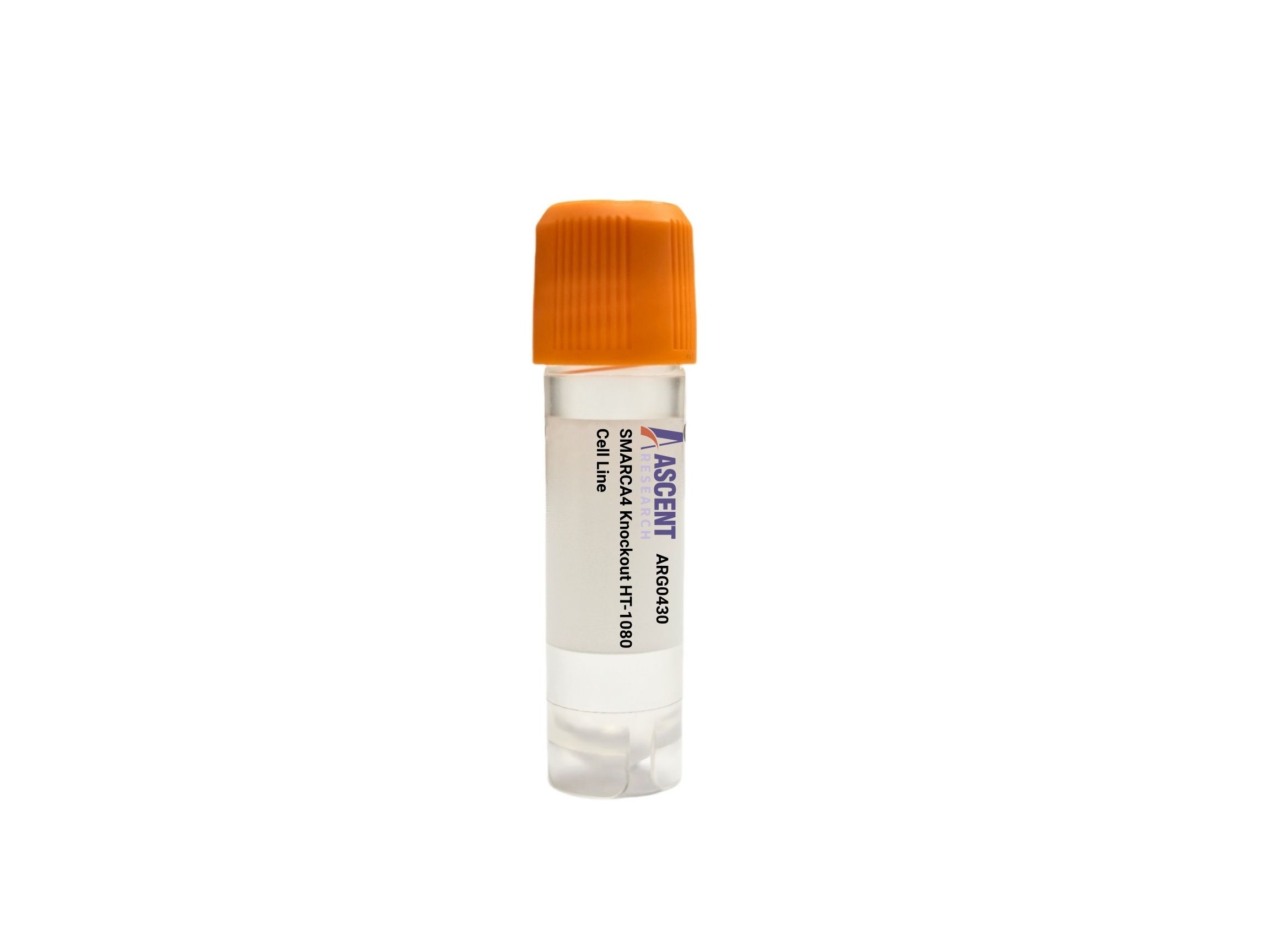
SMARCA4 Knockout HT-1080 Cell Line is a CRISPR/Cas9-edited human fibrosarcoma cell line with disrupted SMARCA4 gene, resulting in loss of the BRG1 ATPase subunit of the SWI/SNF chromatin remodeling complex. BRG1 interacts with BAF155, BAF170, and beta-catenin, and regulates transcription of MYC, CCND1, and VEGF downstream of Wnt and TGF-beta pathways. This model is ideal for studying chromatin remodeling, gene regulation, and tumor invasion in a mesenchymal sarcoma background. Applications include functional genomics, ATAC-seq, RNA-seq, ChIP-qPCR, proliferation and migration assays, drug screening, and synthetic lethality studies. This knockout line provides a powerful tool for investigating SWI/SNF-dependent mechanisms and identifying therapeutic targets in SMARCA4-deficient cancers.
 IFT46 Knockout K562 Polyclonal Cells
Cat. No. ARG20643
NUCB2 Knockout SK-HEP-1 Polyclonal Cells
Cat. No. ARG16222
FAM91A1 Knockout jurkat Polyclonal Cells
Cat. No. ARG12936
LRIF1 Knockout Hela Polyclonal Cells
Cat. No. ARG8791
EIF2A Knockout Hela Polyclonal Cells
Cat. No. ARG40906
CLPB Knockout AGS Polyclonal Cells
Cat. No. ARG2422
IFT46 Knockout K562 Polyclonal Cells
Cat. No. ARG20643
NUCB2 Knockout SK-HEP-1 Polyclonal Cells
Cat. No. ARG16222
FAM91A1 Knockout jurkat Polyclonal Cells
Cat. No. ARG12936
LRIF1 Knockout Hela Polyclonal Cells
Cat. No. ARG8791
EIF2A Knockout Hela Polyclonal Cells
Cat. No. ARG40906
CLPB Knockout AGS Polyclonal Cells
Cat. No. ARG2422
The SMARCA4 Knockout HT-1080 Cell Line is a CRISPR/Cas9-edited knockout cell line with disrupted SMARCA4 gene function, resulting in loss of BRG1 protein. This engineered loss-of-function model derives from human HT-1080 fibrosarcoma cells and enables investigation of SWI/SNF chromatin remodeling. CRISPR/Cas9-mediated gene disruption permanently inactivates target gene function, providing a stable system for downstream applications.
The HT-1080 host cell line is a near-diploid human fibrosarcoma line with fibroblastic morphology, established from a 35-year-old male. Widely used for sarcoma research, it exhibits invasive and metastatic properties, making it a robust model for studying tumor invasion and metastasis. Its well-characterized karyotype and mesenchymal features offer a physiologically relevant background for gene perturbation studies.
SMARCA4 encodes the ATPase BRG1, the core catalytic subunit of the SWI/SNF chromatin remodeling complex, which uses ATP hydrolysis to alter nucleosome positioning and regulate transcription. BRG1 interacts with BAF complex components such as BAF155 (SMARCC1), BAF170 (SMARCC2), BRD7, and ARID1A, and functionally collaborates with transcription factors including beta-catenin, MYC, TP53, and RB1. Upstream, BRG1 activity is regulated by Wnt/beta-catenin, TGF-beta, HIF-1alpha, MAP kinase, and AKT signaling. Downstream, it controls expression of targets like MYC, CCND1, CDKN1A, OCT4, NANOG, and VEGF, impacting cell cycle, differentiation, and angiogenesis. This places SMARCA4 at the nexus of Wnt, TGF-beta, glucocorticoid receptor, and HIF-1 pathways, as well as DNA damage response.
In fibrosarcoma, SMARCA4 can act as tumor suppressor or oncogene. Loss of BRG1 in HT-1080 cells disrupts SWI/SNF-mediated chromatin remodeling, leading to deregulated proliferation, differentiation, and invasion. This knockout model enables dissection of SMARCA4-dependent transcriptional programs, assessment of metastatic behavior, and exploration of sensitivity to therapeutic agents. It also facilitates synthetic lethality studies with chromatin modifiers and DNA repair factors, identifying vulnerabilities in SWI/SNF-deficient tumors.
Typical applications include functional genomics, ATAC-seq for chromatin accessibility, and RNA-seq for transcriptome profiling. The model supports ChIP-qPCR for histone modifications, RT-qPCR and western blotting for target validation, and phenotypic assays such as proliferation, colony formation, and migration/invasion. It is valuable for drug screening to identify compounds with selective activity against SMARCA4-deficient cells. Synthetic lethality screens can uncover new therapeutic strategies for SWI/SNF-mutant cancers. For further technical information, please contact Ascent Research.