Genome-edited Cells
Liver
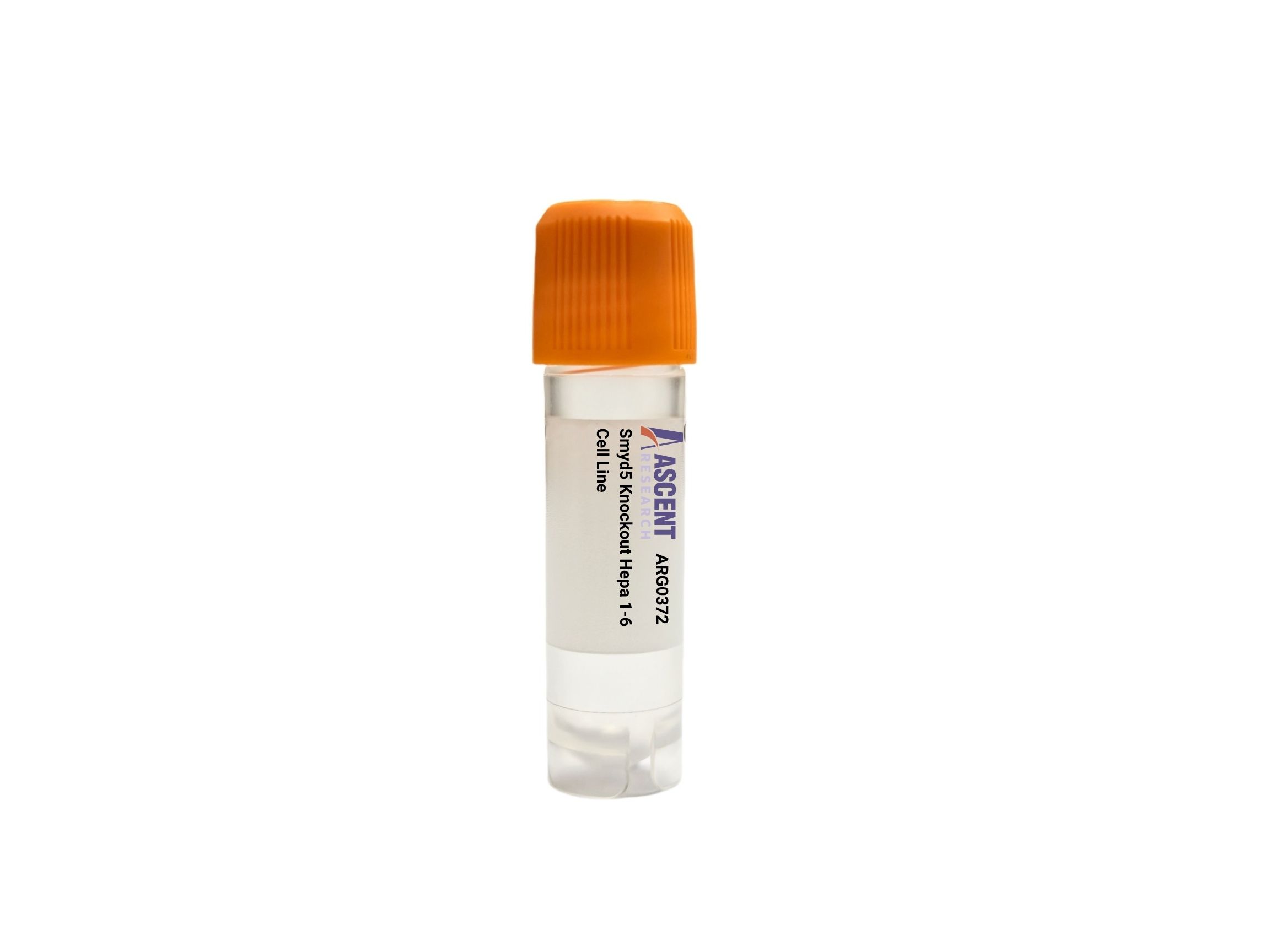
The Smyd5 Knockout Hepa 1-6 Cell Line is a CRISPR/Cas9-edited knockout cell line derived from mouse Hepa 1-6 hepatoma cells, providing a loss-of-function model for the histone methyltransferase Smyd5. Smyd5 trimethylates H3K36me3 to repress target genes like CDKN1A and HEY2, acting as a tumor suppressor via HDAC1/2 complexes and Notch pathway crosstalk. This model is ideal for studying epigenetic regulation in hepatocellular carcinoma, screening Smyd5 modulators, and dissecting histone methylation-dependent tumor suppression using assays such as ChIP-qPCR, colony formation, and xenograft tumor growth.
 GPR174 Knockout HAP1 Polyclonal Cells
Cat. No. ARG22330
BICD2 Knockout SK-HEP-1 Polyclonal Cells
Cat. No. ARG32366
GSK3B Knockout CaSki Polyclonal Cells
Cat. No. ARG35468
CCDC50 Knockout HGC-27 Polyclonal Cells
Cat. No. ARG43023
DNASE1L1 Knockout SK-HEP-1 Polyclonal Cells
Cat. No. ARG39374
GPR174 Knockout HAP1 Polyclonal Cells
Cat. No. ARG22330
BICD2 Knockout SK-HEP-1 Polyclonal Cells
Cat. No. ARG32366
GSK3B Knockout CaSki Polyclonal Cells
Cat. No. ARG35468
CCDC50 Knockout HGC-27 Polyclonal Cells
Cat. No. ARG43023
DNASE1L1 Knockout SK-HEP-1 Polyclonal Cells
Cat. No. ARG39374
 Rat Corneal Epithelial Cell Medium
Cat. No. ARM0385
Rat Corneal Epithelial Cell Medium
Cat. No. ARM0385
The Smyd5 Knockout Hepa 1-6 Cell Line is a CRISPR/Cas9-edited knockout cell line designed to disrupt the Smyd5 gene in the murine Hepa 1-6 hepatoma epithelial cell line. This loss-of-function model enables investigation of Smyd5-dependent epigenetic regulation in a hepatocellular carcinoma context. The knockout is generated through CRISPR/Cas9-mediated gene disruption, resulting in a stable cell line with disrupted Smyd5 expression, suitable for downstream phenotypic and mechanistic analyses.
Hepa 1-6 is a mouse hepatoma epithelial cell line originally derived from a chemically induced tumor in C57L mice. It is widely used as a model for hepatocellular carcinoma, retaining key characteristics of transformed hepatocytes including rapid proliferation and tumorigenic potential. As an established liver cancer model, Hepa 1-6 supports both in vitro and in vivo studies of tumor biology, metastasis, and therapeutic response.
Smyd5 encodes a histone-lysine N-methyltransferase that catalyzes trimethylation of histone H3 at lysine 36 (H3K36me3) at target gene promoters. This epigenetic mark recruits repressive complexes containing HDAC1 and HDAC2, leading to transcriptional silencing of genes such as the cell cycle inhibitor CDKN1A, pro-apoptotic BAX, and Notch effectors HEY2 and ID2. Smyd5 activity is regulated upstream by the NOTCH1 intracellular domain (NICD) and TCF/LEF transcription factors, and it interacts with co-repressors SIN3A and NCOR1. By repressing proliferation and promoting apoptosis, Smyd5 acts as a tumor suppressor in hepatocytes.
In the context of hepatocellular carcinoma, disruption of epigenetic regulators like Smyd5 can drive malignant progression. The Smyd5 Knockout Hepa 1-6 Cell Line provides a precise tool to dissect how loss of H3K36me3-mediated gene repression impacts Notch signaling, chromatin remodeling, and cell fate decisions. This model is particularly valuable for examining crosstalk between histone methylation and transcriptional programs that govern liver cell growth and differentiation.
This knockout line is suited for western blotting of Smyd5 and H3K36me3, RT-qPCR for target gene expression, ChIP-qPCR for H3K36me3 enrichment, and functional assays such as cell viability, apoptosis, colony formation, and xenograft tumor growth. It enables screening of Smyd5 modulators and epigenetic drug discovery targeting histone methyltransferases in liver cancer. For further technical inquiries, please contact Ascent Research.