Genome-edited Cells
Large intestine (colon)
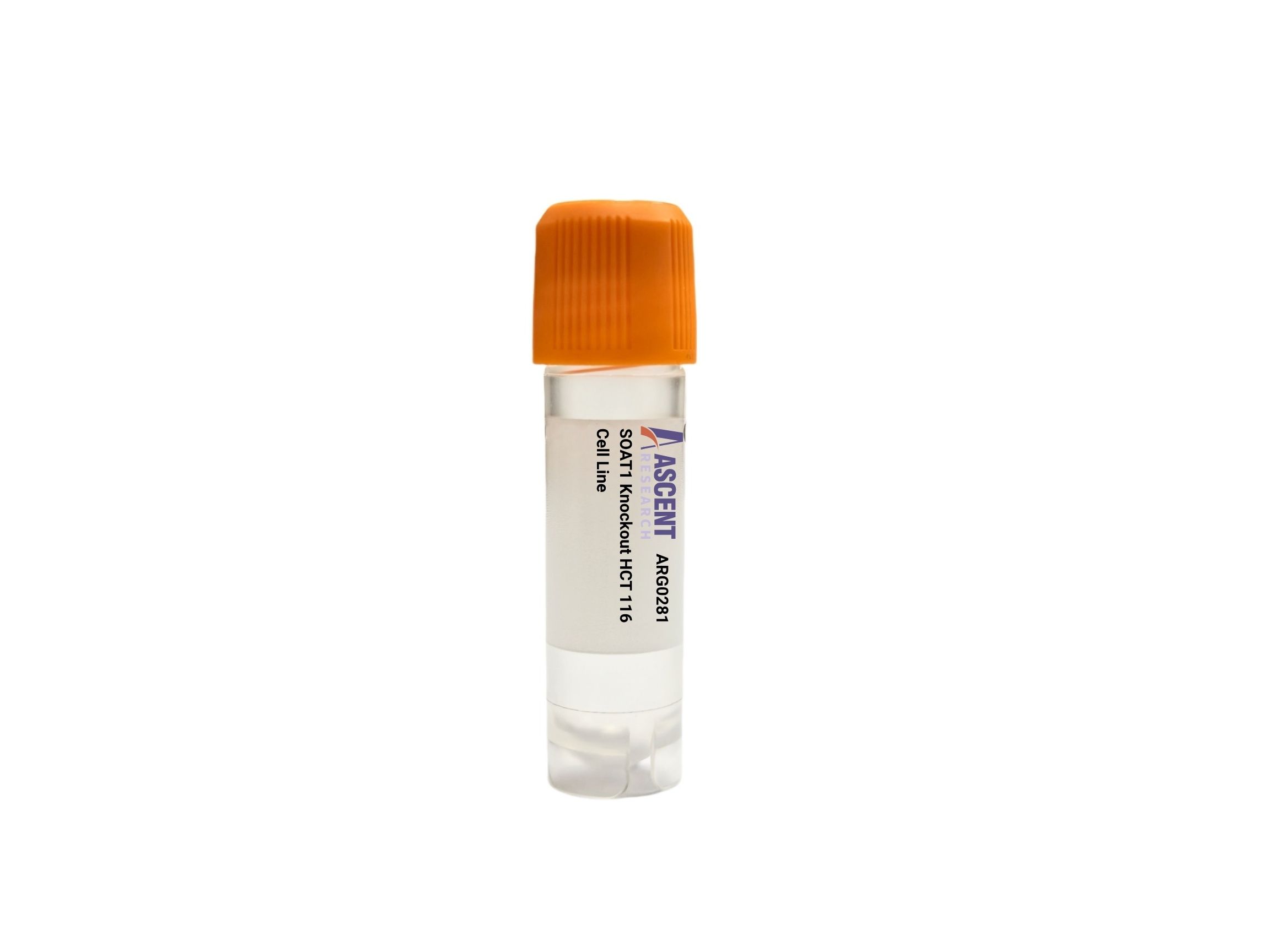
The SOAT1 Knockout HCT 116 Cell Line is a CRISPR/Cas9-edited human colorectal carcinoma model with targeted disruption of SOAT1. SOAT1 encodes sterol O-acyltransferase 1, which esterifies free cholesterol to cholesteryl esters for lipid droplet storage, and is regulated by SREBP-2 and LXR. Knockout abolishes cholesterol esterification, reducing lipid droplets and altering cancer cell proliferation and apoptosis. This cell line suits cancer metabolism studies, drug target validation, and cholesterol pathway analysis. Standard assays include cholesterol esterification assays, Oil Red O staining, cell proliferation and apoptosis readouts, with Western blot and RT-qPCR for molecular confirmation.
 C5orf24 Knockout HT29 Polyclonal Cells
Cat. No. ARG33204
ALOXE3 Knockout HAP1 Polyclonal Cells
Cat. No. ARG21789
KCTD15 Knockout jurkat Polyclonal Cells
Cat. No. ARG34398
AKAP7 Knockout Hela Polyclonal Cells
Cat. No. ARG37265
HSPB7 Knockout HEK293T Polyclonal Cells
Cat. No. ARG38054
PAWR Knockout MES-OV Polyclonal Cells
Cat. No. ARG5926
C5orf24 Knockout HT29 Polyclonal Cells
Cat. No. ARG33204
ALOXE3 Knockout HAP1 Polyclonal Cells
Cat. No. ARG21789
KCTD15 Knockout jurkat Polyclonal Cells
Cat. No. ARG34398
AKAP7 Knockout Hela Polyclonal Cells
Cat. No. ARG37265
HSPB7 Knockout HEK293T Polyclonal Cells
Cat. No. ARG38054
PAWR Knockout MES-OV Polyclonal Cells
Cat. No. ARG5926
The SOAT1 Knockout HCT 116 Cell Line is a CRISPR/Cas9-edited loss-of-function model derived from human HCT 116 colorectal carcinoma cells. By disrupting the SOAT1 gene, this cell line eliminates sterol O-acyltransferase 1 activity, providing a stable platform for studying cholesterol metabolism and colorectal cancer biology without endogenous background interference.
HCT 116 is a human colorectal adenocarcinoma line with microsatellite instability (MSI-H), KRAS G13D and PIK3CA mutations, and wild-type p53. These features make it a key model for colorectal cancer research, including drug screening and signal transduction. Its robust growth and well-characterized genome enable reproducible gene editing and downstream functional assays, establishing it as an optimal host for knockout experiments.
SOAT1 catalyzes the esterification of free cholesterol to cholesteryl esters for storage in lipid droplets, a process critical for cholesterol homeostasis and VLDL secretion. Its expression is transcriptionally regulated by SREBP-2 and LXR in response to sterol levels, and can be modulated by NF-??B and TNF-?? in inflammatory contexts. SOAT1 interacts with ApoB and PLIN2 and works in concert with ACAT2 to promote cholesteryl ester accumulation. These molecular connections position SOAT1 as a central node in lipid droplet biogenesis and cholesterol trafficking.
In the HCT 116 background, SOAT1 knockout blocks cholesterol esterification, leading to diminished lipid droplets and potential cytotoxicity from excess free cholesterol. This metabolic disruption impairs cell proliferation and sensitizes cells to apoptosis, highlighting the enzyme’s relevance to colorectal adenocarcinoma. The model thus permits investigation of how cholesterol storage and lipid droplet dynamics support tumor cell survival and metabolic adaptation.
Researchers can employ this knockout cell line for cancer metabolism studies, drug target validation, and cholesterol pathway analysis. Standard assays include Western blot and RT-qPCR for knockout confirmation, cholesterol esterification activity assays, Oil Red O or fluorescent lipid droplet staining, and cell proliferation or apoptosis assays. These can be integrated with pharmacological perturbation of SREBP-2 or LXR signaling. For technical inquiries, please contact Ascent Research.