Genome-edited Cells
Lung
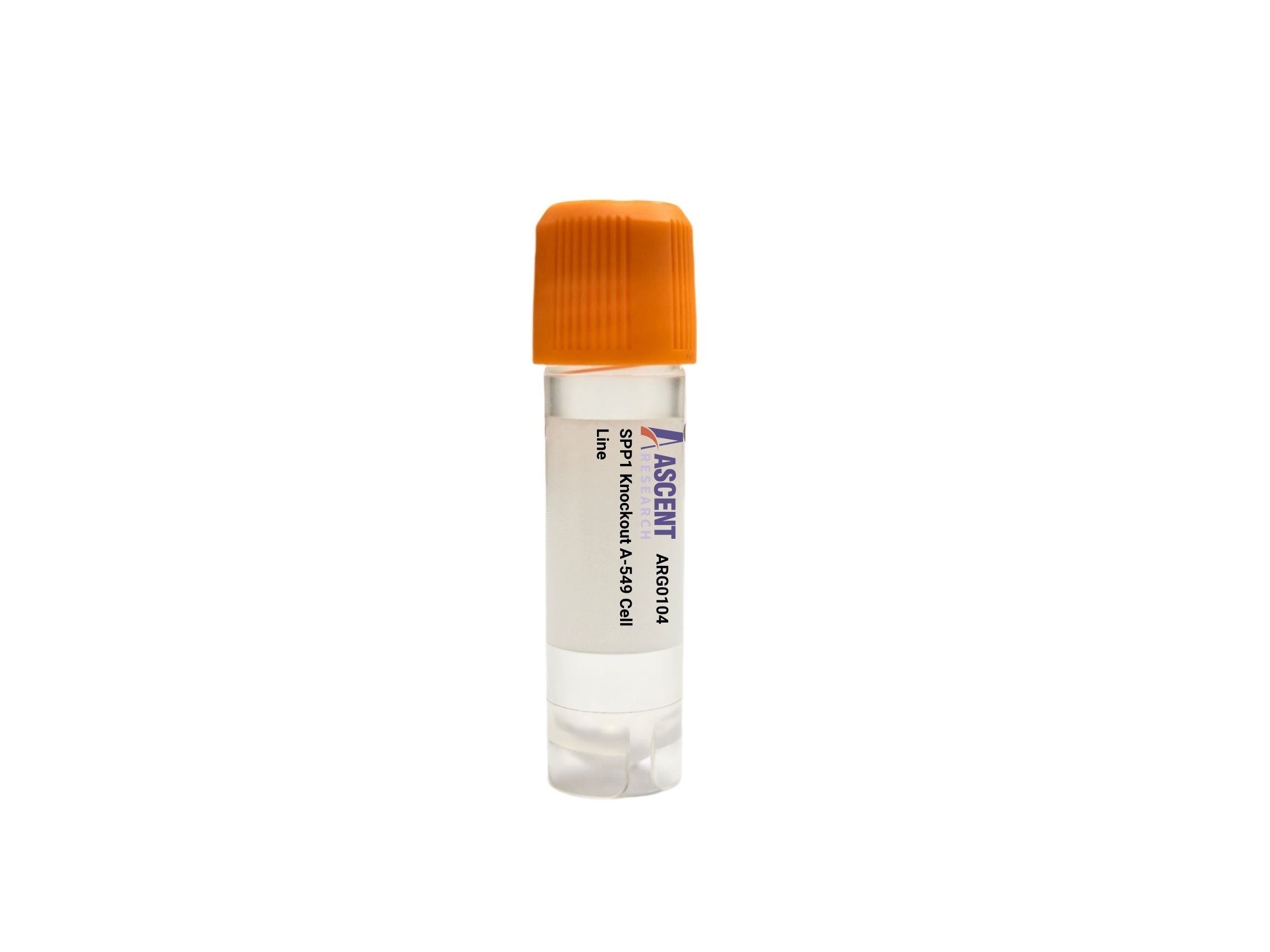
SPP1 Knockout A-549 is a human CRISPR/Cas9-engineered alveolar epithelial adenocarcinoma cell line with disruption of the osteopontin gene, SPP1. In A-549 cells, SPP1 normally functions as a secreted matricellular ligand for CD44 and integrins such as ITGB1-containing complexes, promoting FAK/SRC, PI3K-AKT, MAPK-ERK, and NF-kB signaling linked to adhesion, migration, invasion, inflammation, and extracellular matrix remodeling. This model is useful for lung adenocarcinoma, EMT, and inflammatory signaling studies, including phospho-signaling analysis, ELISA, RT-qPCR, RNA-seq, migration and invasion assays, adhesion assays, and drug response experiments.
 APAF1 Knockout K562 Polyclonal Cells
Cat. No. ARG20145
NFIL3 Knockout A549 Polyclonal Cells
Cat. No. ARG10260
PDZD8 Knockout Hela Polyclonal Cells
Cat. No. ARG8032
AUH Knockout Hela Polyclonal Cells
Cat. No. ARG21056
C2CD5 Knockout HGC-27 Polyclonal Cells
Cat. No. ARG41392
HOXC9 Knockout HAP1 Polyclonal Cells
Cat. No. ARG27572
APAF1 Knockout K562 Polyclonal Cells
Cat. No. ARG20145
NFIL3 Knockout A549 Polyclonal Cells
Cat. No. ARG10260
PDZD8 Knockout Hela Polyclonal Cells
Cat. No. ARG8032
AUH Knockout Hela Polyclonal Cells
Cat. No. ARG21056
C2CD5 Knockout HGC-27 Polyclonal Cells
Cat. No. ARG41392
HOXC9 Knockout HAP1 Polyclonal Cells
Cat. No. ARG27572
The SPP1 Knockout A-549 Cell Line is a human CRISPR/Cas9-engineered cell model in which the SPP1 gene has been disrupted to eliminate functional osteopontin expression. This stable knockout line is generated in A-549 cells, a human alveolar epithelial adenocarcinoma cell line, and provides an in vitro system for interrogating the consequences of SPP1 loss in pulmonary epithelial tumor biology. The model is designed for mechanistic studies of secreted matricellular signaling, extracellular matrix communication, and inflammation-associated phenotypes in a lung-derived epithelial context.
A-549 cells are derived from human lung adenocarcinoma and display alveolar type II epithelial-like characteristics, making them a widely used platform for studying lung cancer biology, epithelial signaling, inflammatory responses, and pharmacologic perturbation. Because this host cell line recapitulates important features of pulmonary epithelial tumor cells, it is frequently used to evaluate growth control, cytokine responsiveness, migration, invasion, and treatment sensitivity. Its established utility in epithelial and tumor signaling studies makes it a relevant background for examining how loss of a secreted extracellular regulator alters cell-intrinsic and matrix-coupled pathways.
SPP1 encodes osteopontin, a secreted phosphoglycoprotein and cytokine-like matricellular ligand that interacts with CD44 and multiple integrin complexes, including integrin alphaVbeta3, alphaVbeta1, and alpha5-containing receptors. SPP1 expression is regulated by TGFB1, TNF, IL1B, IFNG, hypoxia/HIF1A, NF-kB, AP-1, SP1, and ERK1/2 signaling. Once produced, osteopontin acts upstream of ITGB1-FAK and SRC signaling and mediates downstream activation of PI3K-AKT, MAPK1/3, and NFKB1-linked transcriptional programs. These signaling outputs are associated with expression or activation of MMP2, MMP9, VEGFA, and BCL2 family survival pathways, thereby influencing extracellular matrix organization, inflammatory gene expression, adhesion, migration, invasion, and epithelial-mesenchymal transition-associated behavior. Through these mechanisms, SPP1 has broad relevance to lung adenocarcinoma progression, tissue remodeling, fibrosis, and chronic inflammatory lung disease.
In the A-549 background, SPP1 knockout provides a useful model for evaluating how osteopontin-dependent extracellular signaling contributes to epithelial tumor phenotypes. Loss of SPP1 is expected to perturb CD44- and integrin-linked signaling nodes centered on PTK2/FAK, SRC, AKT1, and ERK1/2, enabling investigation of pathway dependency in a host cell line commonly used for lung cancer and inflammatory signaling research. This context is particularly informative for studying matrix-responsive phenotypes, cytokine-induced transcriptional regulation, and mechanisms associated with invasion or remodeling.
The cell line is suited for experimental workflows that compare knockout and control cells using western blotting, RT-qPCR, ELISA for secreted osteopontin, RNA-seq, immunofluorescence, and flow cytometry to assess molecular and phenotypic consequences of SPP1 loss. It can be applied to phospho-FAK, phospho-AKT, and phospho-ERK analyses after stimulation with TGFB1, TNF, IL1B, or hypoxic conditions; to migration, invasion, and adhesion assays examining integrin- and CD44-dependent behavior; and to apoptosis, proliferation, and drug sensitivity studies evaluating survival signaling and therapeutic response. Co-immunoprecipitation and pathway-focused profiling can further support dissection of SPP1-associated networks involving FN1, MMPs, VEGFA, and related extracellular matrix effectors. Researchers may contact Ascent Research for additional technical information, product details, or related gene-edited cell models.