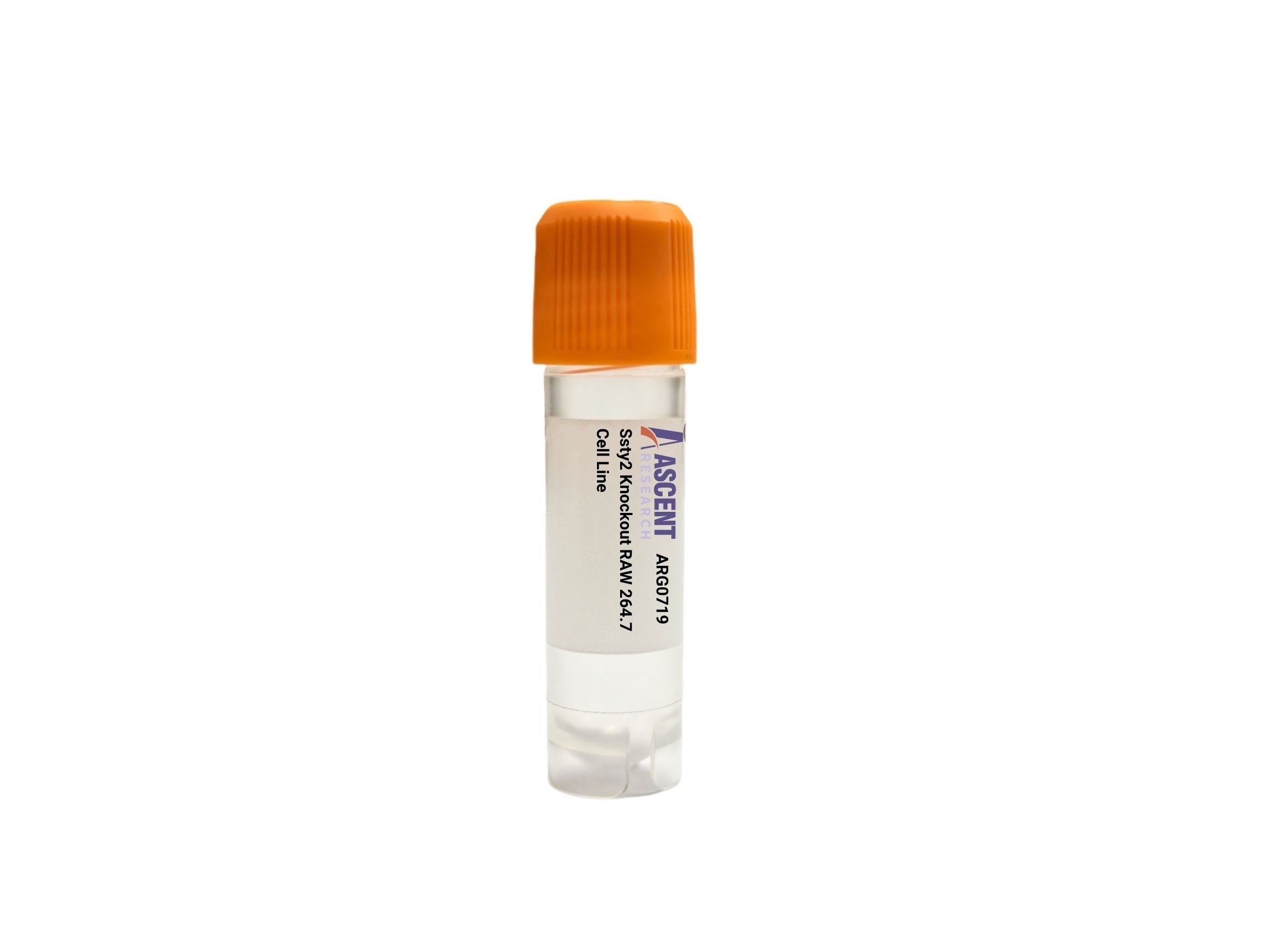
Genome-edited Cells
Ascites
The Ssty2 Knockout RAW 264.7 Cell Line is a CRISPR/Cas9-edited knockout cell line disrupting the Y-linked Ssty2 gene in RAW 264.7 macrophages. Ssty2 encodes a putative RNA-binding protein with a RANBP2-type zinc finger, regulated by testis-specific factors like CREM and DMRT1, and silenced in somatic cells. This model facilitates research into Y chromosome gene expression, epigenetic regulation, and spermatogenesis. The RAW 264.7 macrophage background supports functional studies using phagocytosis assays, cytokine ELISA, and flow cytometry. Applications include Y chromosome gene function, CRISPR knockout controls, and immune-related Y-linked gene studies. Contact Ascent Research for details.
 ARL6IP4 Knockout HAP1 Polyclonal Cells
Cat. No. ARG21901
IL27RA Knockout 786-O Polyclonal Cells
Cat. No. ARG25336
HDAC9 Knockout HAP1 Polyclonal Cells
Cat. No. ARG36966
IRGQ Knockout SKOV3 Polyclonal Cells
Cat. No. ARG36747
FLNA Knockout A549 Polyclonal Cells
Cat. No. ARG10017
LRWD1 Knockout MES-OV Polyclonal Cells
Cat. No. ARG6114
ARL6IP4 Knockout HAP1 Polyclonal Cells
Cat. No. ARG21901
IL27RA Knockout 786-O Polyclonal Cells
Cat. No. ARG25336
HDAC9 Knockout HAP1 Polyclonal Cells
Cat. No. ARG36966
IRGQ Knockout SKOV3 Polyclonal Cells
Cat. No. ARG36747
FLNA Knockout A549 Polyclonal Cells
Cat. No. ARG10017
LRWD1 Knockout MES-OV Polyclonal Cells
Cat. No. ARG6114
The Ssty2 Knockout RAW 264.7 Cell Line is a CRISPR/Cas9-edited knockout cell line disrupting the murine Ssty2 gene in the RAW 264.7 macrophage background. This model offers a loss-of-function system for studying Y chromosome gene expression and epigenetic regulation. Ssty2 encodes a putative RNA-binding protein with a RANBP2-type zinc finger domain, primarily linked to spermatogenesis, making this line useful for male infertility research and broader Y chromosome biology studies. The knockout is achieved through targeted gene disruption, creating a stable resource for cellular and molecular assays.
RAW 264.7 cells are an Abelson murine leukemia virus-transformed macrophage line from BALB/c mice, renowned for robust phagocytosis, antigen presentation, and inflammatory cytokine production. Widely used in innate immunity and macrophage biology studies, these cells provide a well-characterized platform for genetic manipulation, enabling investigation of a Y-linked gene knockout in a somatic cell type where Ssty2 is normally silenced. Their well-characterized signaling pathways facilitate the study of host-pathogen interactions and innate immune responses.
Ssty2 is a Y-linked multicopy gene with a RANBP2-type zinc finger domain, suggesting RNA-binding activity during spermatogenesis. Its expression is regulated by testis-specific transcription factors such as CREM and DMRT1 and is subject to epigenetic silencing in somatic cells. In RAW 264.7 macrophages, where Ssty2 is typically not expressed, this knockout model aids in dissecting Y chromosome gene silencing mechanisms and potential ectopic activation, although downstream targets and interacting partners remain unknown. This model may also facilitate the identification of novel RNA targets and protein interactions.
Despite Ssty2??s normal silencing in somatic cells, its knockout in macrophages provides a unique tool to explore Y chromosome gene regulation outside the germline. This model can be used to study epigenetic reactivation, the functional impact of Y-linked genes in immune cells, and serve as a CRISPR control, contributing to research on sex chromosome gene function in non-reproductive tissues. Additionally, it offers a platform to probe the consequences of Y chromosome gene dosage in immune function.
Researchers can apply this cell line in RT-qPCR, Western blot, and genotyping PCR for knockout validation, RNA-seq for transcript profiling, and functional assays like phagocytosis, cytokine ELISA measuring TNF-?? and IL-6, and flow cytometry to assess macrophage activity. It is ideal for Y chromosome gene function studies, spermatogenesis research, epigenetic regulation analysis, and as a CRISPR/Cas9 knockout control. For further information, please contact Ascent Research.