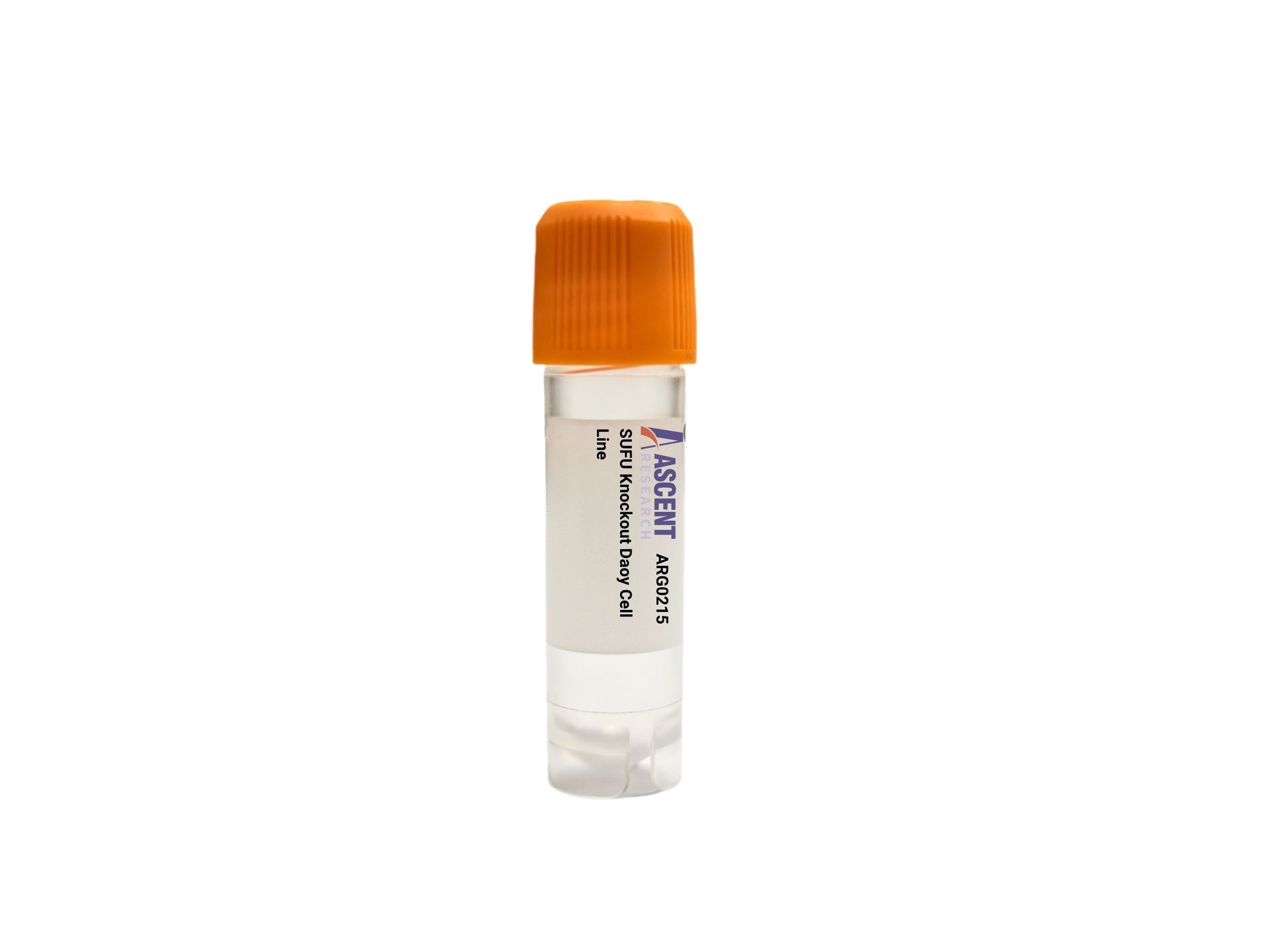
Genome-edited Cells
Brain
The SUFU Knockout Daoy Cell Line is a CRISPR/Cas9-edited knockout cell line derived from the human medulloblastoma cell line Daoy, engineered to disrupt the tumor suppressor SUFU. SUFU is a key negative regulator of Hedgehog signaling, directly binding and inhibiting GLI transcription factors; its loss leads to constitutive pathway activation. This model is highly relevant for studying medulloblastoma, Gorlin syndrome, and other Hedgehog-driven cancers, facilitating investigation of GLI target gene regulation. Applications include drug screening for Hedgehog pathway inhibitors, functional assays such as GLI reporter luciferase and RT-qPCR, and cell proliferation studies. The cell line provides a robust platform for exploring signaling crosstalk with the Wnt pathway and testing SMO inhibitors, enabling advances in cancer biology and targeted therapy development.
 Human Retinal Müller Cells
Cat. No. ARP1198
Human Retinal Müller Cells
Cat. No. ARP1198
 NARF Knockout NCI-H1975 Polyclonal Cells
Cat. No. ARG16790
NHSL1 Knockout HT29 Polyclonal Cells
Cat. No. ARG14494
CDKN1B Knockout jurkat Polyclonal Cells
Cat. No. ARG13522
H2AC14 Knockout HEK293T Polyclonal Cells
Cat. No. ARG38257
NARF Knockout NCI-H1975 Polyclonal Cells
Cat. No. ARG16790
NHSL1 Knockout HT29 Polyclonal Cells
Cat. No. ARG14494
CDKN1B Knockout jurkat Polyclonal Cells
Cat. No. ARG13522
H2AC14 Knockout HEK293T Polyclonal Cells
Cat. No. ARG38257
 MIA paca-2 Luciferase Stable Cell Line
Cat. No. ARG0581
MIA paca-2 Luciferase Stable Cell Line
Cat. No. ARG0581
The SUFU Knockout Daoy Cell Line is a CRISPR/Cas9-edited knockout cell line derived from the human medulloblastoma cell line Daoy, engineered to disrupt the SUFU gene. This loss-of-function model enables the study of SUFU-dependent regulatory mechanisms, particularly within the Hedgehog signaling cascade. The cell line is provided as an adherent culture of epithelial-like cells, offering a consistent and genetically defined platform for investigating tumor suppressor functions.
The Daoy cell line originates from a desmoplastic cerebellar medulloblastoma, representing a widely utilized in vitro model of this malignant pediatric brain tumor. Established from a patient biopsy, these adherent epithelial-like cells retain key molecular features of the original tumor, including active Sonic Hedgehog (SHH) pathway signaling. As a human cell line, Daoy provides a physiologically relevant system for exploring oncogenic mechanisms and evaluating therapeutic interventions in a cellular context that closely mirrors the clinical disease.
SUFU functions as a critical negative regulator of the Hedgehog pathway by physically binding to and inhibiting the GLI family of transcription factors (GLI1, GLI2, GLI3). In the canonical pathway, extracellular Hedgehog ligands (SHH, IHH, DHH) signal through the receptor PTCH1 and the transducer SMO, leading to the dissociation of SUFU from GLI proteins, thereby permitting GLI-mediated transcription. SUFU also interacts with co-repressor complexes containing SAP18, SIN3B, and HDAC1, and is phosphorylated by kinases such as PKA, GSK3??, and CK1, which modulate its stability and activity. Downstream, GLI transcription factors promote expression of target genes including PTCH1, HHIP, CCND1, and MYCN, while SUFU loss results in constitutive GLI activation and uncontrolled transcription of proliferative and anti-apoptotic genes like BCL2. Additionally, crosstalk with the Wnt pathway has been reported, highlighting SUFU??s broader regulatory network.
In the Daoy medulloblastoma background, SUFU deletion is particularly relevant, as hyperactivation of Hedgehog signaling is a hallmark of this tumor type. Loss-of-function mutations in SUFU are implicated in medulloblastoma, Gorlin syndrome, basal cell carcinoma, rhabdomyosarcoma, and prostate cancer. Disruption of SUFU in Daoy cells creates a model that mimics the oncogenic state of constitutive GLI activity, enabling investigation of tumor initiation, maintenance, and progression. This knockout cell line is therefore a powerful tool for dissecting the molecular underpinnings of Hedgehog-driven malignancies and for identifying vulnerabilities that could be exploited therapeutically.
Researchers can utilize the SUFU Knockout Daoy Cell Line for a variety of applications, including cancer research, developmental biology studies, and drug screening for Hedgehog pathway inhibitors. Representative assays include western blotting to assess GLI1 and PTCH1 protein levels, RT-qPCR to quantify Hedgehog target gene expression, and GLI reporter luciferase assays to measure transcriptional activity. The model also supports cell proliferation and apoptosis assays to evaluate the functional consequences of SUFU loss and drug sensitivity studies with SMO inhibitors such as vismodegib. This cell line empowers detailed mechanistic studies and preclinical drug testing. For additional information, please contact Ascent Research.