Genome-edited Cells
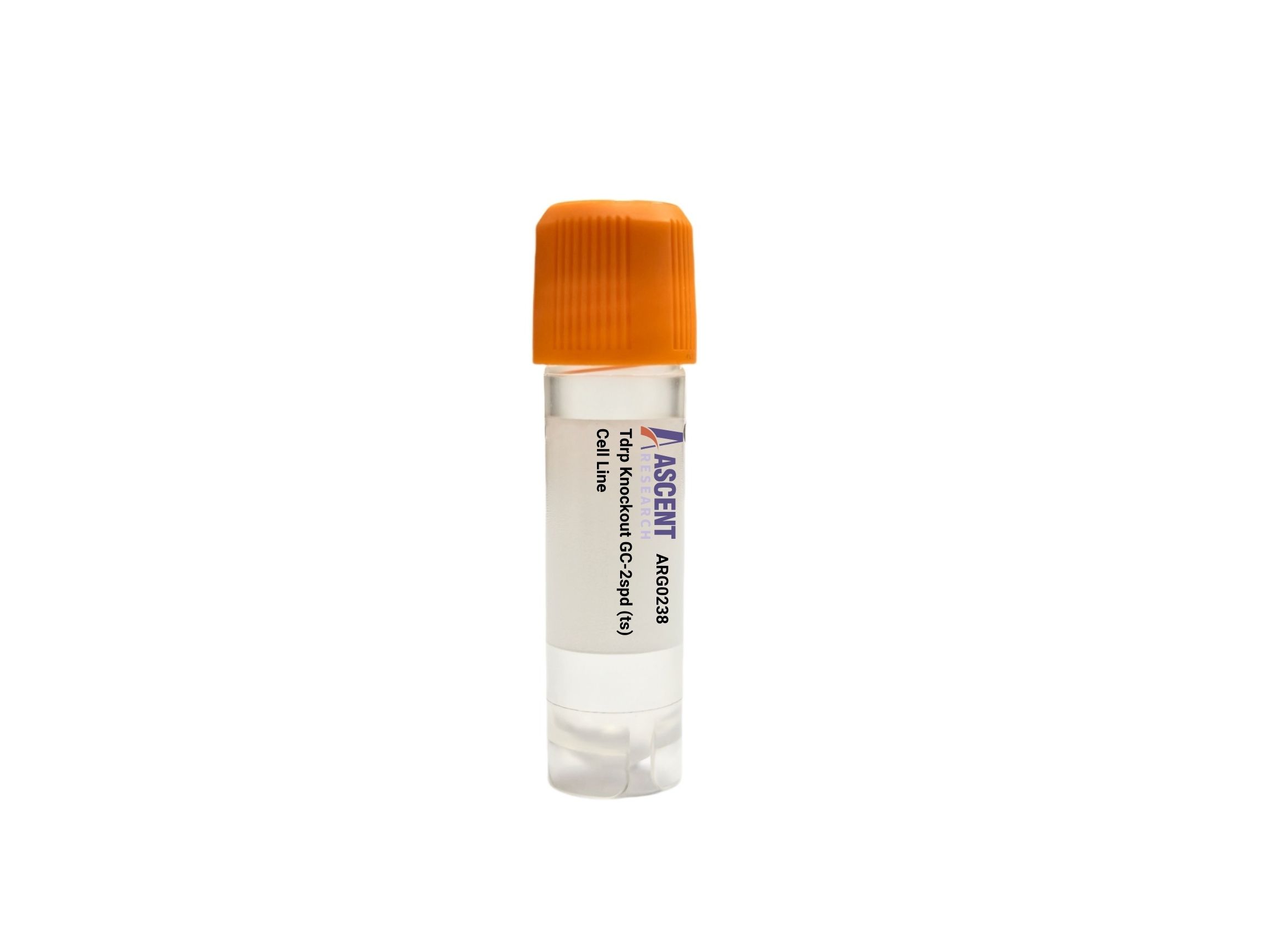
The Tdrp Knockout GC-2spd (ts) Cell Line is a CRISPR/Cas9-edited knockout of the mouse Tdrp gene in the temperature-sensitive GC-2spd(ts) spermatocyte line. It enables loss-of-function studies of TDRP, a Tudor domain protein essential for spermiogenesis and mitochondrial sheath assembly, known to interact with ODF1 and AKAP4. The host cell line differentiates upon temperature shift, providing a controlled in vitro model for sperm tail biogenesis research. Applications include male infertility and asthenozoospermia research, mechanistic studies of spermiogenesis, and mitochondrial organization analysis. The knockout line supports immunofluorescence, co-immunoprecipitation, and differentiation assays, and is suitable for contraceptive drug screening and reproductive toxicology.
 Human Sebocyte Culture Medium
Cat. No. ARM1076
Human Sebocyte Culture Medium
Cat. No. ARM1076
 AAGAB Knockout NCI-H1299 Polyclonal Cells
Cat. No. ARG30167
ELAVL1 Knockout HCT116 Polyclonal Cells
Cat. No. ARG41123
EIF2AK2 Knockout MES-OV Polyclonal Cells
Cat. No. ARG40945
DTNB Knockout AGS Polyclonal Cells
Cat. No. ARG39895
ATG2B Knockout AGS Polyclonal Cells
Cat. No. ARG26685
AAGAB Knockout NCI-H1299 Polyclonal Cells
Cat. No. ARG30167
ELAVL1 Knockout HCT116 Polyclonal Cells
Cat. No. ARG41123
EIF2AK2 Knockout MES-OV Polyclonal Cells
Cat. No. ARG40945
DTNB Knockout AGS Polyclonal Cells
Cat. No. ARG39895
ATG2B Knockout AGS Polyclonal Cells
Cat. No. ARG26685
The Tdrp Knockout GC-2spd (ts) Cell Line is a CRISPR/Cas9-edited knockout cell line for loss-of-function studies of the mouse Tdrp gene. It features targeted disruption in the GC-2spd(ts) mouse spermatocyte cell line, providing an in vitro model for spermatogenesis and male fertility research. The cell line is a stable knockout product for immediate use, generated via CRISPR/Cas9-mediated gene disruption to ablate TDRP expression. This model enables dissection of spermiogenesis and sperm tail development mechanisms.
The host GC-2spd(ts) is an immortalized mouse type B spermatocyte line derived from testis. It exhibits temperature-sensitive growth: proliferation at 32??C, differentiation induced at 37??C or 39??C. This enables controlled studies of meiotic progression, germ cell differentiation, and sperm tail formation. It is a valuable in vitro system for spermatocyte biology and spermiogenesis.
TDRP encodes a Tudor domain-containing protein essential for spermiogenesis, mitochondrial sheath formation, and sperm motility. It localizes to the developing sperm tail, facilitating interactions between outer dense fibers and mitochondrial proteins for proper mitochondrial wrapping around the axoneme. TDRP functions upstream of ODF1 and AKAP4, and is regulated by transcription factors (CREM, RFX2), retinoic acid, and hormonal signals (FSH/testosterone). It interacts with ODF1, AKAP4, and KLC3, and its loss disrupts mitochondrial sheath components, compromising sperm tail integrity.
This knockout line provides a powerful tool within the GC-2spd(ts) model for dissecting TDRP function. Disrupting Tdrp allows study of spermiogenesis and mitochondrial biogenesis during temperature-induced differentiation. It supports time-course studies of sperm tail development, protein complex assembly such as ODF1-AKAP4 interactions, and mitochondrial organization dynamics. The controlled genetic background enables rigorous mechanistic investigation and high-throughput screening.
Typical applications include male infertility research, asthenozoospermia modeling, spermiogenesis mechanistic studies, and contraceptive drug screening. This cell line supports a variety of assays such as Western blot, RT-qPCR, immunofluorescence for mitochondrial sheath markers, flow cytometry for mitochondrial membrane potential, co-immunoprecipitation, temperature-shift differentiation assays, and electron microscopy for ultrastructural analysis. For technical inquiries and ordering, please contact Ascent Research.