Genome-edited Cells
Liver
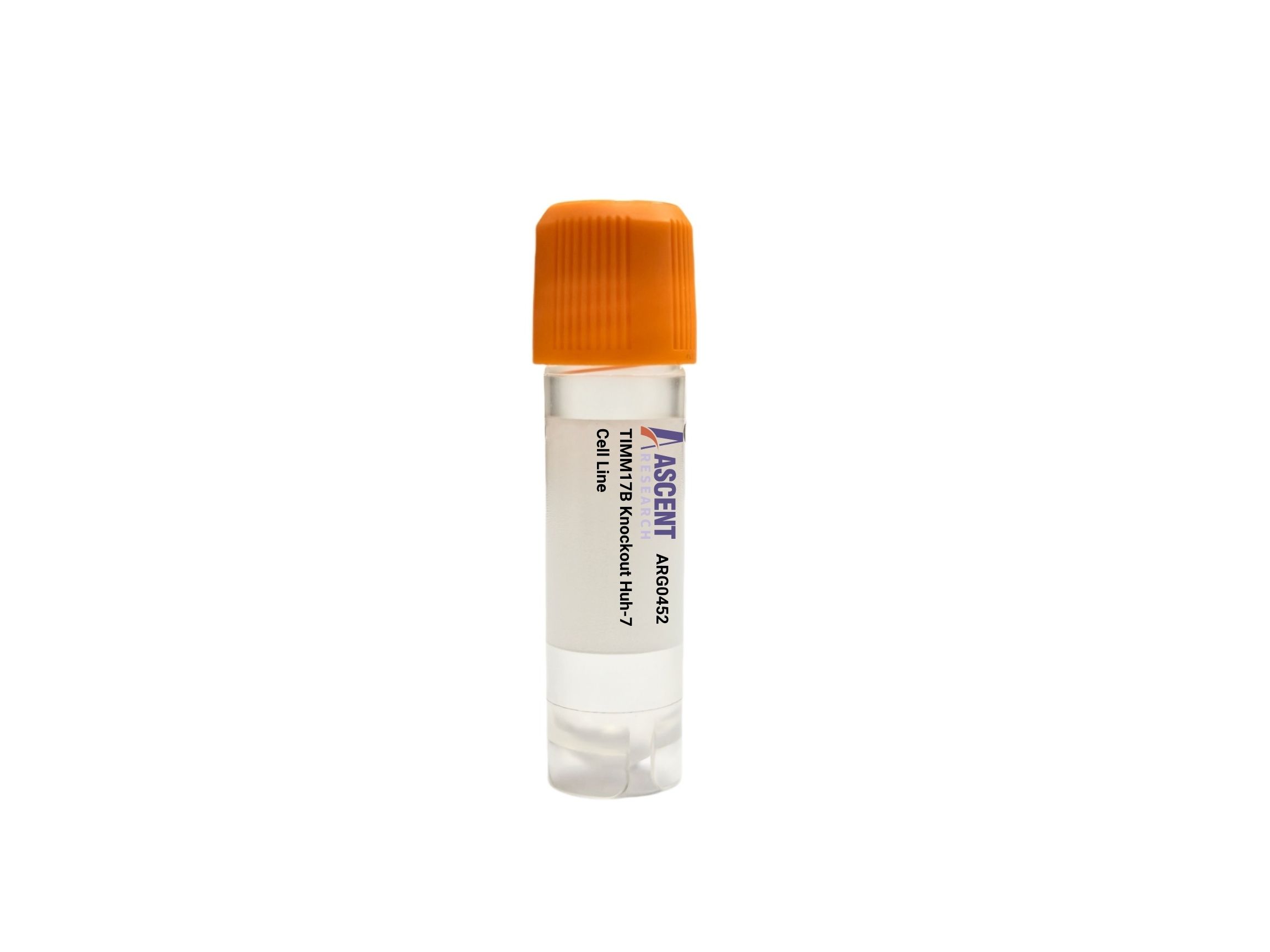
The TIMM17B Knockout Huh-7 Cell Line is a CRISPR/Cas9-edited hepatocellular carcinoma model lacking the core mitochondrial TIM23 translocase subunit TIMM17B. Loss of TIMM17B disrupts mitochondrial protein import, impairing assembly of respiratory chain complexes regulated by PGC-1?? and NRF1, and involving interaction partners such as TIMM23, TIMM44, and mtHSP70. This knockout cell line is applicable for investigating mitochondrial dysfunction in liver cancer, metabolic reprogramming, and antiviral signaling. Typical assays include Western blotting for COXIV and SDHA, Seahorse respirometry, and mitochondrial membrane potential measurement.
 CALD1 Knockout HT29 Polyclonal Cells
Cat. No. ARG33218
CARM1 Knockout HT29 Polyclonal Cells
Cat. No. ARG23305
FBXL18 Knockout jurkat Polyclonal Cells
Cat. No. ARG13136
EBAG9 Knockout A549 Polyclonal Cells
Cat. No. ARG40271
BACE2 Knockout AGS Polyclonal Cells
Cat. No. ARG26719
NLN Knockout MES-OV Polyclonal Cells
Cat. No. ARG6477
CALD1 Knockout HT29 Polyclonal Cells
Cat. No. ARG33218
CARM1 Knockout HT29 Polyclonal Cells
Cat. No. ARG23305
FBXL18 Knockout jurkat Polyclonal Cells
Cat. No. ARG13136
EBAG9 Knockout A549 Polyclonal Cells
Cat. No. ARG40271
BACE2 Knockout AGS Polyclonal Cells
Cat. No. ARG26719
NLN Knockout MES-OV Polyclonal Cells
Cat. No. ARG6477
The TIMM17B Knockout Huh-7 Cell Line is a CRISPR/Cas9-edited knockout cell line derived from human hepatocellular carcinoma, designed for targeted disruption of the TIMM17B gene. TIMM17B encodes a core subunit of the TIM23 inner mitochondrial membrane translocase, and its ablation creates a loss-of-function model to study mitochondrial protein import and associated cellular processes in a liver cancer background.
Huh-7 cells originate from a liver tumor of a 57-year-old Japanese male and maintain liver epithelial cell characteristics, including metabolic and secretory functions. This cell line is widely used for studies of hepatic metabolism, viral hepatitis particularly hepatitis C, and hepatocellular carcinoma, and provides a relevant host environment for examining how mitochondrial dysfunction contributes to liver disease pathogenesis.
At the molecular level, TIMM17B is integral to the TIM23 translocase complex, interacting with TIMM23, TIMM17A, TIMM44, TIMM50, TIM21, ROMO1, and the PAM motor components including mtHSP70. This complex imports nuclear-encoded presequence-containing preproteins into the mitochondrial matrix and inner membrane. TIMM17B expression is regulated by transcription factors PGC-1?? and NRF1, and is responsive to mitochondrial stress and heat shock signals. Its activity is essential for importing respiratory chain complex subunits I?CV, mitochondrial DNA replication factors, and quality control enzymes, thereby directly linking nuclear gene expression to oxidative phosphorylation and mitochondrial biogenesis.
In the Huh-7 context, TIMM17B knockout disrupts mitochondrial protein import, leading to accumulation of precursor proteins, defective assembly of respiratory chain complexes, and impaired oxidative phosphorylation. This triggers the mitochondrial unfolded protein response and metabolic reprogramming, phenomena relevant to hepatocellular carcinoma where altered mitochondrial function supports tumor growth and drug resistance. The model additionally permits exploration of how import defects affect MAVS-mediated antiviral signaling and apoptotic thresholds in liver cancer cells.
Representative applications of this cell line include analyzing mitochondrial protein levels by Western blot e.g., COXIV, SDHA, measuring bioenergetic profiles via Seahorse respirometry, and assessing mitochondrial membrane potential with fluorescent dyes and flow cytometry. Co-immunoprecipitation of TIM23 complex components can reveal translocase integrity following TIMM17B loss, while galactose stress assays probe dependence on mitochondrial ATP production. This knockout model is suitable for drug-induced hepatotoxicity screens, metabolic vulnerability studies, and investigations into mitochondrial contributions to liver tumorigenesis. For further details, please contact Ascent Research.