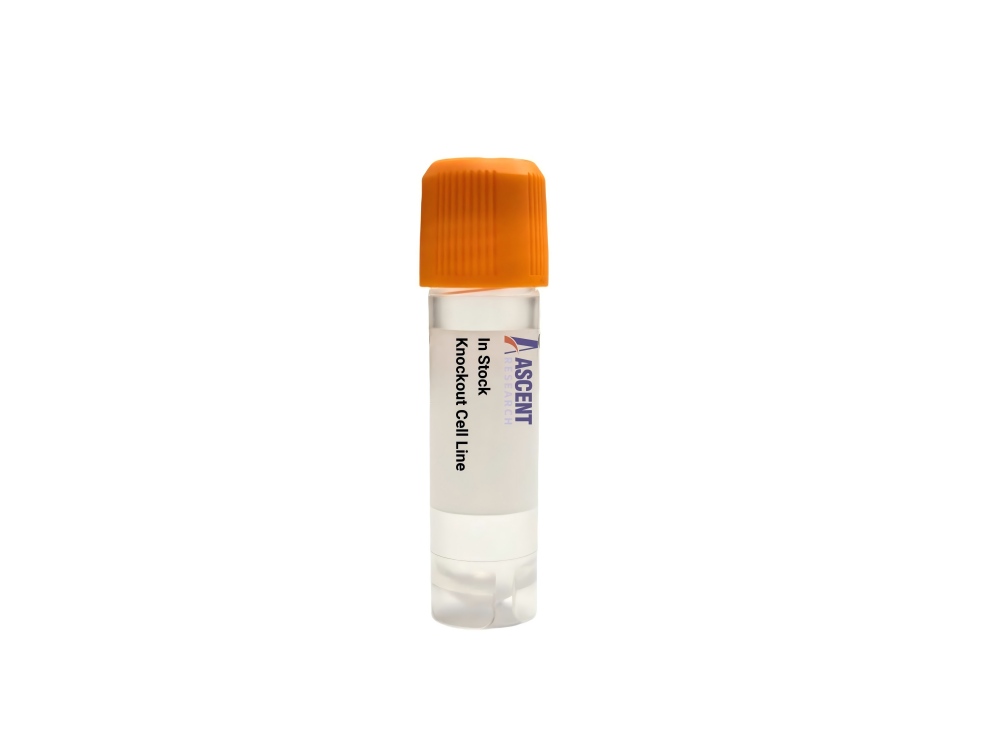
In Stock Cell Lines
Mus musculus (Mouse)
Brain (hippocampus)
Adherent
The Tmem151a Knockout HT22 Cell Line is a CRISPR/Cas9-edited knockout cell line derived from the HT22 mouse hippocampal neuronal cell line, providing a loss-of-function model for the Tmem151a gene. TMEM151A encodes a transmembrane protein implicated in the regulation of neuronal excitability and synaptic transmission, with dysfunction linked to paroxysmal kinesigenic dyskinesia and epilepsy. This knockout model enables investigation of TMEM151A??s role in oxidative stress responses and neuronal hyperexcitability using assays such as glutathione measurement, ROS detection, and patch-clamp electrophysiology. It is suited for mechanistic studies of movement disorders, neuronal signaling, and drug screening applications.
 GULP1 Knockout K562 Polyclonal Cells
Cat. No. ARG20517
KLF3 Knockout AGS Polyclonal Cells
Cat. No. ARG27134
BEND3 Knockout Hela Polyclonal Cells
Cat. No. ARG37403
FOXA1 Knockout CaSki Polyclonal Cells
Cat. No. ARG9854
MON2 Knockout MES-OV Polyclonal Cells
Cat. No. ARG6843
GULP1 Knockout K562 Polyclonal Cells
Cat. No. ARG20517
KLF3 Knockout AGS Polyclonal Cells
Cat. No. ARG27134
BEND3 Knockout Hela Polyclonal Cells
Cat. No. ARG37403
FOXA1 Knockout CaSki Polyclonal Cells
Cat. No. ARG9854
MON2 Knockout MES-OV Polyclonal Cells
Cat. No. ARG6843
 MCF-7 Luciferase Stable Cell Line
Cat. No. ARG0540
MCF-7 Luciferase Stable Cell Line
Cat. No. ARG0540
The Tmem151a Knockout HT22 Cell Line is a CRISPR/Cas9-edited knockout cell line derived from the HT22 mouse hippocampal neuronal cell line. This product provides a loss-of-function model for the Tmem151a gene, which encodes transmembrane protein 151A. Gene disruption is achieved through CRISPR/Cas9-mediated targeting, eliminating functional TMEM151A expression and enabling investigation of its role in neuronal physiology.
HT22 cells are an immortalized mouse hippocampal neuronal cell line that originated as a subclone of HT4 hippocampal cells. This line is widely used to study oxidative stress-induced neurotoxicity because it is exquisitely sensitive to glutamate-induced oxidative toxicity via inhibition of the cystine/glutamate antiporter system xc?, leading to glutathione depletion and a consequent increase in reactive oxygen species. Consequently, HT22 cells serve as a robust model for examining neuronal cell death mechanisms and neuroprotective strategies.
TMEM151A is a transmembrane protein whose precise molecular interactions remain incompletely defined. Evidence implicates it in regulating neuronal excitability and synaptic transmission, potentially through interactions with ion channels or synaptic proteins. Dysfunction of TMEM151A is linked to hyperkinetic movement disorders, notably paroxysmal kinesigenic dyskinesia and certain forms of epilepsy. While upstream regulators, downstream effectors, and specific binding partners are not yet identified, TMEM151A is thought to participate in pathways governing neuronal excitability and synaptic vesicle cycling.
By knocking out Tmem151a in HT22 cells, researchers can dissect the protein??s contribution to oxidative stress responses and neuronal excitability within a neuronal context. This model is particularly valuable for exploring how the loss of TMEM151A affects susceptibility to oxidative damage and for deciphering any crosstalk between TMEM151A-mediated signaling and the glutathione-dependent antioxidant defense system. Because HT22 cells serve as a well-established proxy for hippocampal neuronal physiology, the knockout line permits detailed interrogation of TMEM151A??s role in modulating ion homeostasis and synaptic function. Moreover, it provides a physiologically relevant platform to investigate the cellular pathophysiology underlying paroxysmal dyskinesia and epilepsy.
The Tmem151a Knockout HT22 Cell Line supports diverse experimental workflows, including cell viability assays (MTT, LDH release) under oxidative challenge, quantification of glutathione levels and reactive oxygen species, patch-clamp electrophysiology to assess neuronal firing properties, and molecular analyses such as western blotting and RT-qPCR. These applications enable mechanistic studies of neuronal excitability, oxidative stress signaling, and movement disorder research, as well as screening of small molecules targeting TMEM151A-related pathways. For further technical inquiries or protocol details, please contact Ascent Research.