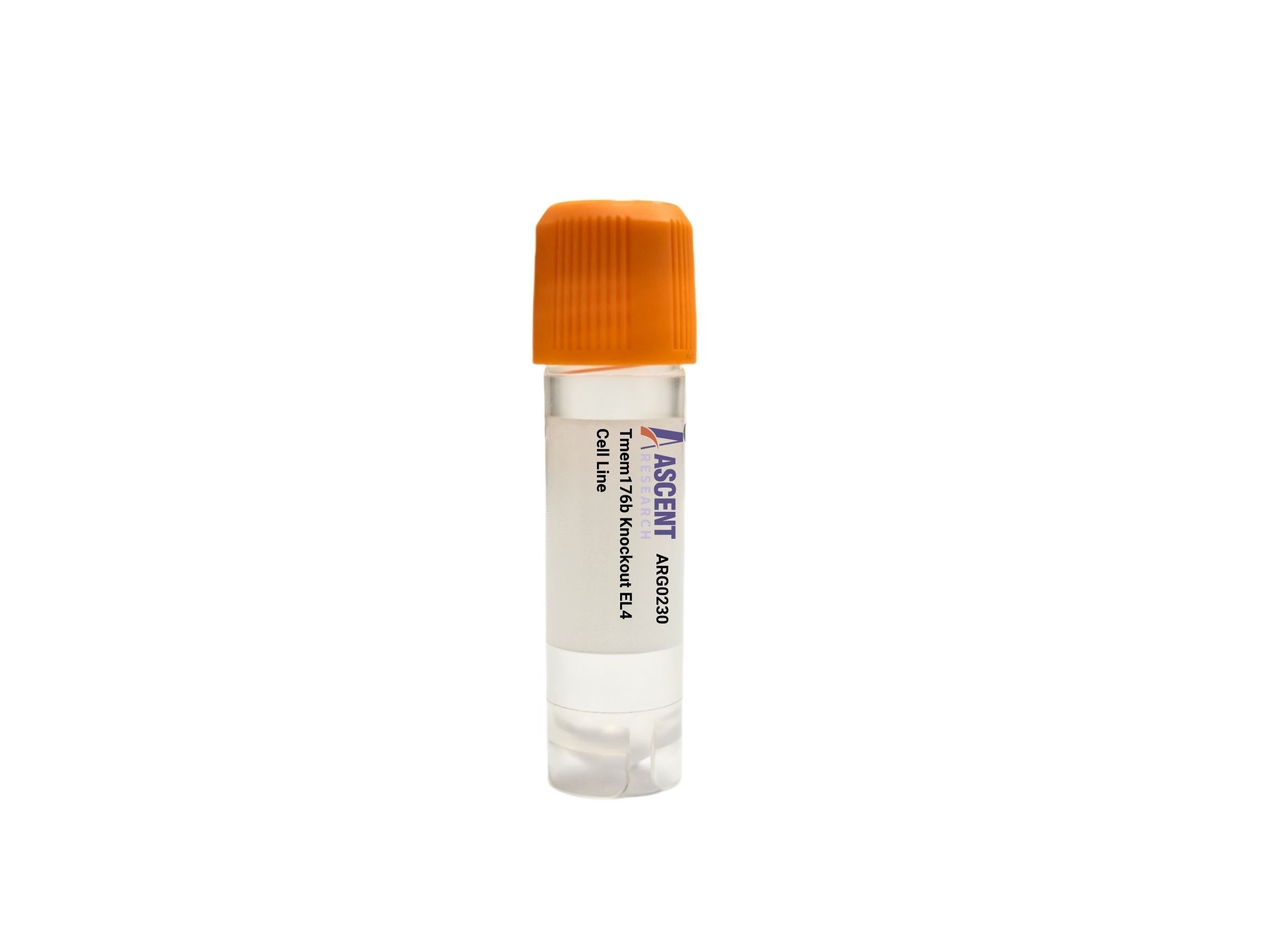
Genome-edited Cells
Ascites
The Tmem176b Knockout EL4 Cell Line is a CRISPR/Cas9-edited mouse T-cell lymphoma line with targeted disruption of the Tmem176b gene, which encodes a modulator of NF-??B signaling and inflammasome activation. Loss of Tmem176b impairs cellular responses to upstream regulators such as TNF-?? and IL-1??, leading to diminished production of downstream targets like IL-6 and IL-12 and altered expression of co-stimulatory molecules CD80/CD86. This model is ideal for investigating T-cell activation, cytokine-mediated signaling, and lymphoma biology. It supports assays including Western blotting, flow cytometry for CD69/CD25, ELISA for IL-2/IL-6, NF-??B reporter analysis, and proliferation studies, facilitating research into autoimmune disease, chronic inflammation, and immune evasion.
 CEACAM7 Knockout SK-Hep-1 Polyclonal Cells
Cat. No. ARG16303
MSL2 Knockout jurkat Polyclonal Cells
Cat. No. ARG12951
CEP170 Knockout Hela Polyclonal Cells
Cat. No. ARG8398
ABHD12 Knockout HAP1 Polyclonal Cells
Cat. No. ARG27153
HDAC1 Knockout UMUC-3 Polyclonal Cells
Cat. No. ARG36922
CPT2 Knockout HEK293T Polyclonal Cells
Cat. No. ARG3847
CEACAM7 Knockout SK-Hep-1 Polyclonal Cells
Cat. No. ARG16303
MSL2 Knockout jurkat Polyclonal Cells
Cat. No. ARG12951
CEP170 Knockout Hela Polyclonal Cells
Cat. No. ARG8398
ABHD12 Knockout HAP1 Polyclonal Cells
Cat. No. ARG27153
HDAC1 Knockout UMUC-3 Polyclonal Cells
Cat. No. ARG36922
CPT2 Knockout HEK293T Polyclonal Cells
Cat. No. ARG3847
The Tmem176b Knockout EL4 Cell Line is a CRISPR/Cas9-mediated gene-disrupted cell line derived from the mouse T-cell lymphoma line EL4. This product provides a stable loss-of-function model for Tmem176b, enabling detailed investigation of its role in immune signaling without the need for transient silencing approaches. The knockout cell line is delivered as a ready-to-use culture, facilitating immediate employment in functional assays and gene perturbation studies relevant to immunology and cancer biology. The gene disruption is achieved through CRISPR/Cas9 technology, ensuring efficient targeting of the Tmem176b locus, though the exact editing pattern is not specified.
The parental EL4 cell line originates from a C57BL/6 mouse and represents a widely used model for T-cell activation, signal transduction, and lymphoma biology. EL4 cells recapitulate key aspects of T-lymphocyte function, including responsiveness to mitogens, cytokine secretion, and surface marker expression changes upon stimulation. Their malignant phenotype also renders them valuable for studying mechanisms of T-cell lymphomagenesis and immune evasion. The introduction of a Tmem176b knockout allows researchers to dissect gene-specific contributions within this well-characterized background, offering a controlled system for comparative analyses.
Tmem176b acts as a modulator of the NF-??B pathway and inflammasome assembly, functions critical for innate and adaptive immunity. The protein is induced by upstream stimuli such as TNF-??, IL-1??, and Toll-like receptor ligands, and it operates at a junction influencing both NF-??B activation and inflammasome component expression. Downstream, it regulates production of cytokines including IL-6 and IL-12, and controls expression of co-stimulatory molecules CD80 and CD86. Tmem176b interacts with MS4A family members and Fc receptor-like proteins, and it affects the assembly of the NLRP3/ASC/caspase-1 complex. Its disruption is known to attenuate NF-??B signaling, dampen inflammatory cytokine output, and impair dendritic cell maturation and T-cell activation.
In the context of EL4 T-lymphoma cells, loss of Tmem176b profoundly alters cellular responses central to immune function and malignant growth. Knockout cells exhibit diminished NF-??B activation, reduced pro-inflammatory cytokine secretion, and altered expression of T-cell activation markers such as CD69 and CD25. These changes make the line particularly suitable for dissecting TLR- and cytokine-driven signaling networks, as well as for investigating how inflammasome regulation intersects with T-cell biology. The model thus supports studies into the molecular underpinnings of autoimmune diseases, chronic inflammation, and immune evasion by lymphoma cells, where dysregulated NF-??B and inflammasome activity are prominent.
This knockout cell line is applied in diverse experimental workflows, including Western blotting for pathway component analysis, RT-qPCR for transcriptional profiling, and flow cytometry for activation marker measurement. Functional assays such as NF-??B luciferase reporter systems, CFSE-based proliferation tests, and Annexin V apoptosis detection provide quantitative insights into signaling dynamics. Researchers employ the line for screening immunomodulatory compounds, investigating T-cell receptor-proximal events, and exploring the regulatory interplay between Tmem176b and its interacting partners. For further details or technical support, please contact Ascent Research.