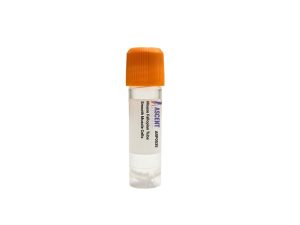
In Stock Cell Lines
The TMEM63A Knockout COS1 Cell Line is a CRISPR/Cas9-edited loss-of-function model targeting the TMEM63A gene in COS1 kidney fibroblasts derived from Chlorocebus aethiops. TMEM63A encodes a mechanosensitive calcium-permeable channel that regulates cell volume and osmotic stress responses by mediating calcium influx upon mechanical stimulation. Knockout of TMEM63A abrogates downstream signaling through NFAT and YAP/TAZ, impairing mechanotransduction and volume regulation. This cell line facilitates calcium imaging, patch-clamp recordings, and cell volume assays for drug target validation and mechanistic studies in cancer, neuroscience, and channelopathy research. Contact Ascent Research for more information.
 LAT2 Knockout SK-Hep-1 Polyclonal Cells
Cat. No. ARG16158
NUP210 Knockout SK-HEP-1 Polyclonal Cells
Cat. No. ARG15763
NEURL4 Knockout HT29 Polyclonal Cells
Cat. No. ARG13860
PAK4 Knockout Hela Polyclonal Cells
Cat. No. ARG8663
AR Knockout Raji Polyclonal Cells
Cat. No. ARG23399
IDH3G Knockout AGS Polyclonal Cells
Cat. No. ARG27003
LAT2 Knockout SK-Hep-1 Polyclonal Cells
Cat. No. ARG16158
NUP210 Knockout SK-HEP-1 Polyclonal Cells
Cat. No. ARG15763
NEURL4 Knockout HT29 Polyclonal Cells
Cat. No. ARG13860
PAK4 Knockout Hela Polyclonal Cells
Cat. No. ARG8663
AR Knockout Raji Polyclonal Cells
Cat. No. ARG23399
IDH3G Knockout AGS Polyclonal Cells
Cat. No. ARG27003
The TMEM63A Knockout COS1 Cell Line is a CRISPR/Cas9-mediated knockout model in the COS1 cell line, designed to disrupt the TMEM63A gene encoding a mechanosensitive calcium-permeable cation channel. This channel is critical for cell volume regulation and osmotic stress responses. The stable knockout cell line provides a defined loss-of-function system for investigating mechanotransduction and calcium signaling pathways without the variability of transient gene silencing.
COS1 cells originate from CV-1 African green monkey kidney fibroblasts (Chlorocebus aethiops) and are immortalized with SV40 large T antigen. They are widely employed for transient protein expression due to their ability to replicate plasmids bearing the SV40 origin. As a kidney fibroblast model, COS1 cells retain relevant ion channel and volume regulatory mechanisms, making them suitable for studying mechanosensitive channels and osmotic stress signaling, with robust and rapid proliferation.
TMEM63A is activated by mechanical stretch, osmotic stress, and cell swelling, mediating calcium influx that triggers downstream signaling cascades. This calcium entry activates calmodulin and calcineurin, which dephosphorylate NFAT transcription factors, promoting their nuclear translocation. Concurrently, TMEM63A-mediated calcium signals modulate the Hippo pathway, affecting YAP and TAZ activity. The channel physically and functionally interacts with the actin cytoskeleton and calcium-calmodulin-dependent kinases, integrating mechanical cues with transcriptional responses. Disruption of TMEM63A abrogates these mechanotransduction pathways, providing a clean background for mechanistic dissection.
In COS1 kidney fibroblasts, TMEM63A knockout impairs normal mechanosensitive calcium entry, likely disrupting regulatory volume decrease and hypotonic stress responses. This model is valuable for investigating TMEM63A-related pathologies, including cerebellar ataxia, cancer, and neurological disorders. The renal fibroblast background enables focused study of volume regulation and mechanotransduction, while the cell line’s robust growth supports high-throughput drug screening and functional genomics approaches targeting channelopathies.
The cell line supports calcium imaging and patch-clamp electrophysiology to assess ion channel activity, cell volume assays for osmoregulation, and immunofluorescence for actin stress fiber organization. Western blotting detects YAP phosphorylation, and qRT-PCR quantifies downstream gene expression changes; cell migration assays evaluate functional outcomes. These applications facilitate drug target validation for mechanosensitive channels and the development of disease models in neuroscience and oncology. For further details or technical assistance, please contact Ascent Research.