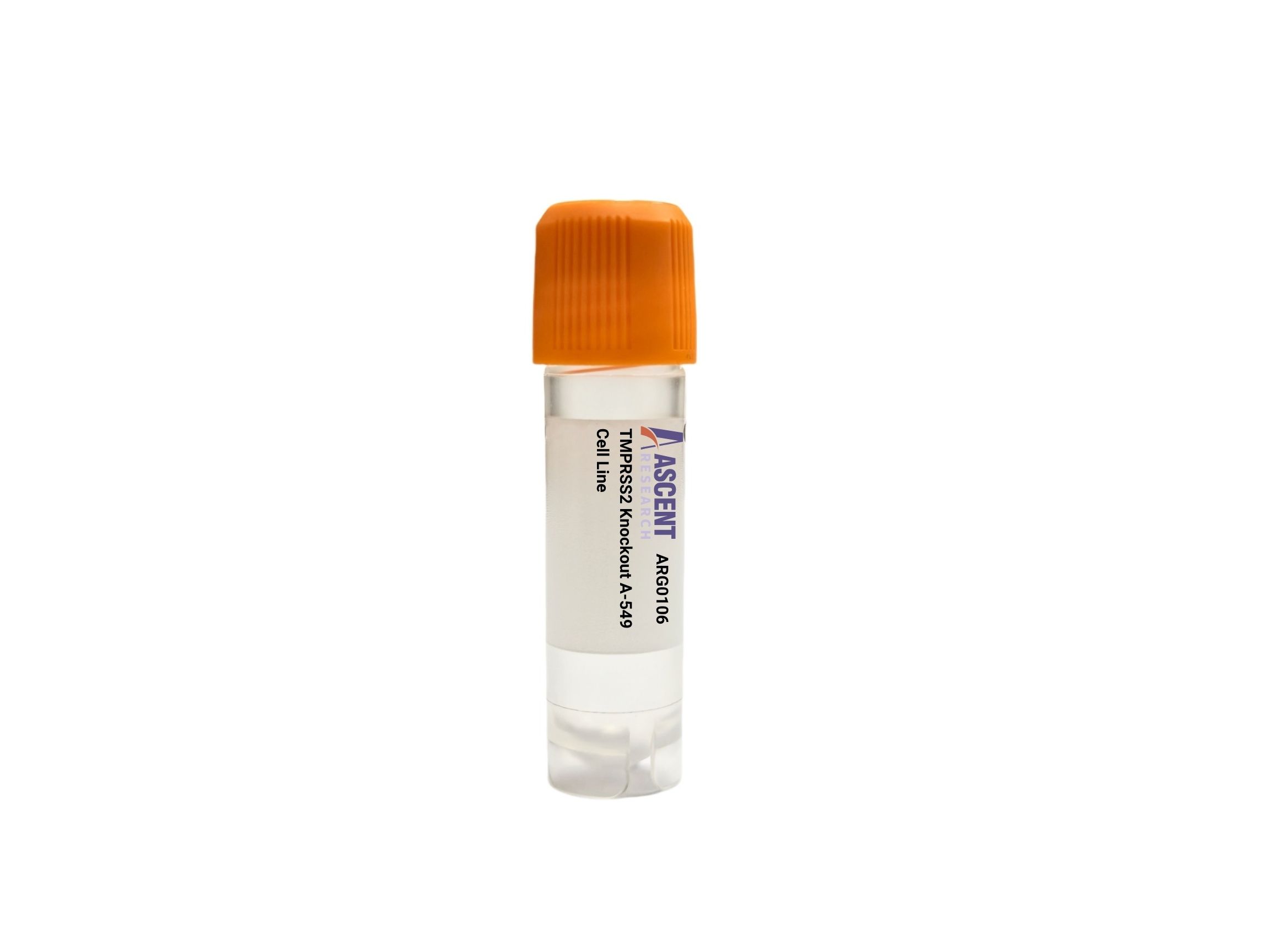
Genome-edited Cells
Lung
TMPRSS2 Knockout A-549 is a human CRISPR/Cas9-edited alveolar epithelial carcinoma cell line with disruption of the TMPRSS2 serine protease gene. In the A-549 lung epithelial background, this model supports analysis of protease-dependent respiratory virus entry, epithelial surface proteolysis, and host-pathogen interactions. TMPRSS2 is regulated by AR-associated signaling and functionally linked to ACE2, SARS-CoV-2 spike priming, and influenza hemagglutinin activation. The cell line is suitable for viral entry and pseudovirus assays, RT-qPCR, western blotting, immunofluorescence, protease activity studies, and antiviral or protease inhibitor evaluation in pulmonary epithelial research.
 LRRC41 Knockout NCI-H1299 Polyclonal Cells
Cat. No. ARG18023
C1GALT1 Knockout A2780 Polyclonal Cells
Cat. No. ARG28943
CCDC91 Knockout MES-OV Polyclonal Cells
Cat. No. ARG43124
CAMK1 Knockout HCT116 Polyclonal Cells
Cat. No. ARG41921
EOGT Knockout HEK293T Polyclonal Cells
Cat. No. ARG3768
LRRC41 Knockout NCI-H1299 Polyclonal Cells
Cat. No. ARG18023
C1GALT1 Knockout A2780 Polyclonal Cells
Cat. No. ARG28943
CCDC91 Knockout MES-OV Polyclonal Cells
Cat. No. ARG43124
CAMK1 Knockout HCT116 Polyclonal Cells
Cat. No. ARG41921
EOGT Knockout HEK293T Polyclonal Cells
Cat. No. ARG3768
 Human Perineurial Cells
Cat. No. ARP0104
Human Perineurial Cells
Cat. No. ARP0104
The TMPRSS2 Knockout A-549 Cell Line is a human CRISPR/Cas9-engineered cell model in which the TMPRSS2 gene has been disrupted to eliminate functional TMPRSS2 expression. This stable knockout line is generated in A-549 cells, a human alveolar epithelial carcinoma cell line, and provides an in vitro system for investigating TMPRSS2-dependent biology in a respiratory epithelial context. Because TMPRSS2 encodes a type II transmembrane serine protease with established roles in extracellular proteolysis and virus-associated membrane fusion processes, this model is well suited for mechanistic studies of epithelial host factors relevant to pulmonary disease and infection biology.
A-549 cells are derived from human lung adenocarcinoma and exhibit type II pneumocyte-like features, making them a widely used model for lung epithelial biology. They are commonly applied to studies of alveolar barrier-associated processes, epithelial signaling, inflammatory responses, and respiratory virus host-cell interactions. In experimental settings, A-549 cells provide a tractable system for examining how epithelial differentiation state, cytokine exposure, and oncogenic context influence cell-surface signaling and pathogen susceptibility. Their relevance to pulmonary research also makes them useful for evaluating molecular determinants of infection efficiency, epithelial protease activity, and host-response programs in lung-derived cells.
TMPRSS2 functions at the plasma membrane as a cell-surface serine protease that proteolytically processes selected extracellular or membrane-proximal substrates. It is transcriptionally regulated by androgen receptor (AR) signaling and can be modulated by dihydrotestosterone, glucocorticoids, epithelial differentiation state, and inflammatory cytokine signaling. Within host-pathogen interaction pathways, TMPRSS2 interacts functionally with ACE2 and promotes proteolytic priming of the SARS-CoV-2 spike protein and influenza A virus hemagglutinin, thereby facilitating membrane fusion competence and protease-dependent viral entry. Its activity is also positioned within a broader epithelial protease network that includes HGF, the endogenous inhibitors HAI-1/SPINT1 and HAI-2/SPINT2, and parallel proteolytic factors such as FURIN and CTSL. These relationships have made TMPRSS2 highly relevant to COVID-19, influenza, respiratory viral infection, and epithelial cancer-associated biology.
In the A-549 background, TMPRSS2 loss provides a focused approach for dissecting how surface proteolysis contributes to respiratory epithelial phenotypes. This knockout can support studies comparing TMPRSS2-dependent and TMPRSS2-independent routes of viral glycoprotein activation, plasma membrane entry, and infection efficiency in lung-derived epithelial cells. It also enables investigation of how AR-regulated transcriptional programs, epithelial state, or inflammatory stimuli intersect with protease-dependent host-cell susceptibility and cell-surface signaling in a clinically relevant pulmonary model.
Applications include respiratory virus entry studies using pseudovirus infection assays, plaque or focus-forming infection assays, and membrane fusion or infectivity readouts to define the requirement for TMPRSS2 in SARS-CoV-2 S- or influenza HA-dependent entry. The model is also useful for western blotting, RT-qPCR, RNA-seq, and immunofluorescence analyses of compensatory protease networks involving ACE2, FURIN, CTSL, SPINT1, and SPINT2 following gene disruption. Additional use cases include cell-surface protein analysis, protease activity assays, co-immunoprecipitation of relevant interacting factors, and drug sensitivity studies evaluating protease inhibitors or host-targeted antiviral strategies in lung epithelial cells. Researchers may contact Ascent Research for additional technical information, product details, or related gene-edited cell models.