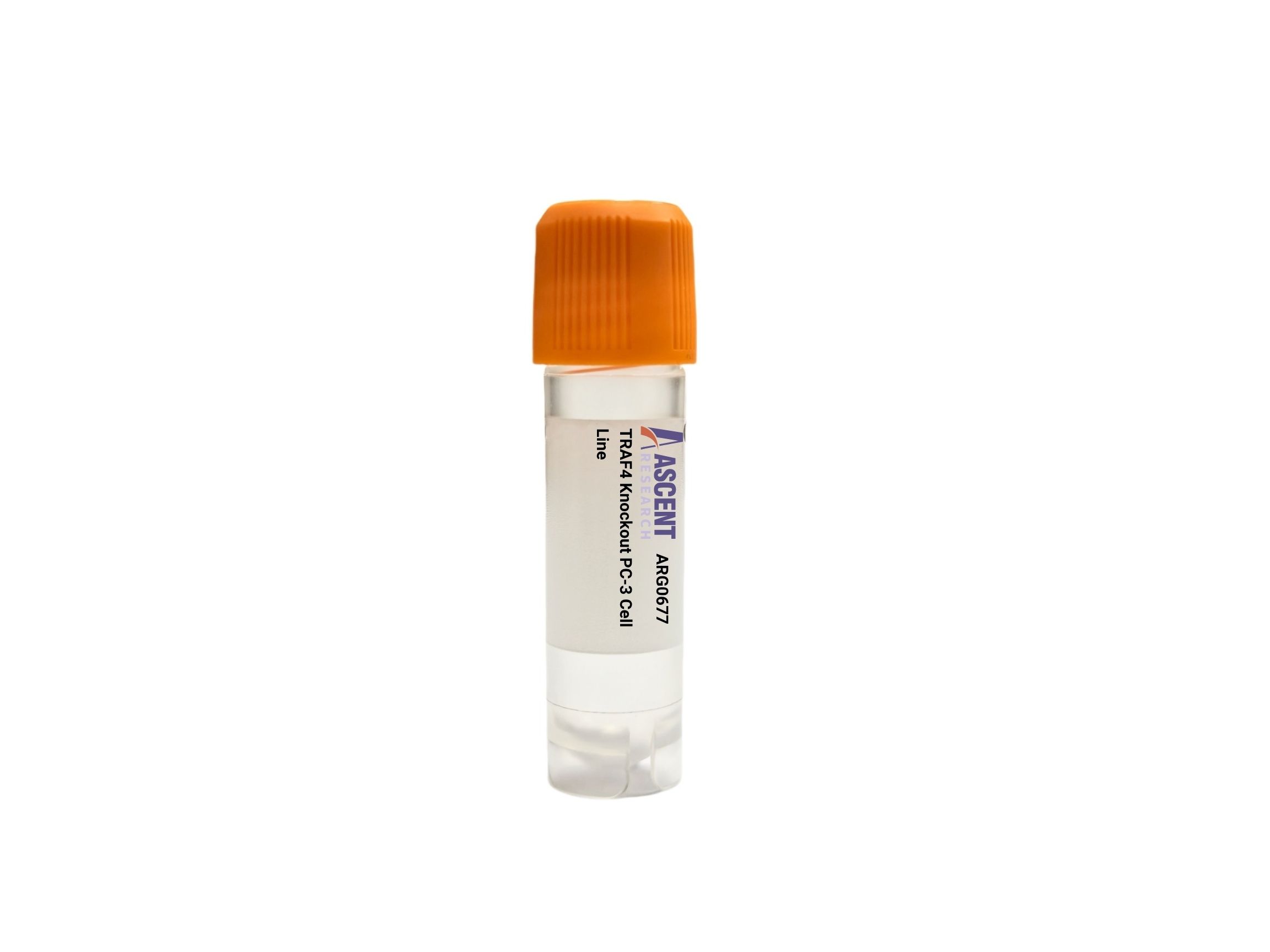
Genome-edited Cells
Prostate
The TRAF4 Knockout PC-3 Cell Line is a CRISPR/Cas9-edited human prostate cancer cell line with targeted disruption of the TRAF4 gene. Derived from the metastatic, androgen-independent PC-3 cell line, this model enables loss-of-function studies of the E3 ubiquitin ligase adaptor TRAF4 in advanced prostate cancer. TRAF4 integrates signals from TNF-??, growth factors, and ROS to activate NF-??B, JNK, and PI3K/AKT pathways, and it interacts with p47phox and ??-catenin. This knockout cell line is ideal for investigating signaling mechanisms, migration, autophagy, drug resistance, and for therapeutic screening in prostate cancer research.
 NAP1L1 Knockout K562 Polyclonal Cells
Cat. No. ARG19246
EPHA3 Knockout HEK293 Polyclonal Cells
Cat. No. ARG12774
ACOT13 Knockout A2780 Polyclonal Cells
Cat. No. ARG28576
HS1BP3 Knockout HGC-27 Polyclonal Cells
Cat. No. ARG29968
METAP1D Knockout MES-OV Polyclonal Cells
Cat. No. ARG5968
NAP1L1 Knockout K562 Polyclonal Cells
Cat. No. ARG19246
EPHA3 Knockout HEK293 Polyclonal Cells
Cat. No. ARG12774
ACOT13 Knockout A2780 Polyclonal Cells
Cat. No. ARG28576
HS1BP3 Knockout HGC-27 Polyclonal Cells
Cat. No. ARG29968
METAP1D Knockout MES-OV Polyclonal Cells
Cat. No. ARG5968
 SNU-601
Cat. No. ARC0875
SNU-601
Cat. No. ARC0875
The TRAF4 Knockout PC-3 Cell Line is a genetically defined loss-of-function model generated by CRISPR/Cas9-mediated disruption of the endogenous TRAF4 gene in the human PC-3 prostate cancer cell line. This knockout cell line provides a stable, renewable resource for investigating TRAF4-dependent signaling mechanisms in an androgen-independent, metastatic prostate cancer background. The targeted gene disruption eliminates functional TRAF4 protein expression, enabling precise dissection of its adaptor functions in oncogenic pathways without pleiotropic effects associated with RNA interference or pharmacological inhibition.
The parental PC-3 cell line was established from a bone metastasis of a grade IV prostatic adenocarcinoma in a male patient. These cells are androgen receptor?Cnegative with high metastatic potential, making them a model for advanced, castration-resistant prostate cancer. PC-3 cells display migratory and invasive properties and constitutively active NF-??B, PI3K/AKT, and JNK pathways relevant to TRAF4-mediated functions.
TRAF4 encodes an E3 ubiquitin ligase adaptor that scaffolds signaling complexes activated by TNF-??, growth factor receptors (EGFR, FGFR), and reactive oxygen species. Downstream, it promotes NF-??B (p65) nuclear translocation, JNK and AKT phosphorylation, and autophagy (LC3-II). TRAF4 directly interacts with p47phox to regulate ROS production and with ??-catenin to modulate TCF/LEF transcriptional activity. It also associates with NOD2, LT??R, CD40, IKK??/??, NIK, and c-IAP1/2, integrating inflammatory, survival, and cytoskeletal cues to control cell survival, migration, and autophagy.
In prostate cancer, TRAF4 overexpression contributes to tumor aggressiveness, therapy resistance, and metastasis. Disruption of TRAF4 in PC-3 cells attenuates oncogenic signaling, impairs migration and invasion, and sensitizes cells to apoptosis. Thus, it is suited for dissecting TRAF4??s roles in advanced prostate cancer, where NF-??B and AKT pathways drive malignancy, and for identifying therapeutic vulnerabilities.
This knockout cell line enables western blotting, RT-qPCR, immunofluorescence, and flow cytometry for target validation and phenotypic analysis. Functional readouts include migration/invasion assays, viability assays (MTT/CellTiter-Glo), apoptosis assays, and ROS detection. Signaling studies can utilize NF-??B and TCF/LEF reporter assays, co-immunoprecipitation, phospho-protein analysis, and autophagy flux measurements. The model is suitable for drug screening, xenograft tumorigenesis, and autophagy or redox regulation studies. For technical inquiries, contact Ascent Research.