Genome-edited Cells
Blood (peripheral blood)
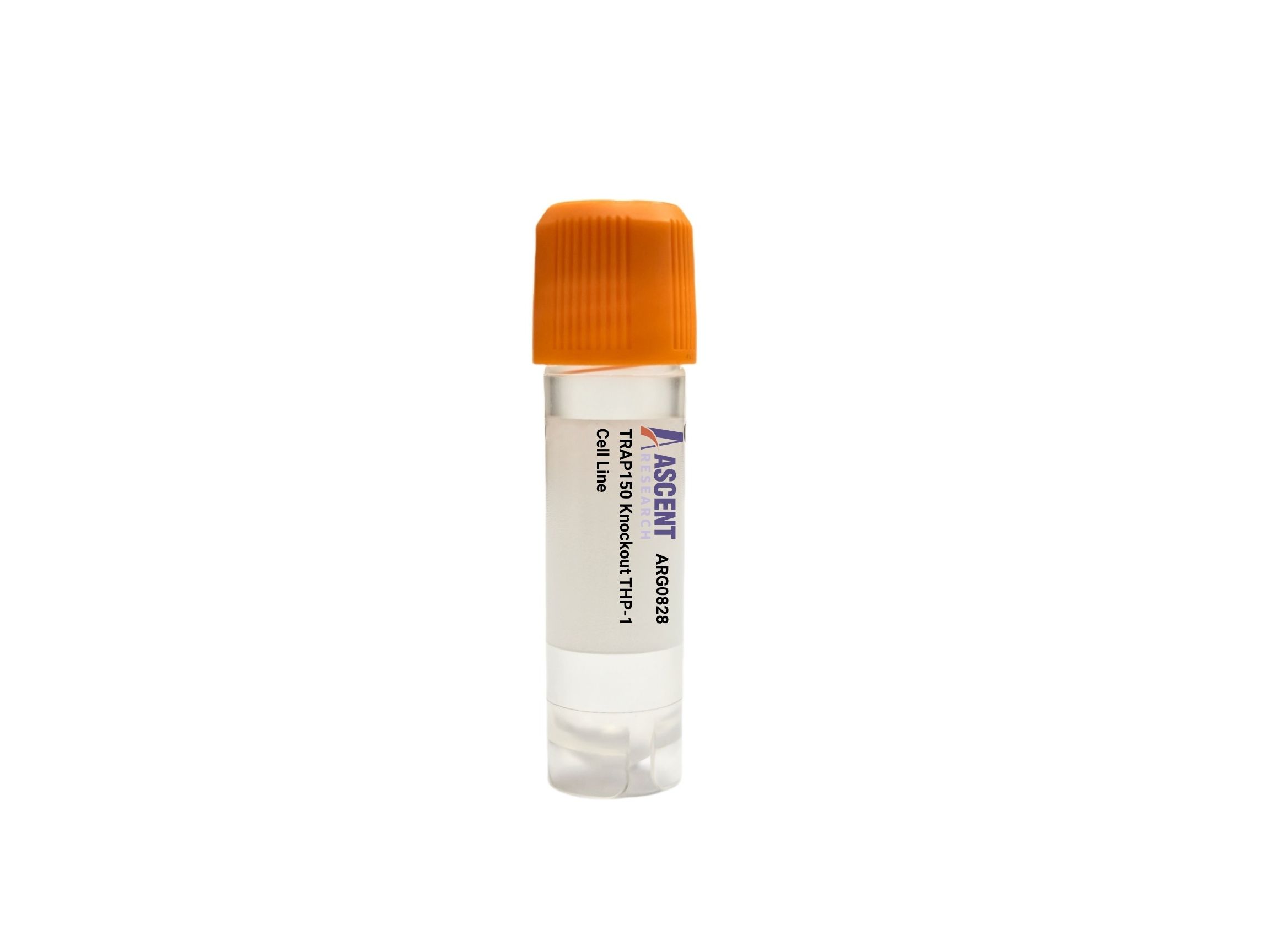
The TRAP150 Knockout THP-1 Cell Line is a CRISPR/Cas9-edited knockout cell line derived from the human monocytic leukemia THP-1 cell line. It provides a loss-of-function model for TRAP150 (THRAP3), a transcriptional coactivator and mRNA splicing regulator that bridges nuclear receptors such as THRB to the mediator complex and splicing factors. This knockout model is ideal for studying thyroid hormone signaling, nuclear receptor-mediated transcription, and alternative splicing in a monocyte/macrophage context. Researchers can employ this cell line in assays including RNA-seq splicing analysis, co-immunoprecipitation, dual-luciferase reporter tests, and immune function studies like phagocytosis and cytokine ELISA. It is applicable to research on thyroid disorders, acute monocytic leukemia, cancer endocrinology, and splicing regulation.
 NUCKS1 Knockout jurkat Polyclonal Cells
Cat. No. ARG13738
BUB1 Knockout HEK293 Polyclonal Cells
Cat. No. ARG23232
AKT3 Knockout 143B Polyclonal Cells
Cat. No. ARG34999
APOBEC3C Knockout SKOV3 Polyclonal Cells
Cat. No. ARG36704
METAP1D Knockout 786-O Polyclonal Cells
Cat. No. ARG4836
MyD88 Knockout AGS Polyclonal Cells
Cat. No. ARG2270
NUCKS1 Knockout jurkat Polyclonal Cells
Cat. No. ARG13738
BUB1 Knockout HEK293 Polyclonal Cells
Cat. No. ARG23232
AKT3 Knockout 143B Polyclonal Cells
Cat. No. ARG34999
APOBEC3C Knockout SKOV3 Polyclonal Cells
Cat. No. ARG36704
METAP1D Knockout 786-O Polyclonal Cells
Cat. No. ARG4836
MyD88 Knockout AGS Polyclonal Cells
Cat. No. ARG2270
The TRAP150 Knockout THP-1 Cell Line is a CRISPR/Cas9-edited knockout cell line derived from the THP-1 human monocytic leukemia cell line. This loss-of-function model targets TRAP150 (THRAP3), a transcriptional coactivator and splicing regulator. Generated through CRISPR/Cas9-mediated gene disruption, it provides a stable knockout context for investigating nuclear receptor signaling and mRNA processing, allowing researchers to dissect how TRAP150 integrates transcriptional and post-transcriptional regulation free of residual protein interference.
The THP-1 cell line, derived from peripheral blood of an acute monocytic leukemia patient, serves as a well-established model for monocyte and macrophage biology, engaging in immune activation, cytokine secretion, and phagocytosis. Retaining features of primary monocytes, THP-1 cells are widely used to study inflammation, innate immunity, and leukemia pathogenesis. This leukemic background offers a physiologically relevant system for examining how oncogenic signaling converges with monocyte function and endocrine pathways mediated by nuclear hormone receptors.
TRAP150 functions as a thyroid hormone receptor-associated coactivator, bridging nuclear receptors such as THRB and retinoic acid receptors to the transcriptional machinery via mediator complex subunits MED1 and MED17. It also modulates alternative splicing through interactions with splicing factors like SF3B1 and U2AF2. Upstream signals from thyroid hormones (T3/T4) via THRA/THRB and retinoic acid regulate TRAP150 activity, positioning it at a nexus where transcriptional activation by nuclear receptors integrates with splice site selection to coordinate gene expression programs.
In the THP-1 monocyte/macrophage context, TRAP150 disruption likely impairs hormone-dependent transcription and alters splicing patterns, affecting cytokine production and phagocytosis. This model is particularly relevant for studying thyroid disorders and acute monocytic leukemia, where nuclear receptor signaling and splicing are dysregulated. By eliminating TRAP150, researchers can investigate how this coactivator influences the inflammatory phenotype and endocrine responsiveness of leukemic monocytes, providing a platform to explore the intersection of oncogenic transformation and endocrine signaling in immune cells.
Applications include western blotting and RT-qPCR for confirmation and target analysis, RNA-seq for splicing profiling, co-immunoprecipitation to detect altered interactions, dual-luciferase reporter assays for nuclear receptor activity, and functional assays like phagocytosis and cytokine ELISA. This makes the cell line applicable to nuclear receptor signaling, monocyte/macrophage biology, cancer endocrinology, and splicing regulation studies. For further details, please contact Ascent Research.