Genome-edited Cells
Liver
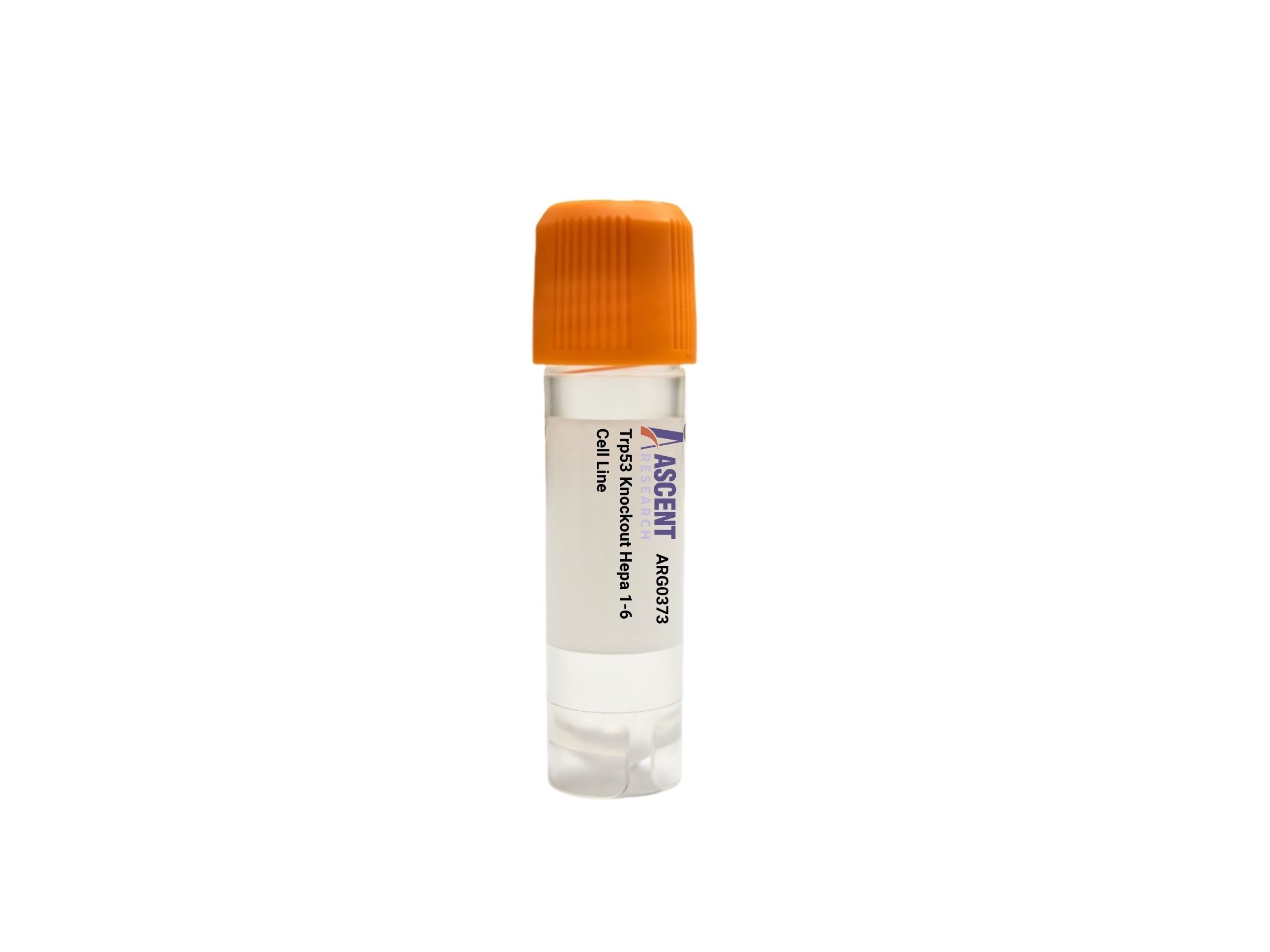
The Trp53 Knockout Hepa 1-6 Cell Line is a CRISPR/Cas9-edited knockout cell line derived from mouse Hepa 1-6 hepatoma cells, lacking functional p53. This model abolishes p53-mediated tumor suppression, including cell cycle arrest and apoptosis, in a liver cancer context. Hepa 1-6 cells, from C57L/J mouse hepatocellular carcinoma, retain hepatic metabolic features ideal for liver cancer research. Trp53 encodes p53, which transcriptionally regulates CDKN1A (p21) and BAX downstream of ATM/ATR, interacting with MDM2. This knockout disrupts the network, enabling unchecked proliferation. Applications include liver cancer modeling, drug screening, apoptosis studies, and tumor suppressor research, facilitating investigation of p53 pathways in hepatocellular carcinoma.
 CASKIN2 Knockout Hela Polyclonal Cells
Cat. No. ARG23974
BCL6B Knockout HAP1 Polyclonal Cells
Cat. No. ARG22067
MME Knockout SK-HEP-1 Polyclonal Cells
Cat. No. ARG15177
CASKIN2 Knockout Hela Polyclonal Cells
Cat. No. ARG23974
BCL6B Knockout HAP1 Polyclonal Cells
Cat. No. ARG22067
MME Knockout SK-HEP-1 Polyclonal Cells
Cat. No. ARG15177
 Cynomolgus Monkey CD20+ B Cells
Cat. No. ARP1046
ACYP2 Knockout NCI-H1299 Polyclonal Cells
Cat. No. ARG30229
HMMR Knockout huh-7 Polyclonal Cells
Cat. No. ARG28317
Cynomolgus Monkey CD20+ B Cells
Cat. No. ARP1046
ACYP2 Knockout NCI-H1299 Polyclonal Cells
Cat. No. ARG30229
HMMR Knockout huh-7 Polyclonal Cells
Cat. No. ARG28317
The Trp53 Knockout Hepa 1-6 Cell Line is a CRISPR/Cas9-edited knockout cell line derived from the mouse Hepa 1-6 hepatoma cell line, designed to disrupt the endogenous Trp53 gene. This loss-of-function model abolishes p53 tumor suppressor activity, providing a defined genetic background for studying p53-dependent processes. The knockout was generated via CRISPR/Cas9-mediated gene disruption, yielding a stable cell line lacking functional p53. Researchers can investigate p53-mediated signaling in liver-derived cells without pharmacological inhibitors or RNAi.
The parental Hepa 1-6 line originates from a spontaneous hepatocellular carcinoma in C57L/J mice, retaining liver parenchymal features with metabolic and detoxification functions. Widely used in HCC research, these cells grow rapidly, are tumorigenic, and susceptible to immune clearance in syngeneic models, enabling in vitro and in vivo studies in immunocompetent hosts for liver cancer biology and preclinical evaluation.
Trp53 encodes p53, a transcription factor that functions as a central tumor suppressor. Under normal conditions, p53 is maintained at low levels through MDM2-mediated ubiquitination and proteasomal degradation. In response to DNA damage or oncogenic stress, upstream kinases such as ATM and ATR phosphorylate p53, disrupting its interaction with MDM2 and stabilizing the protein. Activated p53 then transcriptionally regulates downstream target genes, including CDKN1A (p21) for cell cycle arrest, and BAX, PUMA, and NOXA for apoptosis. Additionally, p53 interacts with cofactors such as p300/CBP and HSP90, modulating its activity and stability. Knockout of Trp53 eliminates these regulatory nodes, resulting in unchecked proliferation and compromised DNA repair, as exemplified by pathway components ATM, CHK2, p53, p21, and BAX.
In hepatocellular carcinoma, p53 is frequently mutated; its loss drives tumor progression, genomic instability, and therapy resistance. The Trp53 Knockout Hepa 1-6 Cell Line enables dissection of p53-dependent tumor suppression in liver cancer cells. Comparison with parental Hepa 1-6 (wild-type Trp53) allows assessment of p53 loss on cell cycle regulation, apoptosis, and sensitivity to genotoxic agents. This isogenic pair is valuable for identifying p53-dependent metabolic changes and evaluating therapies targeting p53-deficient hepatocellular carcinoma.
This knockout cell line supports liver cancer modeling, drug screening, apoptosis studies, and tumor suppressor research. Assays include western blotting and RT-qPCR for p53 target expression, flow cytometric cell cycle analysis, annexin V apoptosis assays, and syngeneic tumorigenicity studies. The defined deletion enables functional genomics and drug response profiling in liver cancer. For technical inquiries, ordering, or custom editing, contact Ascent Research.