Genome-edited Cells
Lung
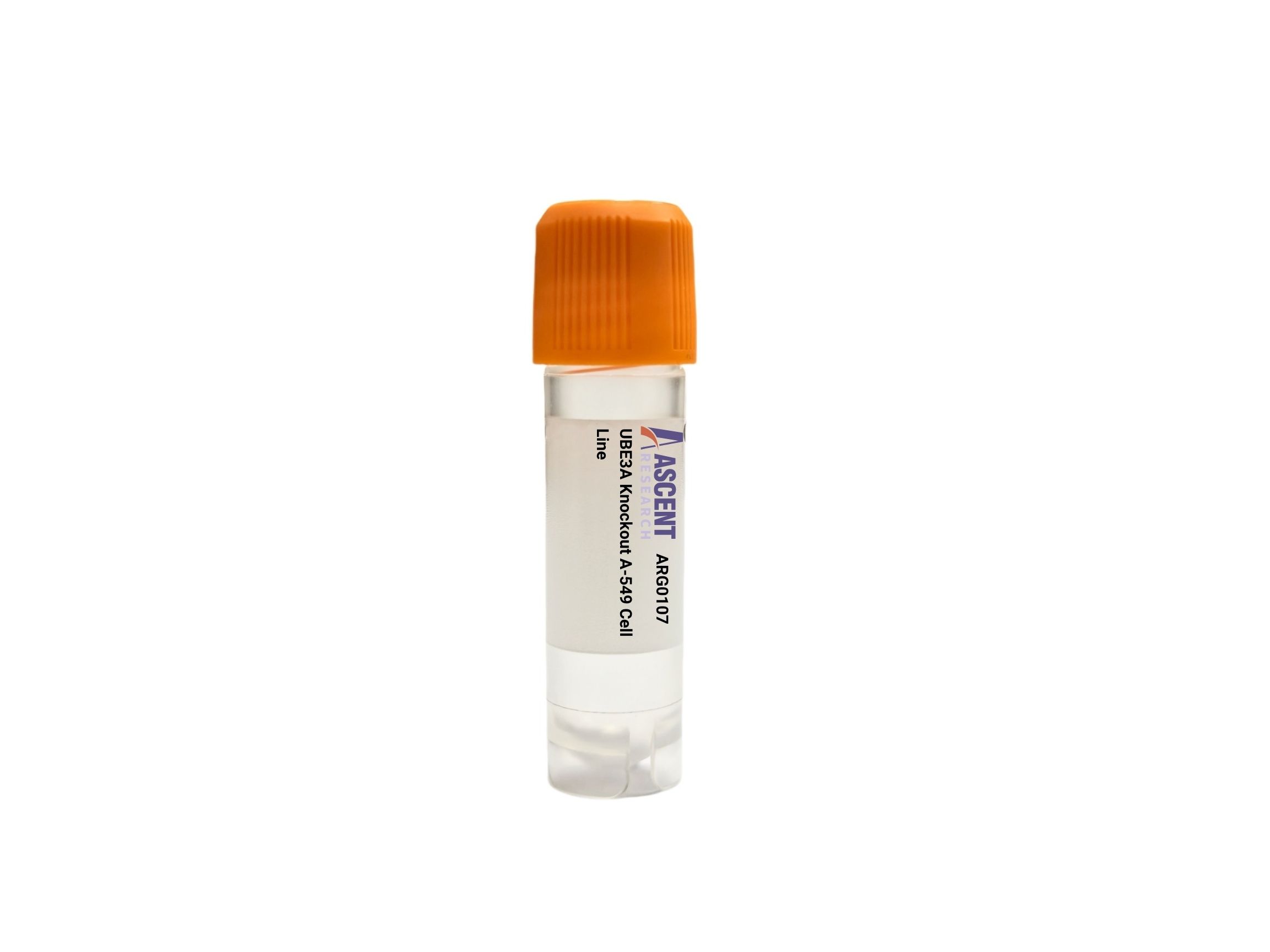
UBE3A Knockout A-549 is a human CRISPR/Cas9-edited alveolar epithelial carcinoma cell line with disruption of the UBE3A gene encoding the HECT-domain E3 ubiquitin ligase E6AP. In A-549 cells, this model supports analysis of ubiquitin-proteasome signaling, proteostasis, p53 pathway regulation, and epithelial cancer stress responses. UBE3A interacts with factors including TP53, HPV16 E6, HERC2, and estrogen receptor alpha, and in defined contexts mediates ubiquitin-dependent TP53 degradation. Suitable applications include western blotting, RNA-seq, ubiquitination assays, co-immunoprecipitation, proteasome inhibition studies, apoptosis and cell cycle assays, and drug sensitivity testing in lung cancer signaling research.
 BLOC1S6 Knockout Hela Polyclonal Cells
Cat. No. ARG21507
EPHB2 Knockout Hela Polyclonal Cells
Cat. No. ARG8613
ANXA2 Knockout HAP1 Polyclonal Cells
Cat. No. ARG21830
Gna13 Knockout HEK293T Polyclonal Cells
Cat. No. ARG37989
P4HA1 Knockout HCT116 Polyclonal Cells
Cat. No. ARG7153
MCFD2 Knockout MES-OV Polyclonal Cells
Cat. No. ARG5910
BLOC1S6 Knockout Hela Polyclonal Cells
Cat. No. ARG21507
EPHB2 Knockout Hela Polyclonal Cells
Cat. No. ARG8613
ANXA2 Knockout HAP1 Polyclonal Cells
Cat. No. ARG21830
Gna13 Knockout HEK293T Polyclonal Cells
Cat. No. ARG37989
P4HA1 Knockout HCT116 Polyclonal Cells
Cat. No. ARG7153
MCFD2 Knockout MES-OV Polyclonal Cells
Cat. No. ARG5910
The UBE3A Knockout A-549 Cell Line is a human CRISPR/Cas9-engineered knockout model in which the UBE3A gene has been disrupted to eliminate functional E6AP ubiquitin ligase expression. This stable in vitro cell model is generated in the A-549 background, a human alveolar epithelial carcinoma cell line, and is intended for mechanistic studies of ubiquitin-dependent signaling, proteostasis regulation, and stress-responsive pathways in pulmonary epithelial cancer cells. The model is suited for researchers requiring a defined loss-of-function system to examine UBE3A-associated molecular circuitry in a lung epithelial context.
A-549 cells are derived from human lung adenocarcinoma and are widely used to investigate airway and alveolar epithelial biology, epithelial stress responses, tumor-associated signaling, and cytotoxic or host-response phenotypes induced by environmental or infectious stimuli. Their extensive use in cancer biology and pulmonary cell signaling makes them a practical host for analyzing how gene disruption alters epithelial growth control, survival pathways, and response to perturbation. In addition, A-549 cells provide a relevant framework for studying signaling networks that intersect with proteostasis, apoptosis regulation, and transcriptional adaptation in epithelial malignancy.
UBE3A encodes E6AP, a HECT-domain E3 ubiquitin ligase that functions with ubiquitin, E1 activating enzymes, and ubiquitin-conjugating E2 enzymes to transfer ubiquitin to selected substrates and thereby regulate protein stability and signaling output. UBE3A interacts with proteasome components and with factors including TP53, HERC2, estrogen receptor alpha, progesterone receptor, and HPV16 E6. In defined HPV E6-associated settings, UBE3A mediates ubiquitin-dependent TP53 degradation, linking it directly to cell cycle progression and apoptosis sensitivity. UBE3A is further regulated by cellular stress, DNA damage signaling, steroid hormone receptor context, and broader proteostasis perturbation, and it has documented connections to the ubiquitin-proteasome system, p53 signaling, Wnt/beta-catenin signaling, and steroid hormone receptor coactivation. These functions underlie its relevance to Angelman syndrome, Dup15q syndrome, autism spectrum disorder, cervical cancer, HPV-associated malignancies, and broader cancer biology.
In the A-549 background, loss of UBE3A provides a useful system for testing how impaired E3 ligase activity reshapes epithelial cancer cell signaling and proteome homeostasis. This model can support investigation of whether UBE3A acts upstream of altered proteasome substrate handling, apoptosis susceptibility, transcriptional programs regulated by nuclear receptor signaling, or pathway responses to DNA damage and cellular stress. Because A-549 cells are commonly used for lung cancer signaling studies, the knockout is also relevant for examining UBE3A-dependent vulnerabilities in pulmonary epithelial tumor models.
This cell line can be applied to western blotting and ubiquitination assays to assess changes in substrate ubiquitination and steady-state abundance; co-immunoprecipitation to study interactions involving UBE3A-associated factors such as TP53, HPV16 E6, or HERC2; and proteasome inhibition studies to dissect ubiquitin-proteasome flux. Researchers may also use RT-qPCR and RNA-seq to profile transcriptional consequences of UBE3A loss, including effects on p53-responsive or nuclear receptor-linked programs, as well as immunofluorescence, proliferation assays, apoptosis assays, and flow-cytometric cell cycle analysis to quantify phenotype-level consequences. Reporter assays and drug sensitivity studies are additionally applicable for evaluating pathway dependency, stress tolerance, and responses to compounds targeting proteostasis, apoptosis control, or related signaling axes. Researchers may contact Ascent Research for additional technical information, product details, or related gene-edited cell models.