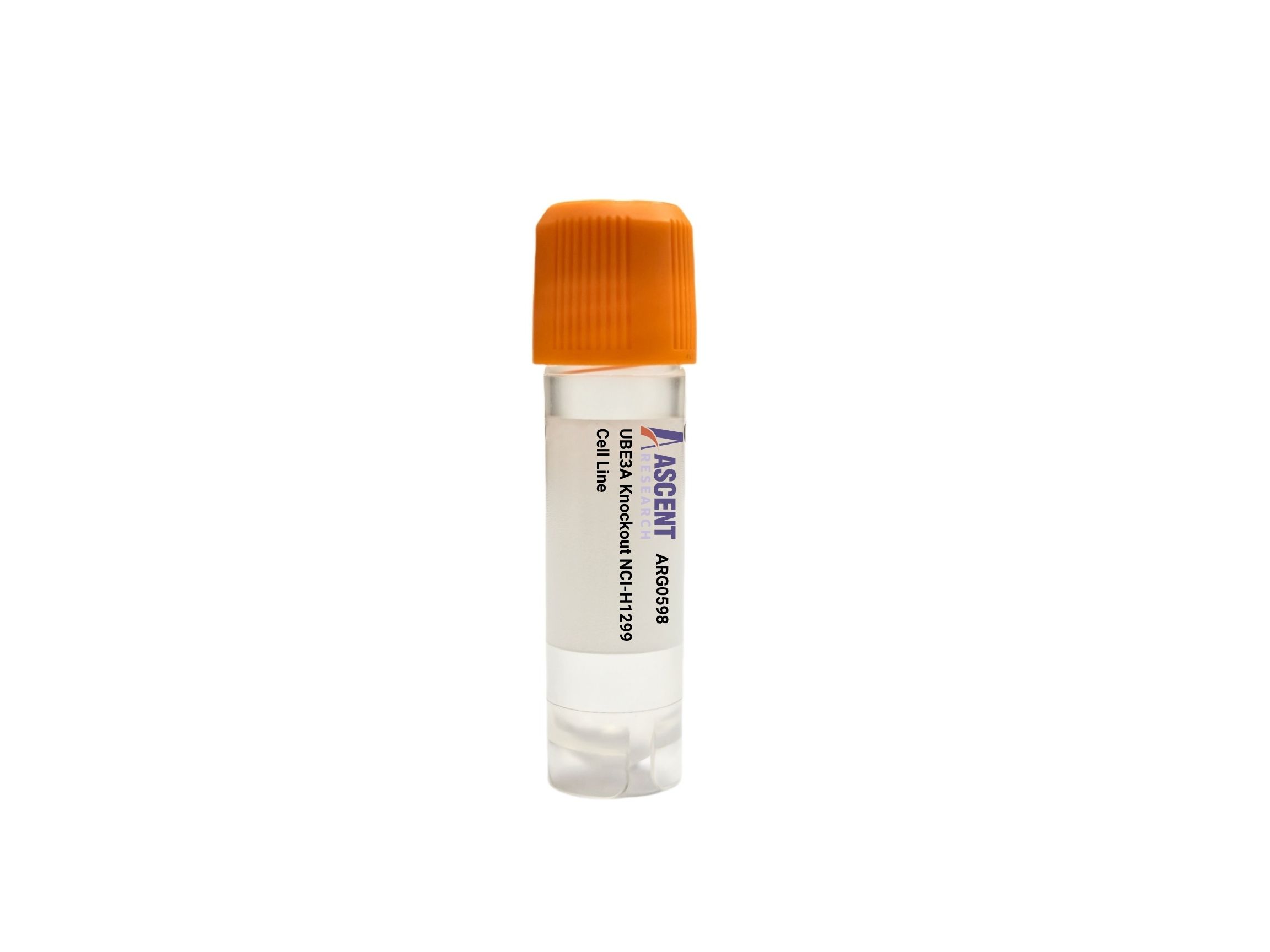
Genome-edited Cells
Lung
The UBE3A Knockout NCI-H1299 Cell Line is a CRISPR/Cas9-edited loss-of-function model lacking E3 ubiquitin ligase E6AP in p53-null human lung adenocarcinoma cells. This knockout disrupts the ubiquitin-proteasome degradation of substrates such as ??-catenin (CTNNB1) and PML, thereby altering Wnt/??-catenin signaling and apoptotic regulation. It enables investigation of UBE3A-mediated protein degradation in lung cancer, functional studies of Wnt pathway dynamics, and screening of E3 ligase inhibitors. Compatible assays include Western blotting, RT-qPCR, TOP/FOP reporter assays, and drug sensitivity testing. For inquiries, contact Ascent Research.
 CaMK4 Knockout TE1 Polyclonal Cells
Cat. No. ARG12169
CAMK2G Knockout AGS Polyclonal Cells
Cat. No. ARG26826
CSNK2A1 Knockout HCT116 Polyclonal Cells
Cat. No. ARG7228
LRRC20 Knockout 786-O Polyclonal Cells
Cat. No. ARG4838
CTNNA2 Knockout HEK293T Polyclonal Cells
Cat. No. ARG4534
CaMK4 Knockout TE1 Polyclonal Cells
Cat. No. ARG12169
CAMK2G Knockout AGS Polyclonal Cells
Cat. No. ARG26826
CSNK2A1 Knockout HCT116 Polyclonal Cells
Cat. No. ARG7228
LRRC20 Knockout 786-O Polyclonal Cells
Cat. No. ARG4838
CTNNA2 Knockout HEK293T Polyclonal Cells
Cat. No. ARG4534
 Mouse Pulmonary Artery Endothelial Cell Medium
Cat. No. ARM0428
Mouse Pulmonary Artery Endothelial Cell Medium
Cat. No. ARM0428
The UBE3A Knockout NCI-H1299 Cell Line is a CRISPR/Cas9-edited knockout cell line with targeted disruption of the UBE3A gene in the human non-small cell lung cancer line NCI-H1299. This loss-of-function model eliminates the E3 ubiquitin ligase E6AP, enabling stable investigation of UBE3A-dependent proteasomal degradation pathways within a lung adenocarcinoma context.
The parental NCI-H1299 cell line was derived from a metastatic lymph node of a lung adenocarcinoma patient and harbors a homozygous deletion of TP53, rendering it p53-null. These epithelial cells are widely used in lung cancer research, particularly for studies of non-small cell lung cancer proliferation, apoptosis, and drug response. The absence of p53 redirects E6AP activity toward alternative substrates such as ??-catenin and PML.
UBE3A encodes E6AP, a HECT domain E3 ubiquitin ligase that transfers ubiquitin to target proteins, promoting their 26S proteasome degradation. E6AP associates with ubiquitin-conjugating enzymes UBE2L3 and UBE2D1 and is controlled by upstream signals including HPV E6, MYC, and oxidative stress. Well-characterized substrates include TP53 (p53), CTNNB1 (??-catenin), PML, and RAD23A. In the p53-null NCI-H1299 background, UBE3A knockout primarily impairs the degradation of ??-catenin and PML, thereby perturbing Wnt/??-catenin signaling and apoptotic regulation.
The p53-null nature of NCI-H1299 makes it an ideal host to study UBE3A functions independent of HPV-driven p53 degradation. Disruption of UBE3A allows analysis of E6AP-dependent regulation of ??-catenin, PML, and other non-p53 substrates, offering insights into ubiquitin-proteasome roles in lung adenocarcinoma. This model also permits examination of how altered protein homeostasis affects proliferation, apoptosis, and sensitivity to chemotherapeutics.
This knockout cell line supports diverse research applications, including elucidation of UBE3A-mediated proteasomal degradation mechanisms in lung cancer, functional dissection of Wnt/??-catenin signaling, and screening of small-molecule E3 ligase inhibitors. Validated assays include Western blotting and RT-qPCR for expression analysis, MTT and Annexin V for proliferation and apoptosis, TOP/FOP reporter systems for Wnt activity, and co-immunoprecipitation coupled with proteasome activity assays for ubiquitination studies. Drug sensitivity testing, for instance to cisplatin, can be performed. For further information, please contact Ascent Research.