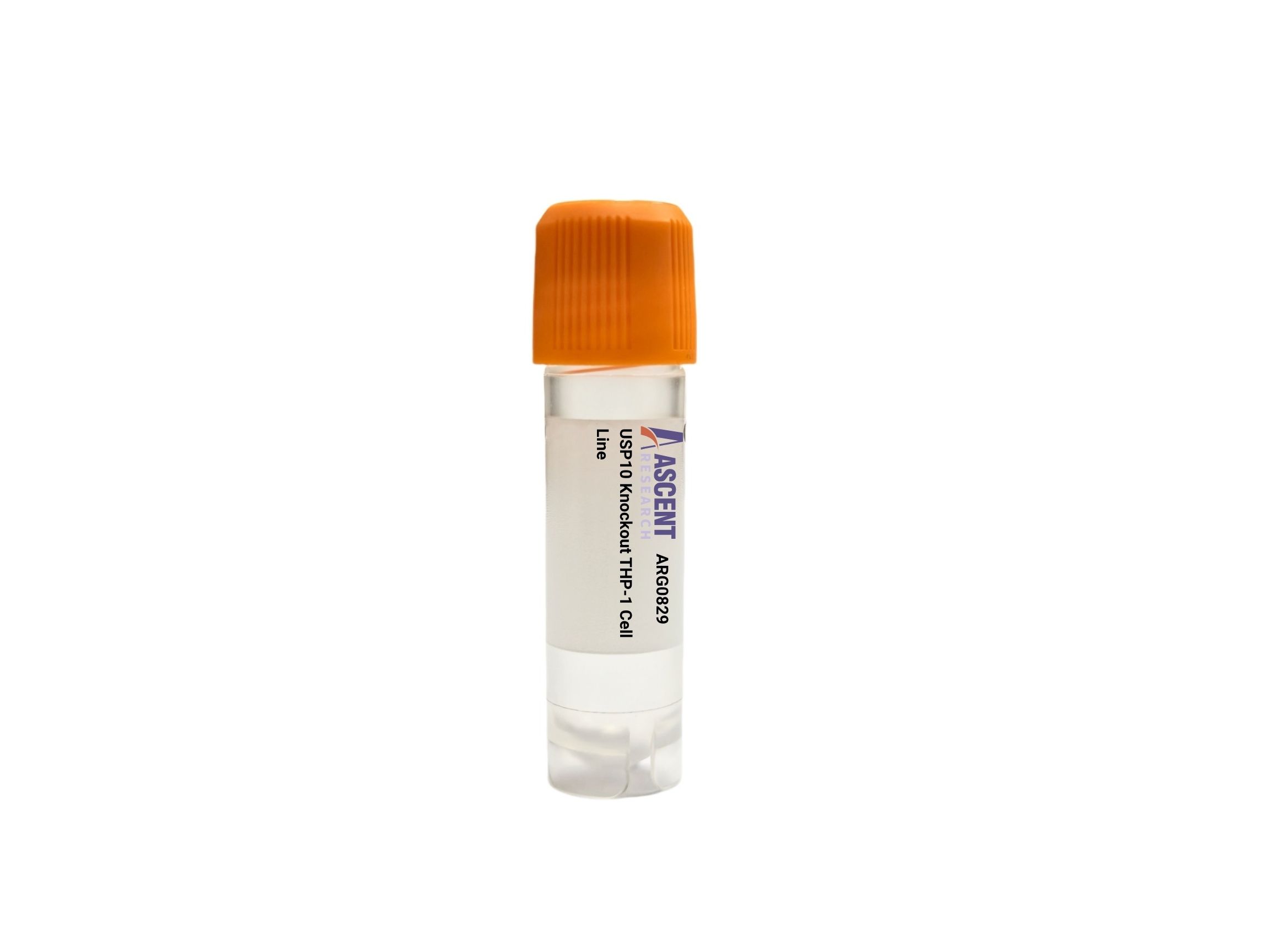
Genome-edited Cells
Blood (peripheral blood)
The USP10 Knockout THP-1 Cell Line is a CRISPR/Cas9-edited knockout cell line targeting the deubiquitinase USP10 in the human THP-1 monocytic leukemia background. USP10 stabilizes p53 and activates autophagy by deubiquitinating Beclin1, playing critical roles in DNA damage response and stress signaling. This model enables investigation of p53-dependent apoptosis, autophagy regulation, and ubiquitin-mediated signaling in a monocytic leukemia context. Key applications include evaluating DNA damage responses, drug sensitivity, and autophagy flux using techniques such as Western blotting, RT-qPCR, and flow cytometry. The cell line provides a stable, disease-relevant platform for dissecting USP10 function in leukemogenesis and stress adaptation.
 AGO3 Knockout Raji Polyclonal Cells
Cat. No. ARG21094
AFF1 Knockout HGC-27 Polyclonal Cells
Cat. No. ARG29444
CACUL1 Knockout NCI-H1975 Polyclonal Cells
Cat. No. ARG41773
C4BPA Knockout NCI-H1975 Polyclonal Cells
Cat. No. ARG41476
CNP Knockout Hela Polyclonal Cells
Cat. No. ARG7834
PHC2 Knockout HEK293T Polyclonal Cells
Cat. No. ARG4170
AGO3 Knockout Raji Polyclonal Cells
Cat. No. ARG21094
AFF1 Knockout HGC-27 Polyclonal Cells
Cat. No. ARG29444
CACUL1 Knockout NCI-H1975 Polyclonal Cells
Cat. No. ARG41773
C4BPA Knockout NCI-H1975 Polyclonal Cells
Cat. No. ARG41476
CNP Knockout Hela Polyclonal Cells
Cat. No. ARG7834
PHC2 Knockout HEK293T Polyclonal Cells
Cat. No. ARG4170
The USP10 Knockout THP-1 Cell Line is a CRISPR/Cas9-edited knockout cell line featuring targeted disruption of the USP10 gene in the human THP-1 monocytic leukemia cell background. This loss-of-function model is designed for investigations into the deubiquitinase USP10 and its roles in p53-dependent stress responses, autophagy regulation, and ubiquitin-mediated signaling pathways. The engineered cell line enables stable, long-term studies without the transient effects of siRNA or pharmacological inhibition, providing a reliable platform for mechanistic and drug-sensitivity assays.
The parental THP-1 cell line was derived from the peripheral blood of a human male infant with acute monocytic leukemia and is widely used as a monocyte/macrophage progenitor model. THP-1 cells can be differentiated into macrophage-like cells, making them a versatile system for studying monocytic differentiation, innate immune functions, and leukemogenesis. This disease-relevant context is ideal for evaluating tumor-suppressive mechanisms and therapeutic vulnerabilities associated with USP10 disruption.
USP10 encodes a deubiquitinase that removes ubiquitin chains from target proteins, controlling their stability and activity. ATM kinase activates USP10 following DNA damage, leading to deubiquitination and stabilization of p53, which transcriptionally induces CDKN1A and BAX to promote cell cycle arrest and apoptosis. USP10 also deubiquitinates Beclin1, a key component of the Vps34/PI3K complex, to positively regulate autophagy initiation. Additional interacting factors include G3BP1 and AR, linking USP10 to stress granule dynamics and NF-??B signaling through IKK?? modulation. Knockout of USP10 disrupts these events, impairing p53-mediated checkpoint control and autophagic flux.
In the THP-1 monocytic leukemia background, loss of USP10 function attenuates p53-dependent apoptotic responses to genotoxic agents and compromises autophagy-mediated stress adaptation. This model allows dissection of how deubiquitinase activity governs leukemic cell survival, differentiation, and drug sensitivity. Since THP-1 cells retain functional p53, the USP10 knockout line is suited for examining crosstalk between ubiquitin editing and p53-driven tumor suppression in a hematological malignancy.
This knockout cell line supports a broad range of applications. Researchers can use Western blotting to assess USP10, p53, and LC3-II levels, RT-qPCR for CDKN1A and BAX transcripts, flow cytometry with Annexin V for apoptosis, and immunofluorescence for ??H2AX foci after etoposide treatment to probe DNA damage responses. Autophagy flux assays with bafilomycin A1 and co-immunoprecipitation of USP10-Beclin1 further elucidate mechanism. These approaches enable investigation of DNA damage responses in leukemia, autophagy in monocytic cells, p53-dependent drug sensitivity, and ubiquitin signaling in immune cells. For additional information or technical support, please contact Ascent Research.