Genome-edited Cells
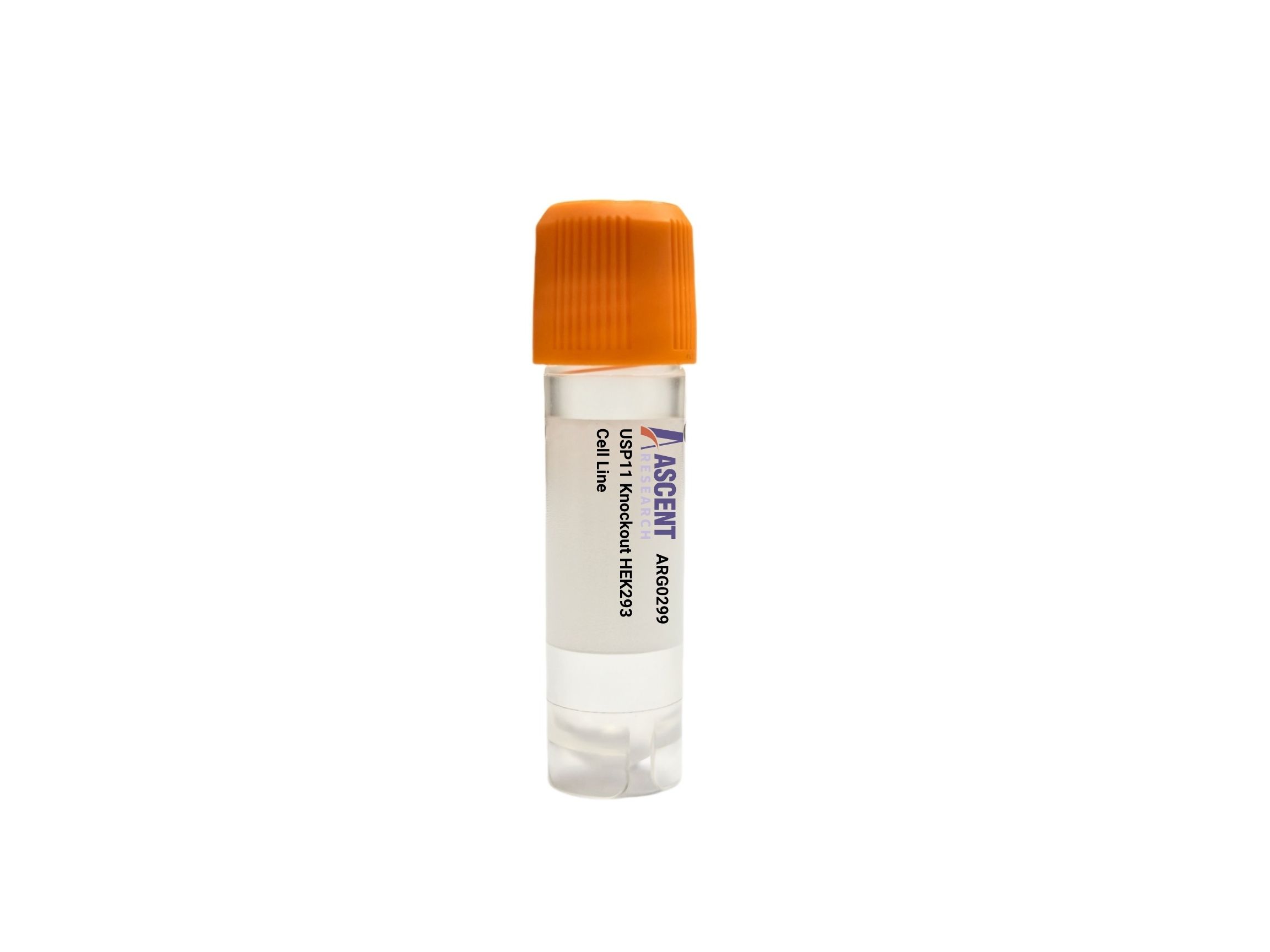
The USP11 Knockout HEK293 Cell Line provides a CRISPR/Cas9-edited loss-of-function model for the USP11 deubiquitinase, which stabilizes tumor suppressors p53 and PTEN. USP11 disruption accelerates proteasomal degradation of these proteins, impairing DNA damage repair, cell cycle arrest, and PTEN/Akt signaling. This knockout cell line is a valuable resource for cancer biology, DNA damage response studies, and drug target validation. Commonly utilized assays include Western blotting for ubiquitination, immunofluorescence for ??H2AX foci, comet assay, and cell proliferation measurements. For technical details, contact Ascent Research.
 LUZP1 Knockout HT29 Polyclonal Cells
Cat. No. ARG14098
MAPKAPK2 Knockout 143B Polyclonal Cells
Cat. No. ARG11811
LRRC41 Knockout A549 Polyclonal Cells
Cat. No. ARG10624
AURKA Knockout Jurkat Polyclonal Cells
Cat. No. ARG23342
AKAP12 Knockout A549 Polyclonal Cells
Cat. No. ARG31462
LUZP1 Knockout HT29 Polyclonal Cells
Cat. No. ARG14098
MAPKAPK2 Knockout 143B Polyclonal Cells
Cat. No. ARG11811
LRRC41 Knockout A549 Polyclonal Cells
Cat. No. ARG10624
AURKA Knockout Jurkat Polyclonal Cells
Cat. No. ARG23342
AKAP12 Knockout A549 Polyclonal Cells
Cat. No. ARG31462
 Rabbit Bladder Stromal Fibroblast Medium
Cat. No. ARM0745
Rabbit Bladder Stromal Fibroblast Medium
Cat. No. ARM0745
The USP11 Knockout HEK293 Cell Line is a CRISPR/Cas9-edited knockout cell line designed to eliminate USP11 deubiquitinase activity in human HEK293 cells. This stable loss-of-function model enables rigorous investigation of USP11-dependent processes without the variability of transient silencing, providing a consistent platform for functional genomics and drug discovery studies.
HEK293 cells are human embryonic kidney epithelial cells immortalized by adenovirus type 5 transformation, extensively utilized for heterologous protein expression and biochemical analysis. They retain proficient DNA damage response and apoptotic signaling pathways, making them an ideal host for studying deubiquitinase-mediated regulation. The USP11 knockout derivative extends the utility of this widely adopted cell line into targeted investigation of ubiquitin-dependent signaling.
USP11 is a deubiquitinase that cleaves polyubiquitin chains from substrate proteins, with tumor suppressors p53 and PTEN as primary targets. Activated by ATM/ATR kinases upon DNA damage, USP11 stabilizes p53 and PTEN by preventing MDM2- and other E3 ligase-driven proteasomal degradation. It also interacts with the BRCA1-A complex and RAD51 to facilitate homologous recombination repair, and targets ALKBH3 for alkylation damage reversal. Consequently, USP11 orchestrates genome protection, cell cycle arrest, and inhibition of PI3K/Akt signaling. Its function additionally intersects with NF-??B and TGF-?? pathways.
In HEK293 cells, USP11 knockout impairs DNA damage-induced stabilization of p53 and PTEN, leading to diminished checkpoint responses, reduced ??H2AX foci resolution, and unchecked proliferation driven by hyperactive Akt signaling. This engineered cellular context thus models critical aspects of genomic instability and oncogenic transformation, providing a powerful tool to dissect USP11??s tumor-suppressive roles.
Wide-ranging applications include cancer biology, DNA repair studies, and drug target validation. Representative assays encompass Western blot assessment of p53 and PTEN ubiquitination, immunofluorescence for ??H2AX foci, comet assay for DNA strand breaks, cell proliferation assays, co-immunoprecipitation of USP11 substrates, RT-qPCR for p53 target genes, and NF-??B luciferase reporters. For technical inquiries, please reach out to Ascent Research.