Genome-edited Cells
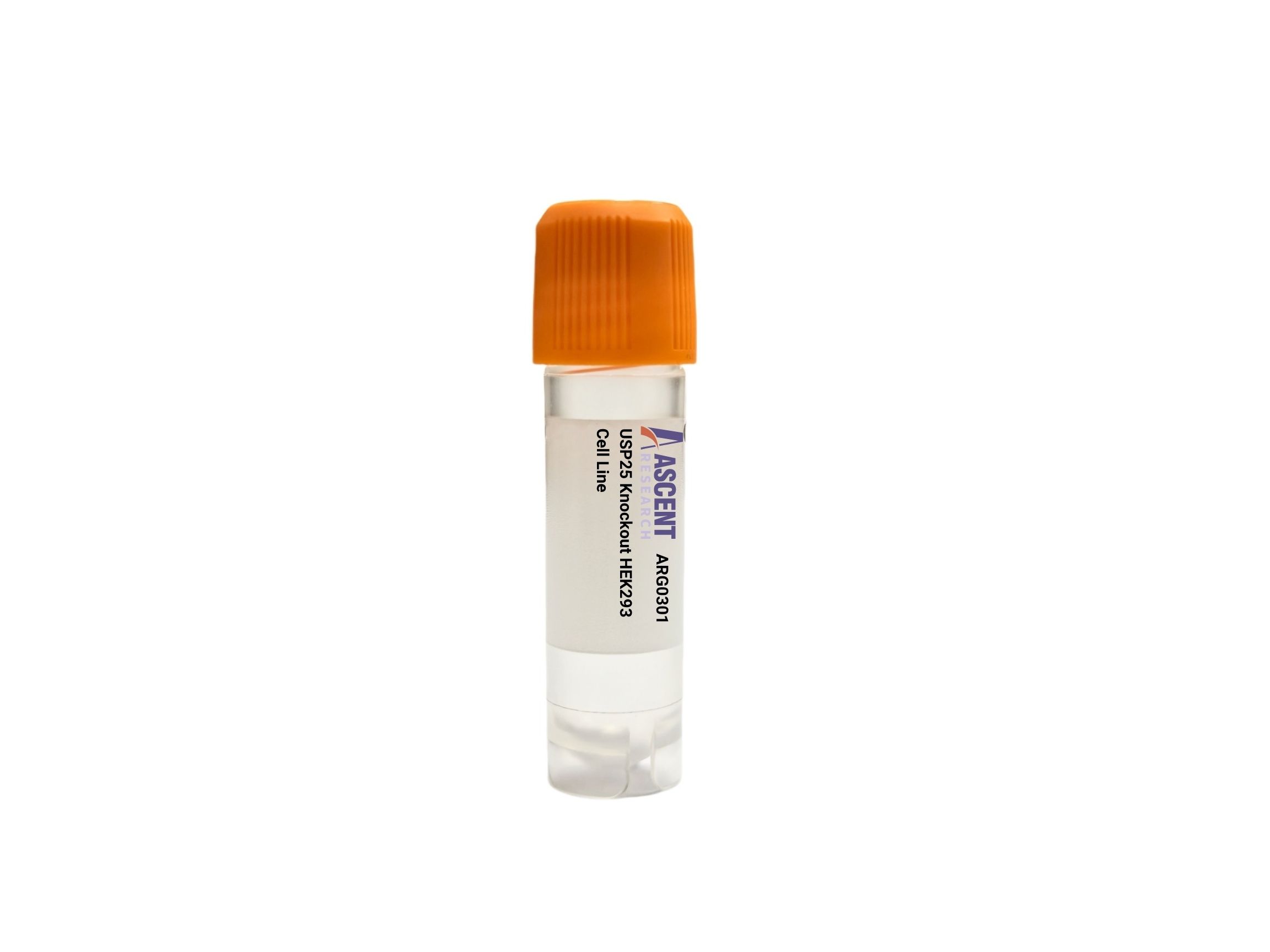
The USP25 Knockout HEK293 Cell Line is a CRISPR/Cas9-edited human cell line disrupting the deubiquitinating enzyme USP25. This loss-of-function model enables study of USP25-mediated deubiquitination of TRAF5 and TRAF6, key adaptors in IL-17 and TNF?? signaling that promote NF-??B activation. Derived from adenovirus 5-transformed HEK293 cells, it provides a robust platform for investigating ubiquitin-dependent regulation of inflammatory pathways, cancer biology, and drug target validation. Applications include ubiquitin profiling, NF-??B reporter assays, and cytokine analysis.
 ADCY9 Knockout Hela Polyclonal Cells
Cat. No. ARG20438
Map3k20 Knockout RAW 264.7 Polyclonal Cells
Cat. No. ARG12534
NNMT Knockout A549 Polyclonal Cells
Cat. No. ARG10236
ATG4C Knockout NCI-H1975 Polyclonal Cells
Cat. No. ARG31244
ITGAM Knockout CaSki Polyclonal Cells
Cat. No. ARG35450
LRIF1 Knockout MES-OV Polyclonal Cells
Cat. No. ARG6489
ADCY9 Knockout Hela Polyclonal Cells
Cat. No. ARG20438
Map3k20 Knockout RAW 264.7 Polyclonal Cells
Cat. No. ARG12534
NNMT Knockout A549 Polyclonal Cells
Cat. No. ARG10236
ATG4C Knockout NCI-H1975 Polyclonal Cells
Cat. No. ARG31244
ITGAM Knockout CaSki Polyclonal Cells
Cat. No. ARG35450
LRIF1 Knockout MES-OV Polyclonal Cells
Cat. No. ARG6489
The USP25 Knockout HEK293 Cell Line is a CRISPR/Cas9-edited knockout cell line designed to disrupt USP25 function in Homo sapiens. This loss-of-function model provides a genetically defined system for investigating deubiquitination-dependent signaling pathways without confounding endogenous gene activity. Supplied as a validated cell line, it ensures experimental reproducibility across a broad range of downstream applications.
HEK293 cells are adenovirus 5-transformed human embryonic kidney epithelial cells, widely recognized for their robust growth and high transfection efficiency. They endogenously express core components of IL-17 and TNF?? signaling, including IL-17R, ACT1, TRAF5, TRAF6, and NEMO, making them an optimal host for studying NF-??B activation and associated ubiquitin modifications in a human cellular context.
USP25 encodes a deubiquitinating enzyme that hydrolyzes ubiquitin chains from substrate proteins to control their stability, localization, and activity. In inflammatory cascades, USP25 deubiquitinates and stabilizes the adaptor molecules TRAF5 and TRAF6, thereby enhancing signal propagation from IL-17R and TNFR to the IKK complex and NF-??B. USP25 also interacts with NEMO, RIP1, TAX1BP1, and Smad7, positioning it at the intersection of TGF-??, autophagy, and NF-??B pathways. Consequently, USP25 knockout impairs TRAF5/6 ubiquitination, attenuates IKK and NF-??B activation, and reduces the expression of pro-inflammatory cytokines.
The HEK293 background offers a clean genetic platform to dissect USP25-dependent regulation of NF-??B signaling. The cells respond to stimulation with IL-17, TNF??, and Toll-like receptor ligands, enabling precise analysis of pathway hierarchies and the validation of USP25 as a therapeutic target in inflammatory diseases, cancer, and neurodegenerative disorders characterized by aberrant NF-??B activity.
This knockout model supports diverse applications including western blotting and co-immunoprecipitation for assessing ubiquitination states of TRAF5, TRAF6, and RIP1; NF-??B luciferase reporter assays for measuring transcriptional activity; RT-qPCR quantification of inflammatory gene induction (e.g., IL6, IL8, TNFA); and ELISA-based cytokine secretion profiling. It also facilitates drug target validation by comparing pharmacological inhibitors in USP25-null versus wild-type cells. For further details, please contact Ascent Research.