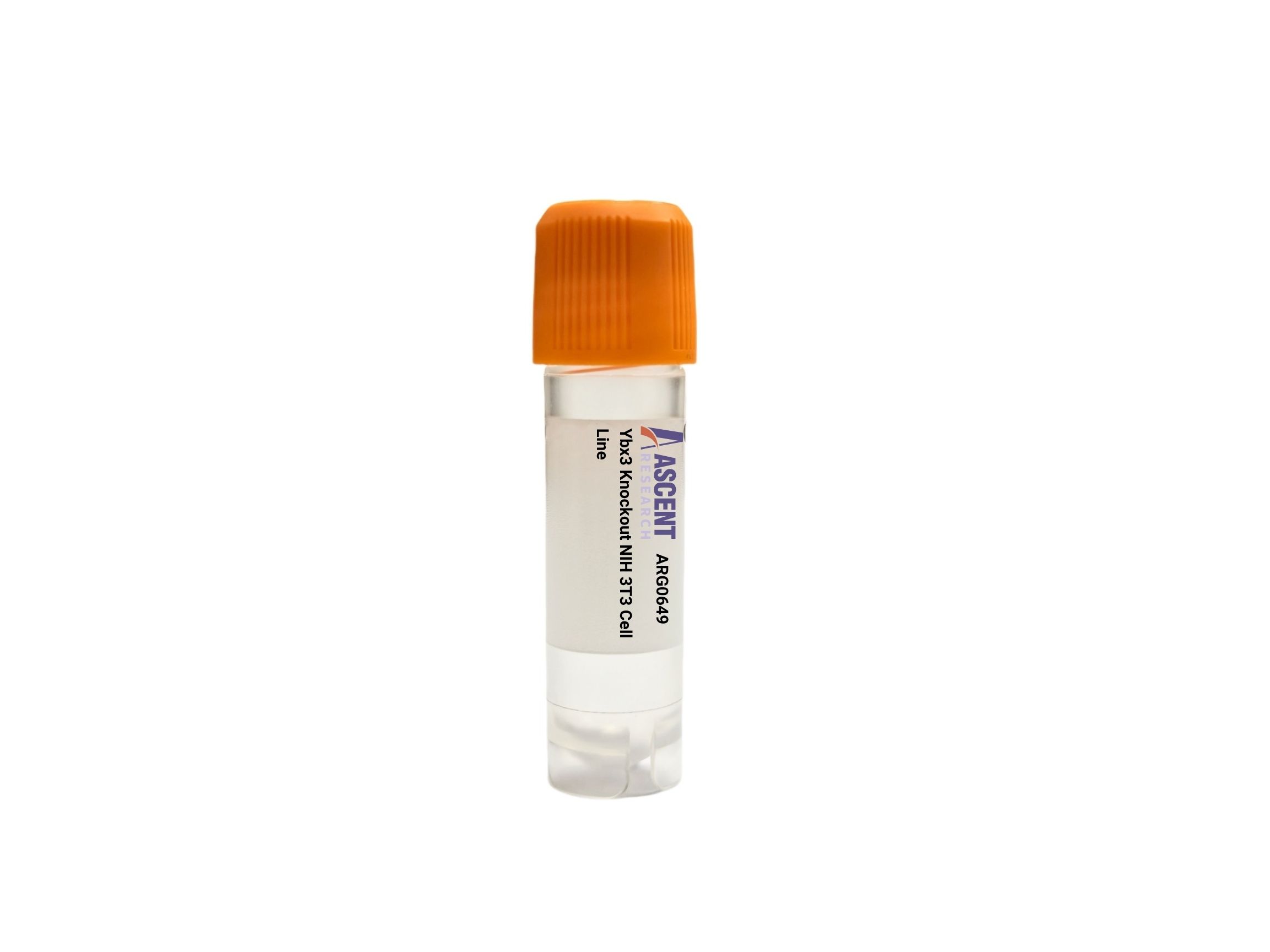
Genome-edited Cells
The Ybx3 Knockout NIH 3T3 Cell Line is a CRISPR/Cas9-edited mouse embryonic fibroblast model with targeted disruption of Ybx3, which encodes an RNA-binding protein that stabilizes transcripts such as Ccnd1 and Mmp2. YBX3 is activated by AKT1 phosphorylation downstream of EGF and PDGF and interacts with ELAVL1 and eIF4E to regulate mRNA translation and stability. This knockout line enables study of fibroblast proliferation, migration, and fibrotic mechanisms, with applications in cancer metastasis research, fibrosis modeling, and targeted drug screening. Researchers can perform scratch wound-healing assays, MTT proliferation tests, and transcriptomic profiling.
 CTAG2 Knockout Hela Polyclonal Cells
Cat. No. ARG8716
CD300ld Knockout HAP1 Polyclonal Cells
Cat. No. ARG43486
CARD9 Knockout HAP1 Polyclonal Cells
Cat. No. ARG42312
DNAJC15 Knockout K562 Polyclonal Cells
Cat. No. ARG39215
GAA Knockout 786-O Polyclonal Cells
Cat. No. ARG4854
GKAP1 Knockout HEK293T Polyclonal Cells
Cat. No. ARG3726
CTAG2 Knockout Hela Polyclonal Cells
Cat. No. ARG8716
CD300ld Knockout HAP1 Polyclonal Cells
Cat. No. ARG43486
CARD9 Knockout HAP1 Polyclonal Cells
Cat. No. ARG42312
DNAJC15 Knockout K562 Polyclonal Cells
Cat. No. ARG39215
GAA Knockout 786-O Polyclonal Cells
Cat. No. ARG4854
GKAP1 Knockout HEK293T Polyclonal Cells
Cat. No. ARG3726
The Ybx3 Knockout NIH 3T3 Cell Line is a CRISPR/Cas9-edited model featuring targeted disruption of the murine Ybx3 gene in the NIH 3T3 fibroblast cell line. This stable knockout cell line eliminates expression of full-length YBX3 protein, enabling rigorous loss-of-function analyses. It is provided as a ready-to-use resource for investigating YBX3-dependent cellular processes without the variability of transient gene silencing.
NIH 3T3 cells are an immortalized embryonic fibroblast line established from NIH Swiss mouse embryos. They display robust contact inhibition and are extensively used to study proliferation, migration, and signal transduction in response to growth factors. This well-characterized system offers a consistent platform for examining oncogenic and fibrotic mechanisms, making it particularly suitable for YBX3 functional studies.
YBX3 is an RNA-binding protein that preferentially recognizes Y-box motifs in target mRNAs, enhancing the stability and translation of transcripts such as Ccnd1, Mmp2, and Mmp9. Upstream, EGF and PDGF signaling via AKT1 and mTORC1 phosphorylates YBX3 to potentiate its activity, while interaction with 14-3-3?? promotes cytoplasmic retention and functional inhibition. YBX3 cooperates with ELAVL1 and hnRNP A1 to regulate mRNA fate and with eIF4E to facilitate translation. Downstream, it promotes expression of SNAI1 and VEGF, linking it to epithelial-mesenchymal transition and angiogenic programs. Consequently, YBX3 operates at the convergence of AKT/mTOR, Ras-MAPK (HRAS-BRAF-MAPK1/3), and Wnt/??-catenin pathways, serving as a key node in coordinating proliferation and motility.
In the NIH 3T3 context, knockout of Ybx3 is expected to attenuate growth factor-driven cell cycle entry and scratch wound closure, thereby providing a clear model to dissect fibroblast activation mechanisms. The line??s inherent contact inhibition allows precise assessment of how YBX3 loss impacts re-entry into the cell cycle and migratory capacity, with direct relevance to fibrosis and tumor microenvironment research.
Typical applications include cancer cell proliferation and metastasis studies using wound-healing and MTT assays, as well as fibrosis research through analysis of MMP activity and fibrotic marker expression by RT-qPCR. The line is also amenable to drug screening for YBX3-targeted therapies and global analyses such as RNA-seq and co-immunoprecipitation. For further inquiries, please contact Ascent Research.