Genome-edited Cells
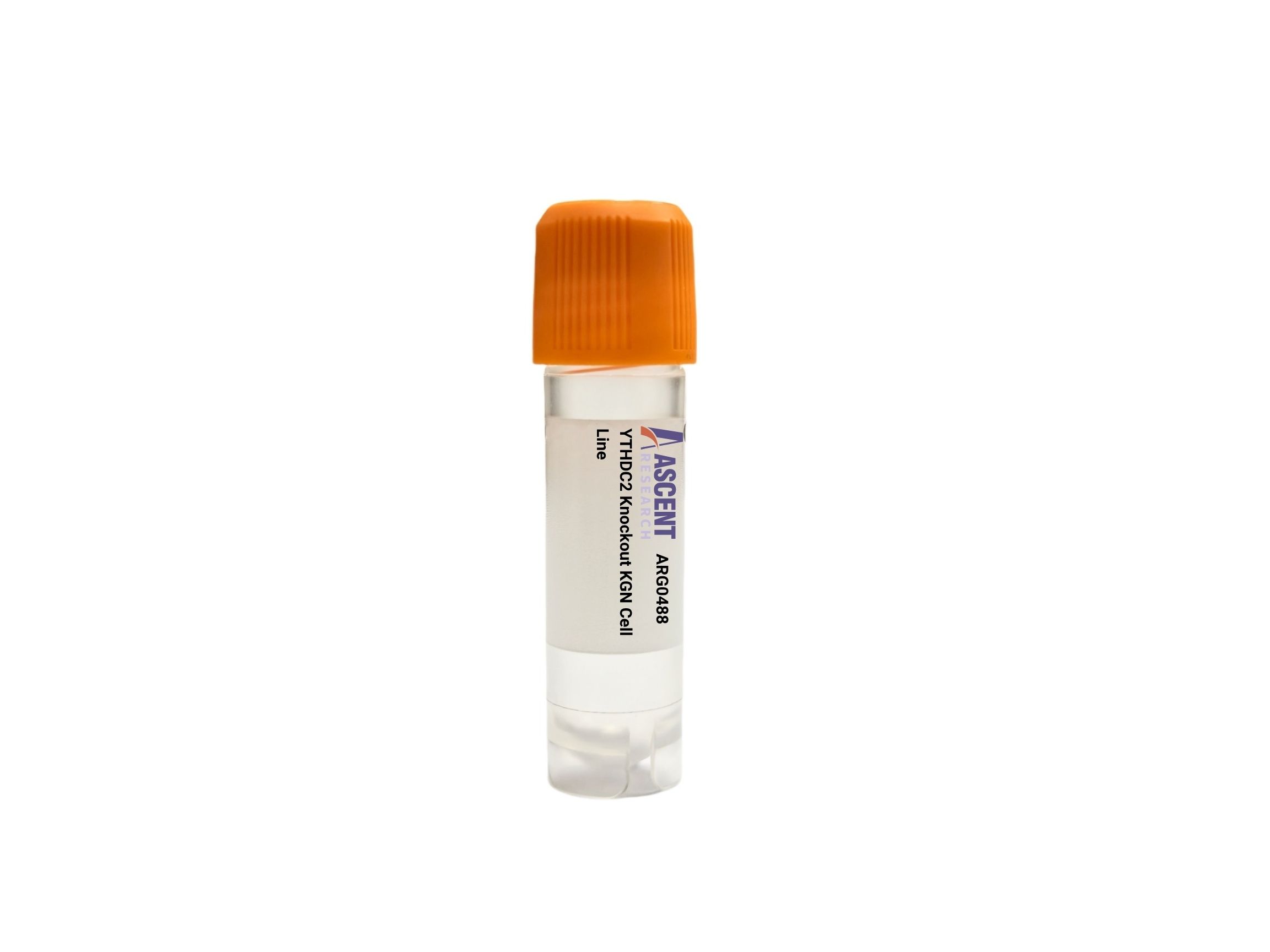
The YTHDC2 Knockout KGN Cell Line is a CRISPR/Cas9-edited knockout cell line on the human ovarian granulosa cell tumor background KGN. This model disrupts the YTHDC2 gene, eliminating the m6A reader and RNA helicase that regulates mRNA stability and translation. By abolishing YTHDC2 interactions with factors such as XRN1 and the METTL3/METTL14 complex, it enables investigation of m6A-dependent post?transcriptional control in a steroidogenic and tumorigenic context. Researchers can employ this knockout to study m6A modification dynamics in granulosa cell function, RNA metabolism in ovarian tumors, and for drug screening targeting m6A pathways. The line is suitable for transcriptomic, epitranscriptomic, and phenotypic assays including RNA-seq, m6A-seq, and steroid hormone profiling.
 NOTCH1 Knockout K562 Polyclonal Cells
Cat. No. ARG19353
ACOT2 Knockout A2780 Polyclonal Cells
Cat. No. ARG28577
NEXN Knockout HEK293T Polyclonal Cells
Cat. No. ARG3782
CMC2 Knockout AGS Polyclonal Cells
Cat. No. ARG3002
FASTKD2 Knockout Raji Polyclonal Cells
Cat. No. ARG1650
NOTCH1 Knockout K562 Polyclonal Cells
Cat. No. ARG19353
ACOT2 Knockout A2780 Polyclonal Cells
Cat. No. ARG28577
NEXN Knockout HEK293T Polyclonal Cells
Cat. No. ARG3782
CMC2 Knockout AGS Polyclonal Cells
Cat. No. ARG3002
FASTKD2 Knockout Raji Polyclonal Cells
Cat. No. ARG1650
 Pig Type II Alveolar Epithelial Cell Medium
Cat. No. ARM0913
Pig Type II Alveolar Epithelial Cell Medium
Cat. No. ARM0913
The YTHDC2 Knockout KGN Cell Line is a CRISPR/Cas9-edited knockout cell line derived from the human granulosa cell tumor cell line KGN. This model features a targeted disruption of the YTHDC2 gene, eliminating YTHDC2 protein expression and its subsequent molecular functions. As a loss-of-function cellular tool, it provides a robust platform for investigating YTHDC2-mediated regulation of m6A-modified transcripts and associated RNA metabolic processes without relying on transient suppression methods.
The parental KGN cell line was established from a patient with an ovarian granulosa cell tumor and retains key characteristics of granulosa cells, including the capacity for steroidogenesis and expression of the follicle-stimulating hormone receptor (FSHR). These properties make KGN a widely used model for ovarian follicle biology, steroidogenic pathways, and granulosa cell tumor research. The knockout derivative thus allows precise dissection of gene function in a disease-relevant background.
YTHDC2 encodes an RNA helicase that functions as a reader of N6-methyladenosine (m6A) modifications on mRNA. It interacts with components of the RNA degradation machinery such as XRN1 and the RNA exosome, as well as the ribosome, to modulate mRNA stability and translation. YTHDC2 is known to associate with m6A-modified transcripts, including those encoding cell cycle regulators and steroidogenic enzymes. The m6A methylation pathway involves writers (METTL3/METTL14), erasers (FTO, ALKBH5), and additional readers (YTHDF1/2), placing YTHDC2 at a critical intersection of epitranscriptomic control and post-transcriptional gene regulation.
In the KGN background, disruption of YTHDC2 eliminates its ability to regulate m6A-modified mRNAs, leading to aberrant expression of genes governing proliferation, apoptosis, and steroidogenesis. This perturbation may impact granulosa cell function and tumorigenic potential. Consequently, the YTHDC2 Knockout KGN Cell Line represents a valuable model for elucidating the role of m6A dynamics in ovarian granulosa cell tumor biology and for probing the molecular mechanisms by which YTHDC2 influences cell fate decisions in this steroidogenic cell type.
This knockout cell line is suitable for a diverse array of functional studies, including transcriptome-wide analysis via RNA-seq, m6A epitranscriptomic profiling by m6A-seq, and phenotypic assays such as cell viability, apoptosis, cell cycle analysis, and steroid hormone quantification. It supports drug screening for RNA methylation modulators and the functional genomics of YTHDC2 in meiotic gene expression regulation. For further technical details and ordering information, please contact Ascent Research.