Genome-edited Cells
Uterus (cervix)
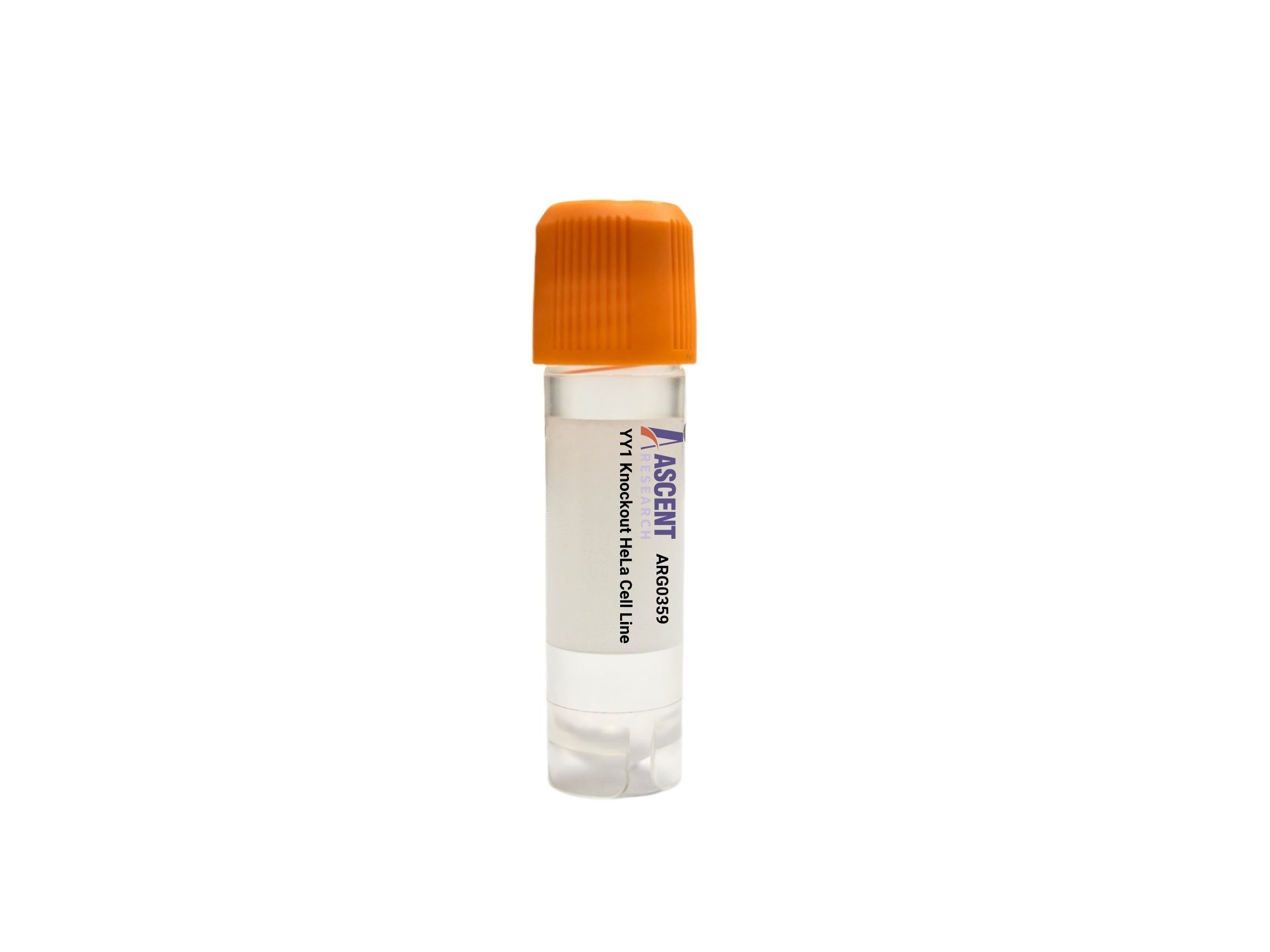
The YY1 Knockout HeLa Cell Line is a CRISPR/Cas9-edited human cervical adenocarcinoma cell model with targeted disruption of the YY1 gene. YY1 is a zinc-finger transcription factor that regulates apoptosis, proliferation, and DNA damage responses by interacting with co-factors such as p300 and HDACs and controlling downstream targets like p53 and c-Myc. This knockout line enables dissection of YY1-dependent transcriptional networks in an HPV18-positive context. It is suitable for investigating transcriptional regulation, epigenetic mechanisms, cell cycle control, and drug response in cervical cancer research. Applications include ChIP, RNA-seq, apoptosis assays, and migration studies.
 CHPF Knockout A2780 Polyclonal Cells
Cat. No. ARG19042
MCOLN1 Knockout NCI-H1703 Polyclonal Cells
Cat. No. ARG12624
HSP90B1 Knockout HEK293 Polyclonal Cells
Cat. No. ARG23243
ABHD6 Knockout HEK293T Polyclonal Cells
Cat. No. ARG25563
ANKRD16 Knockout HEK293T Polyclonal Cells
Cat. No. ARG25684
MAN2B2 Knockout 786-O Polyclonal Cells
Cat. No. ARG5746
CHPF Knockout A2780 Polyclonal Cells
Cat. No. ARG19042
MCOLN1 Knockout NCI-H1703 Polyclonal Cells
Cat. No. ARG12624
HSP90B1 Knockout HEK293 Polyclonal Cells
Cat. No. ARG23243
ABHD6 Knockout HEK293T Polyclonal Cells
Cat. No. ARG25563
ANKRD16 Knockout HEK293T Polyclonal Cells
Cat. No. ARG25684
MAN2B2 Knockout 786-O Polyclonal Cells
Cat. No. ARG5746
The YY1 Knockout HeLa Cell Line is a CRISPR/Cas9-edited knockout cell line originating from the HeLa host line, designed to disrupt the YY1 gene via CRISPR/Cas9-mediated targeting. This stable loss-of-function model enables investigation of YY1, a multifunctional zinc-finger transcription factor, in a cervical adenocarcinoma-derived epithelial background. Supplied as a live cell culture, this product is suitable for mechanistic studies in cancer biology, transcriptional regulation, and signal transduction.
The HeLa cell line, derived from a cervical adenocarcinoma, exhibits epithelial morphology and carries integrated human papillomavirus 18 (HPV18) sequences. This classic model is widely used for studying oncogene function, viral-host interactions, and cell cycle control. The HPV18-positive context provides a relevant tumorigenic environment for examining YY1 disruption in pathways often dysregulated in cervical cancer, including p53 and Rb inactivation by viral oncoproteins.
YY1 is a GLI-Kr??ppel zinc-finger transcription factor that activates or represses genes by recruiting co-activators like p300 or co-repressors including HDAC1/2 and EZH2. It is regulated upstream by NF-??B, p53, Sp1, c-Myc, E2F1, TGF-??, and TNF-??, and it controls downstream targets such as c-Myc, p53, BCL2, BAX, VEGFA, PTGS2, and CDKN1A. YY1 integrates signaling from Wnt/??-catenin, TGF-??, p53, and Notch pathways, influencing chromatin remodeling, histone modification, and cell cycle progression. Mechanistically, YY1 scaffolds transcription factors and epigenetic modifiers at promoters to regulate proliferation, apoptosis, and DNA damage responses.
In HeLa cells, YY1 supports the malignant phenotype by promoting proliferation and inhibiting apoptosis through transcriptional regulation of BCL2 family members and modulation of p53 activity. Knockout of YY1 disrupts these networks, altering expression of cell cycle regulators like CDKN1A and apoptosis effectors like BAX. This model is particularly valuable for dissecting YY1 function in HPV18-positive cells, where viral oncoproteins compromise p53 and Rb. It can reveal collaborative effects on transcription and chemosensitivity, aiding targeted therapy development for cervical cancer.
This cell line enables transcriptional regulation studies, epigenetic analysis, and drug response profiling. Researchers can use ChIP-qPCR/ChIP-seq to examine YY1-dependent chromatin modifications, RNA-seq for global expression changes, and Western blotting/RT-qPCR for targeted validation. Flow cytometry?Cbased apoptosis and proliferation assays, along with migration/invasion and reporter gene assays, provide functional readouts. Co-immunoprecipitation helps assess protein interactions. For additional information or to place an order, contact Ascent Research.