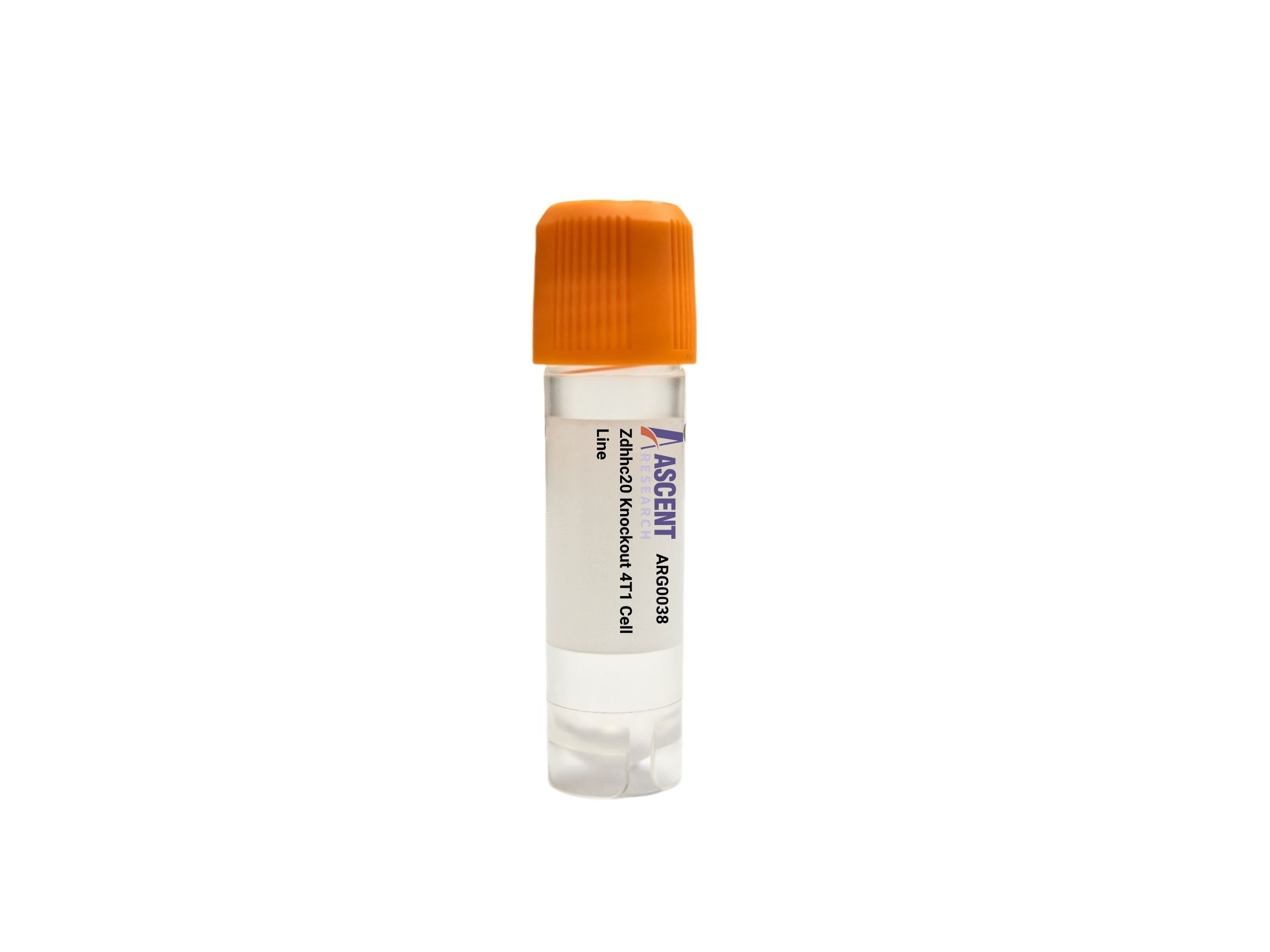
Genome-edited Cells
Breast (mammary gland)
Zdhhc20 Knockout 4T1 is a CRISPR/Cas9-edited mouse mammary carcinoma cell line with disruption of the Zdhhc20 palmitoyl acyltransferase gene in the metastatic 4T1 triple-negative breast cancer background. ZDHHC20 mediates S-palmitoylation of membrane proteins including EGFR, thereby regulating receptor stability, trafficking, and downstream PI3K-AKT and MAPK-ERK signaling. This model supports studies of palmitoylation biology, EGFR pathway regulation, tumor cell proliferation, migration, invasion, and drug response using assays such as CRISPR genotyping, western blotting, palmitoylation assays, flow cytometry, phospho-signaling analysis, and functional phenotyping.
 C8orf82 Knockout HGC-27 Polyclonal Cells
Cat. No. ARG29791
EPS8L2 Knockout NCI-H1975 Polyclonal Cells
Cat. No. ARG16472
MAP7D1 Knockout SK-HEP-1 Polyclonal Cells
Cat. No. ARG15904
MC5R Knockout T47D Polyclonal Cells
Cat. No. ARG11960
EGF Knockout HAP1 Polyclonal Cells
Cat. No. ARG40716
C8orf82 Knockout HGC-27 Polyclonal Cells
Cat. No. ARG29791
EPS8L2 Knockout NCI-H1975 Polyclonal Cells
Cat. No. ARG16472
MAP7D1 Knockout SK-HEP-1 Polyclonal Cells
Cat. No. ARG15904
MC5R Knockout T47D Polyclonal Cells
Cat. No. ARG11960
EGF Knockout HAP1 Polyclonal Cells
Cat. No. ARG40716
 Mouse Thoracic Aortic Smooth Muscle Cell Medium
Cat. No. ARM0454
Mouse Thoracic Aortic Smooth Muscle Cell Medium
Cat. No. ARM0454
The Zdhhc20 Knockout 4T1 Cell Line is an engineered mouse mammary carcinoma model in which the Zdhhc20 gene has been disrupted using CRISPR/Cas9 genome editing, resulting in loss of functional gene expression. This stable in vitro knockout system is established in 4T1 cells, a widely used tumor epithelial background for mechanistic studies of aggressive breast cancer. The model is designed for investigators examining how loss of a DHHC-domain palmitoyl acyltransferase alters membrane protein regulation, receptor signaling, and malignant cell behavior in a breast cancer-relevant context.
4T1 is a murine triple-negative mammary carcinoma cell line derived from a BALB/c mouse mammary tumor and is extensively used as a syngeneic model of metastatic breast cancer. Because 4T1 cells display aggressive growth, invasion, and metastatic potential, they are commonly used to study tumor progression, epithelial tumor cell plasticity, and tumor-immune interactions. The host background is therefore particularly useful for analyzing signaling pathways that regulate proliferation, motility, receptor trafficking, and communication with the tumor microenvironment in a biologically relevant mammary carcinoma setting.
ZDHHC20 functions as a palmitoyl-CoA-dependent S-palmitoyltransferase within the protein S-palmitoylation cycle, catalyzing reversible lipid modification of selected membrane-associated proteins. A key mechanistic context for this enzyme is regulation of EGFR palmitoylation, membrane localization, stability, and signaling competence. ZDHHC20 acts upstream of canonical receptor tyrosine kinase signaling modules involving EGFR, GRB2, SOS1, RAS, RAF, MEK1/2, and ERK1/2, and also influences PI3K-AKT pathway output. Its activity is regulated by growth factor stimulation, EGFR pathway activity, membrane trafficking state, and broader transcriptional programs linked to lipid metabolism and stress responses. ZDHHC20 function is further shaped by interactions with other DHHC palmitoyltransferases, membrane trafficking machinery, and the depalmitoylating enzymes APT1 and APT2, which together control dynamic palmitoylation turnover.
In the 4T1 background, loss of Zdhhc20 provides a focused system for examining how disrupted palmitoylation affects receptor stability, cell-surface EGFR, downstream phospho-AKT and phospho-ERK signaling, and phenotypes associated with tumor progression such as proliferation, migration, and invasion. This context is relevant to breast cancer, metastatic disease, and EGFR-driven oncogenic programs, where membrane partitioning and receptor trafficking can strongly influence signaling amplitude and treatment response.
This knockout cell line is well suited for integrated molecular and phenotypic workflows. Gene disruption can be confirmed by CRISPR genotyping, RT-qPCR, and western blotting. Effects on protein palmitoylation may be assessed using acyl-biotin exchange, acyl-resin-assisted capture, or click-chemistry palmitate labeling. Researchers can evaluate EGFR localization and abundance by immunofluorescence, co-immunoprecipitation, and flow cytometry for surface EGFR, and quantify pathway activity by phospho-EGFR, phospho-AKT, and phospho-ERK analyses. Functional consequences can be investigated using proliferation, colony formation, apoptosis, migration, and invasion assays, while transcriptomic and pharmacologic responses can be profiled by RNA-seq and drug sensitivity testing. Researchers may contact Ascent Research for additional technical information, product details, or related gene-edited cell models.