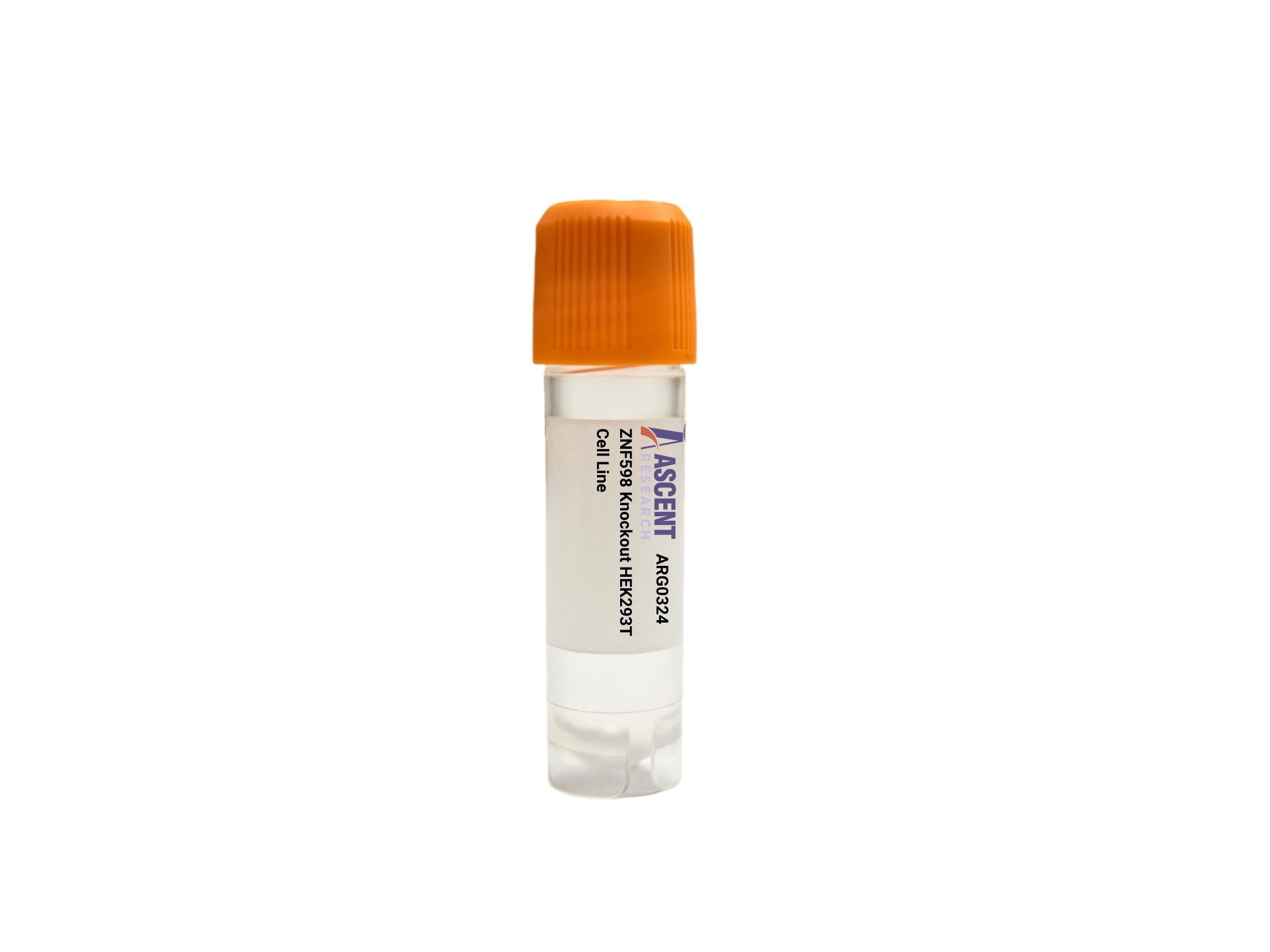
Genome-edited Cells
Kidney
The ZNF598 Knockout HEK293T Cell Line is a CRISPR/Cas9-edited knockout cell line derived from human embryonic kidney HEK293T cells, engineered to disrupt expression of the E3 ubiquitin ligase ZNF598. This factor recognizes stalled and collided ribosomes, ubiquitinating 40S proteins such as RPS10 to trigger ribosome-associated quality control (RQC). The knockout model enables dissection of ribosome collision sensing, translational surveillance, and the ubiquitin-proteasome system, with downstream effects mediated by factors like TCF25 and NEMF. Applications include studies of neurodegenerative proteinopathies, translation regulation, and viral replication impact.
 NCKIPSD Knockout A2780 Polyclonal Cells
Cat. No. ARG18234
PBRM1 Knockout HEK293 Polyclonal Cells
Cat. No. ARG12678
HR Knockout HAP1 Polyclonal Cells
Cat. No. ARG22614
ABCC4 Knockout HAP1 Polyclonal Cells
Cat. No. ARG27173
C20orf27 Knockout NCI-H1299 Polyclonal Cells
Cat. No. ARG41346
MAN2A2 Knockout Hela Polyclonal Cells
Cat. No. ARG7603
NCKIPSD Knockout A2780 Polyclonal Cells
Cat. No. ARG18234
PBRM1 Knockout HEK293 Polyclonal Cells
Cat. No. ARG12678
HR Knockout HAP1 Polyclonal Cells
Cat. No. ARG22614
ABCC4 Knockout HAP1 Polyclonal Cells
Cat. No. ARG27173
C20orf27 Knockout NCI-H1299 Polyclonal Cells
Cat. No. ARG41346
MAN2A2 Knockout Hela Polyclonal Cells
Cat. No. ARG7603
The ZNF598 Knockout HEK293T Cell Line is a CRISPR/Cas9-edited knockout cell line designed to disrupt the expression of ZNF598, a critical E3 ubiquitin ligase involved in ribosome-associated quality control. This model provides a stable loss-of-function system for investigating molecular events triggered by ribosome stalling and collision. By ablating ZNF598 function, researchers can dissect the early steps of the ribosome collision response and the downstream pathways that manage defective translational complexes, without altering other components of the ubiquitin-proteasome system. The cell line is derived from HEK293T cells and offers a genetically defined background for mechanistic studies.
HEK293T cells are a human embryonic kidney epithelial cell line immortalized by adenovirus 5 DNA and expressing the SV40 large T antigen. This host line is widely employed for heterologous protein expression, lentivirus production, and biochemical studies due to its high transfection efficiency and robust protein synthesis machinery. The kidney epithelial origin provides a relevant context for studying fundamental cell biology, while the SV40 large T antigen facilitates transient and stable genetic manipulation. The combination of these features makes HEK293T an ideal platform for generating knockout models that require consistent growth characteristics and experimental reproducibility.
ZNF598 functions as an E3 ubiquitin ligase that specifically recognizes stalled and collided ribosomes during translation. Upon sensing ribosome collision, ZNF598 is recruited to the 40S ribosomal subunit and mediates ubiquitination of ribosomal proteins such as RPS10 and RPS20. This modification is critical for the assembly of the ribosome quality control (RQC) complex, which includes TCF25 and NEMF. The pathway involves upstream regulators EDF1 and GCN1, and downstream effectors LTN1 (Listerin) and the proteasome, linking translational fidelity to the degradation of aberrant nascent polypeptides and ribosomal subunit recycling.
In the HEK293T background, loss of ZNF598 disrupts the initiation of RQC and allows accumulation of stalled ribosome complexes, making this cell line a powerful tool for studying the consequences of impaired ribosome quality control. The high endogenous translation rate of HEK293T cells exacerbates the demand for efficient ribosome surveillance, amplifying the phenotypic effects of ZNF598 deficiency. This model enables the investigation of how defects in ribosome collision sensing influence cellular homeostasis, stress responses, and the ubiquitin-proteasome system, providing insights into diseases linked to translational dysregulation such as neurological disorders and ribosome-related developmental syndromes.
Researchers can apply this knockout cell line in varied experimental approaches including western blotting for RPS10 ubiquitination, polysome profiling, dual-luciferase readthrough reporter assays, co-immunoprecipitation of RQC components, immunofluorescence for stress granules, puromycin incorporation assays, and ribosome profiling. Such studies contribute to investigating neurodegenerative proteinopathies and viral replication control. For further details, please contact Ascent Research.