Genome-edited Cells
Esophagus
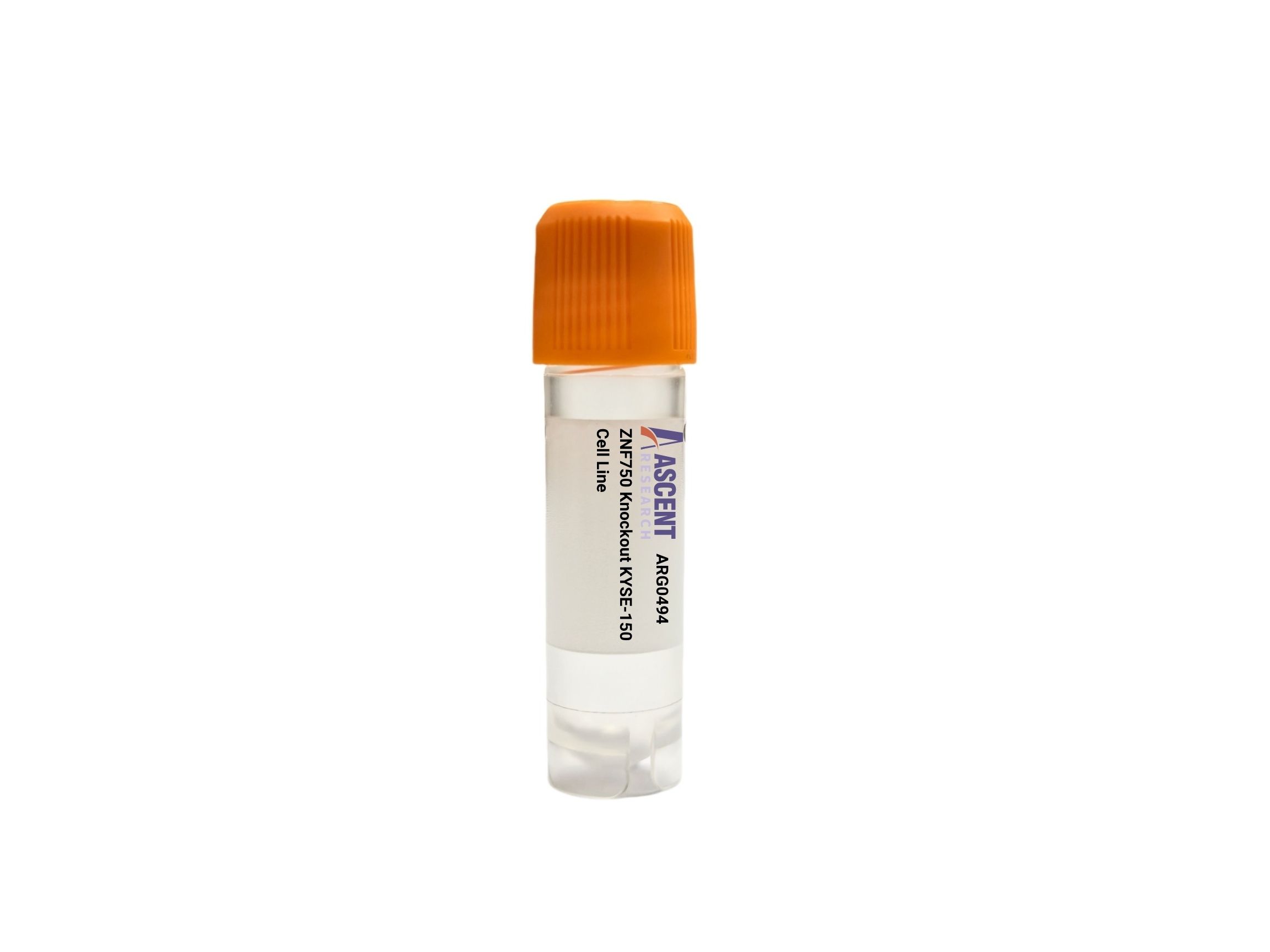
The ZNF750 Knockout KYSE-150 Cell Line is a CRISPR/Cas9-edited knockout cell line targeting ZNF750, a transcription factor and tumor suppressor that drives terminal epidermal differentiation downstream of TP63. ZNF750 activates cornified envelope genes (IVL, LOR, FLG) and the lipid barrier gene ABCA12, cooperating with KLF4 and CEBPA. This model utilizes the poorly differentiated KYSE-150 ESCC line to enable functional studies of ZNF750 in squamous cell carcinogenesis. Applications include expression profiling, ChIP, and phenotypic assays for migration, invasion, and drug sensitivity. Contact Ascent Research for more information.
 ATP6V1G3 Knockout HAP1 Polyclonal Cells
Cat. No. ARG21997
MME Knockout SK-HEP-1 Polyclonal Cells
Cat. No. ARG15177
CGGBP1 Knockout NCI-H1299 Polyclonal Cells
Cat. No. ARG17737
MAPK4 Knockout SKOV3 Polyclonal Cells
Cat. No. ARG12368
MPZL3 Knockout Hela Polyclonal Cells
Cat. No. ARG8150
DUSP23 Knockout A2780 Polyclonal Cells
Cat. No. ARG40054
ATP6V1G3 Knockout HAP1 Polyclonal Cells
Cat. No. ARG21997
MME Knockout SK-HEP-1 Polyclonal Cells
Cat. No. ARG15177
CGGBP1 Knockout NCI-H1299 Polyclonal Cells
Cat. No. ARG17737
MAPK4 Knockout SKOV3 Polyclonal Cells
Cat. No. ARG12368
MPZL3 Knockout Hela Polyclonal Cells
Cat. No. ARG8150
DUSP23 Knockout A2780 Polyclonal Cells
Cat. No. ARG40054
The ZNF750 Knockout KYSE-150 Cell Line is a CRISPR/Cas9-edited knockout cell line that provides a stable loss-of-function model for investigating the transcriptional tumor suppressor ZNF750 in esophageal squamous cell carcinoma (ESCC). Generated by CRISPR/Cas9-mediated gene disruption of ZNF750 in the KYSE-150 parental line, this homogeneous knockout cell line enables reproducible functional studies and is suitable for a wide range of molecular and cellular assays.
KYSE-150 is a poorly differentiated human esophageal squamous cell carcinoma line originally derived from a 49-year-old male patient. These cells retain hallmark features of malignant esophageal squamous epithelial cells, including loss of terminal differentiation and aggressive growth properties, making them a physiologically relevant model for studying factors that regulate ESCC pathogenesis and differentiation.
ZNF750 functions as a master transcription factor downstream of TP63 and NOTCH signaling, driving terminal epidermal differentiation. It directly activates genes encoding structural components of the cornified envelope, such as involucrin (IVL), loricrin (LOR), and filaggrin (FLG), as well as the lipid transporter ABCA12, which is critical for barrier formation. ZNF750 cooperates with KLF4 and CEBPA and interacts with the co-repressor RCOR1. Disruption of this network by ZNF750 knockout impairs barrier integrity and promotes squamous carcinogenesis.
This knockout model is particularly valuable for dissecting the TP63?CZNF750?CKLF4 regulatory axis in ESCC. By comparing knockout and parental cells, researchers can assess ZNF750-dependent changes in gene expression, cell cycle progression, migration, and invasion. The model also allows investigation of how ZNF750 loss alters responses to upstream regulators such as NOTCH1 and AP-1, and how it influences the expression of late differentiation markers and sensitivity to chemotherapeutic agents.
Standard applications include Western blotting and RT?qPCR for ZNF750 and its targets (IVL, LOR, FLG), RNA?seq for transcriptome profiling, ChIP?qPCR for mapping ZNF750 occupancy at genomic targets, immunofluorescence for cornified envelope proteins, and functional assays such as cell migration, invasion, and drug sensitivity testing by MTT and colony formation. This knockout cell line serves as an essential tool for advancing ESCC research and screening for differentiation?inducing therapeutics. For additional details or ordering, please contact Ascent Research.