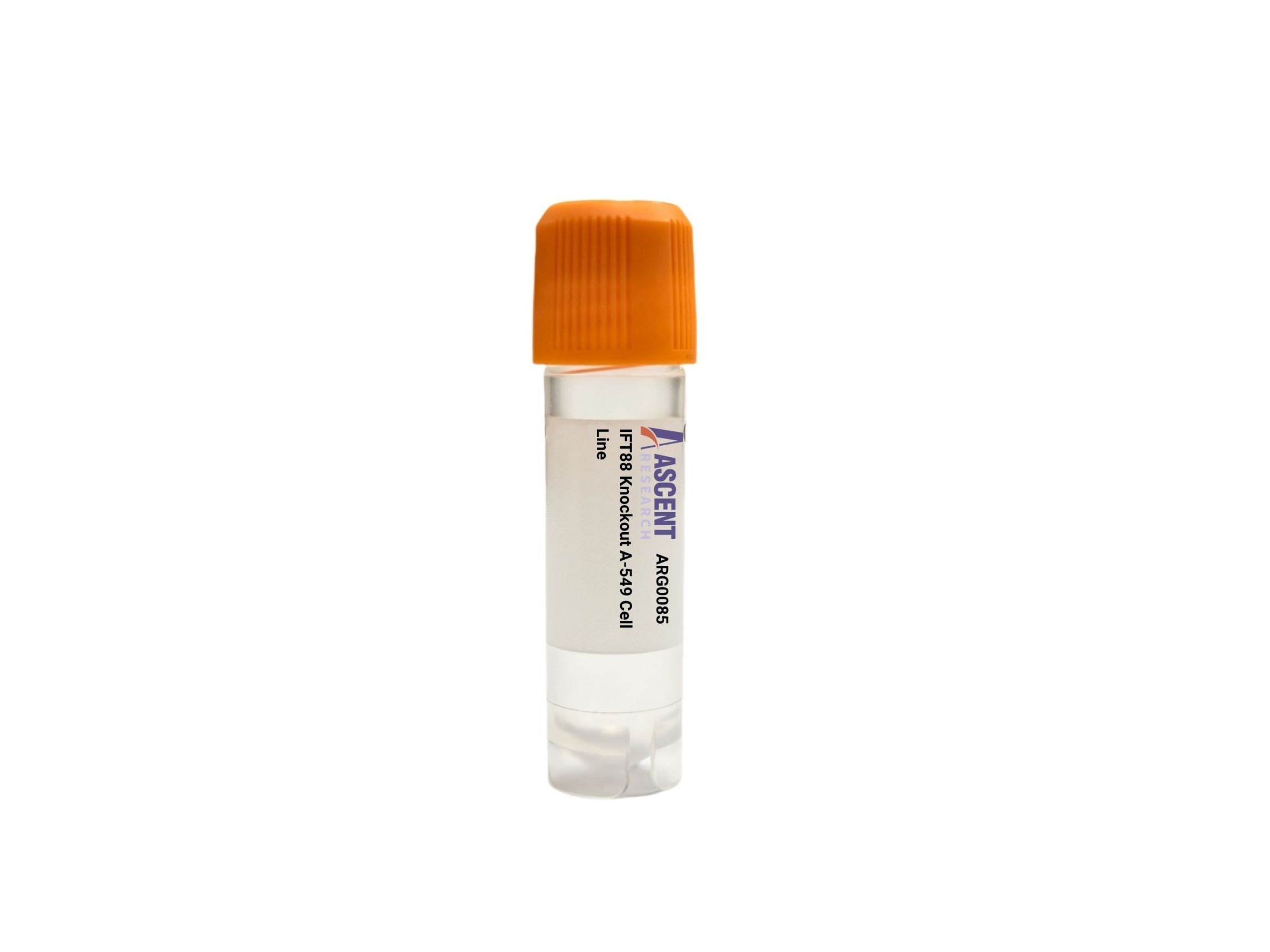
Genome-edited Cells
Lung
IFT88 Knockout A-549 is a human CRISPR/Cas9-edited lung adenocarcinoma epithelial cell line with disruption of the core IFT-B component IFT88. In the A-549 non-small cell lung cancer background, this model supports analysis of primary cilium loss, altered intraflagellar transport, and attenuation of cilium-dependent signaling involving PTCH1, SMO, GLI2/3, and PDGFRalpha. It is well suited for studies of Hedgehog pathway output, ciliogenesis, epithelial tumor signaling, migration, proliferation, and drug response using assays such as immunofluorescence for acetylated alpha-tubulin or ARL13B, RT-qPCR, western blotting, and reporter-based pathway analysis.
 ARL6IP1 Knockout A2780 Polyclonal Cells
Cat. No. ARG28778
DVL2 Knockout huh-7 Polyclonal Cells
Cat. No. ARG40110
PDK1 Knockout MES-OV Polyclonal Cells
Cat. No. ARG6189
GLT8D1 Knockout 786-O Polyclonal Cells
Cat. No. ARG5740
ARL6IP1 Knockout A2780 Polyclonal Cells
Cat. No. ARG28778
DVL2 Knockout huh-7 Polyclonal Cells
Cat. No. ARG40110
PDK1 Knockout MES-OV Polyclonal Cells
Cat. No. ARG6189
GLT8D1 Knockout 786-O Polyclonal Cells
Cat. No. ARG5740
 Rat Astrocytes Medium
Cat. No. ARM0369
Rat Astrocytes Medium
Cat. No. ARM0369
 Human Calvarial Osteoblast Medium
Cat. No. ARM0154
Human Calvarial Osteoblast Medium
Cat. No. ARM0154
The IFT88 Knockout A-549 Cell Line is a human CRISPR/Cas9-engineered cell model in which the IFT88 gene has been disrupted in the A-549 background, resulting in loss of functional IFT88 expression. This stable in vitro knockout line is generated in a human lung adenocarcinoma epithelial cell context and is intended for investigation of primary cilium biology, cilium-dependent signal transduction, and tumor-associated epithelial signaling networks. As an isogenic perturbation model, it enables controlled analysis of IFT88-dependent phenotypes in a widely used non-small cell lung cancer cell system.
A-549 is a human alveolar epithelial adenocarcinoma cell line extensively used to study lung cancer biology, epithelial signaling, and therapeutic response mechanisms. The line provides a relevant model for examining tumor cell proliferation, polarity, migration, and signal integration in an epithelial setting. Because A-549 cells are broadly used for pathway interrogation and drug testing, editing this background offers a practical system for evaluating how specific gene loss alters signaling architecture, transcriptional outputs, and phenotype in lung cancer-relevant experimental workflows.
IFT88 encodes a core component of the intraflagellar transport B complex that is required for anterograde transport within the primary cilium and for cilium assembly and maintenance. IFT88 functions together with IFT52, IFT57, IFT74, IFT81, and IFT172, and operates in the context of the KIF3A-KIF3B motor and ciliary structural organizers including CEP290, PCM1, and BBS4. Its activity is regulated by ciliogenesis-associated programs linked to cell cycle status, serum starvation, centriole maturation, CP110 removal, and cilium disassembly factors such as PLK1, AURKA, and HDAC6. Loss of IFT88 disrupts primary cilium formation and thereby attenuates signaling organized at the ciliary compartment, including Hedgehog and PDGFRalpha-associated signaling. In this setting, signaling through PTCH1, SMO, SUFU, GLI2, and GLI3 is altered, with downstream consequences for GLI1, PTCH1, and HHIP expression as well as cell proliferation, cell cycle progression, directional migration, and mechanosensory signaling. These functions connect IFT88 to ciliopathies, developmental disorders, and cancer biology.
In the A-549 host background, IFT88 loss provides a useful model for defining how cilium ablation reshapes epithelial tumor cell behavior. This is particularly relevant for studies of cilia-dependent oncogenic signaling, pathway dependency in lung cancer cells, and changes in migration or polarity associated with altered cilium assembly status. The model also supports investigation of how epithelial cancer cells integrate growth-regulatory cues when the ciliary signaling platform is impaired.
This knockout cell line is suitable for mechanistic studies using immunofluorescence detection of acetylated alpha-tubulin and ARL13B to quantify cilium frequency and length, western blotting or RT-qPCR to assess IFT88-related pathway outputs, and RNA-seq to profile cilium-dependent transcriptional changes. Researchers can apply Hedgehog reporter assays and expression analysis of GLI1, PTCH1, and HHIP to define cilium-dependent signal transmission, while phospho-signaling assays can be used to examine PDGFRalpha-linked responses. Additional applications include co-immunoprecipitation for IFT-B network studies, cell proliferation assays to measure growth effects, migration assays to evaluate directional movement, and drug sensitivity studies designed to test agents whose activity may depend on intact ciliary signaling architecture. Researchers may contact Ascent Research for additional technical information, product details, or related gene-edited cell models.