Genome-edited Cells
Lung
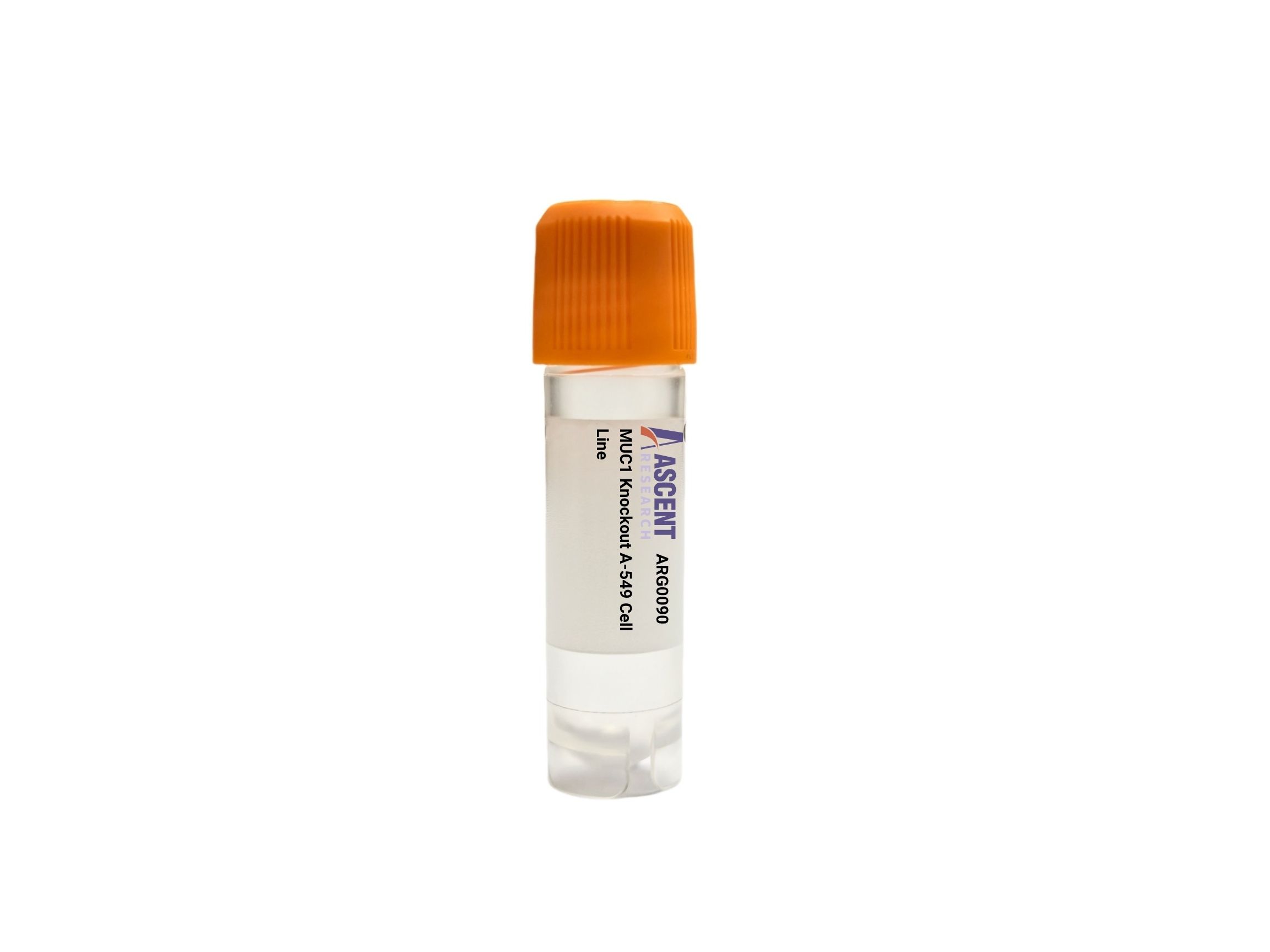
The MUC1 Knockout A-549 Cell Line is a human CRISPR/Cas9-edited lung adenocarcinoma-derived alveolar epithelial carcinoma model with disruption of the MUC1 transmembrane mucin gene. In A-549 cells, MUC1 is relevant to epithelial barrier biology and tumor-associated signaling downstream of EGFR, ERBB2, PI3K-AKT, MAPK-ERK, JAK-STAT, NF-kB, and CTNNB1-linked pathways. This knockout model supports mechanistic studies of mucin function, lung cancer signaling, inflammation-cancer crosstalk, migration and invasion, and drug response using assays such as western blotting, phospho-signaling analysis, RT-qPCR, RNA-seq, immunofluorescence, co-immunoprecipitation, and proliferation or apoptosis testing.
 IPO5 Knockout NCI-H1299 Polyclonal Cells
Cat. No. ARG30837
HAVCR1 Knockout Lovo Polyclonal Cells
Cat. No. ARG36369
DNAJA2 Knockout NCI-H1299 Polyclonal Cells
Cat. No. ARG39073
CDK6 Knockout CaSki Polyclonal Cells
Cat. No. ARG9885
FAM118B Knockout AGS Polyclonal Cells
Cat. No. ARG2135
IPO5 Knockout NCI-H1299 Polyclonal Cells
Cat. No. ARG30837
HAVCR1 Knockout Lovo Polyclonal Cells
Cat. No. ARG36369
DNAJA2 Knockout NCI-H1299 Polyclonal Cells
Cat. No. ARG39073
CDK6 Knockout CaSki Polyclonal Cells
Cat. No. ARG9885
FAM118B Knockout AGS Polyclonal Cells
Cat. No. ARG2135
 NCTC clone 929
Cat. No. ARI0090
NCTC clone 929
Cat. No. ARI0090
The MUC1 Knockout A-549 Cell Line is a human CRISPR/Cas9-engineered alveolar epithelial carcinoma model in which the MUC1 gene has been disrupted to eliminate functional gene expression. This stable in vitro system enables direct investigation of MUC1-dependent biology in a lung adenocarcinoma-derived epithelial background. Because MUC1 encodes a transmembrane mucin with both extracellular barrier functions and intracellular signaling activity, its loss in A-549 cells provides a defined platform for mechanistic studies of epithelial mucin biology, tumor-associated signaling, and pathway-dependent phenotypes relevant to pulmonary cancer research.
A-549 is a widely used human non-small cell lung cancer model derived from lung adenocarcinoma and is extensively applied in studies of epithelial differentiation, host response signaling, pulmonary toxicology, and drug response. As an alveolar epithelial carcinoma cell line, A-549 recapitulates important features of lung epithelial tumor biology, including mucin-associated epithelial surface regulation, receptor-mediated signaling, and responses linked to tumor progression. This background makes it particularly useful for analyzing how disruption of epithelial regulatory genes influences growth control, survival pathways, adhesion, migration, and inflammatory signaling in a clinically relevant lung cancer context.
MUC1 is synthesized as a heterodimeric transmembrane mucin comprising the extracellular MUC1-N subunit and the membrane-associated MUC1-C subunit. In epithelial cells, MUC1 contributes to apical surface protection while the MUC1 cytoplasmic tail acts as a signaling scaffold that mediates signaling downstream of receptor tyrosine kinases and inflammatory inputs. MUC1 is regulated by EGFR, ERBB2/HER2, IL6, TNF, IFNG, STAT3, NF-kB, hypoxia/HIF1A, and estrogen receptor signaling. It interacts with EGFR, ERBB2, CTNNB1, SRC, GRB2, LGALS3, ICAM1, p53, and ESR1, and functions within PI3K-AKT, MAPK-ERK, JAK-STAT, NF-kB, and Wnt-beta-catenin networks. Through these interactions, MUC1 can promote AKT and ERK1/2 phosphorylation, STAT3 activation, NF-kB-dependent transcription, cyclin D1 and MYC expression, BCL2 family survival signaling, and transcriptional programs associated with epithelial-mesenchymal transition, proliferation, migration, and invasion.
In the A-549 background, MUC1 knockout is relevant for defining how mucin-associated signaling contributes to lung epithelial tumor phenotypes and inflammation-associated cancer mechanisms. Loss of MUC1 may help separate receptor tyrosine kinase signaling events from mucin-dependent scaffolding functions, allowing assessment of pathway dependency downstream of EGFR, ERBB2, JAK2-STAT3, SRC, and CTNNB1 in a host cell line broadly used to model lung adenocarcinoma biology.
This cell line is suitable for western blotting and phospho-signaling analysis of AKT1, MAPK1/3, STAT3, NFKB1, and RELA pathway outputs; RT-qPCR or RNA-seq studies of CCND1, MYC, inflammatory genes, and EMT-associated transcriptional changes; and immunofluorescence or flow cytometry assays examining epithelial surface markers and mucin-related phenotypes. Co-immunoprecipitation can be used to study disruption of MUC1-associated complexes with EGFR, ERBB2, SRC, or beta-catenin, while reporter assays support evaluation of NF-kB, STAT3, or Wnt-beta-catenin transcriptional activity. The model is also applicable to proliferation, apoptosis, migration, invasion, and drug sensitivity studies designed to test how MUC1 loss alters oncogenic signaling crosstalk, inflammatory pathway responses, and therapeutic susceptibility in non-small cell lung cancer cells. Researchers may contact Ascent Research for additional technical information, product details, or related gene-edited cell models.